
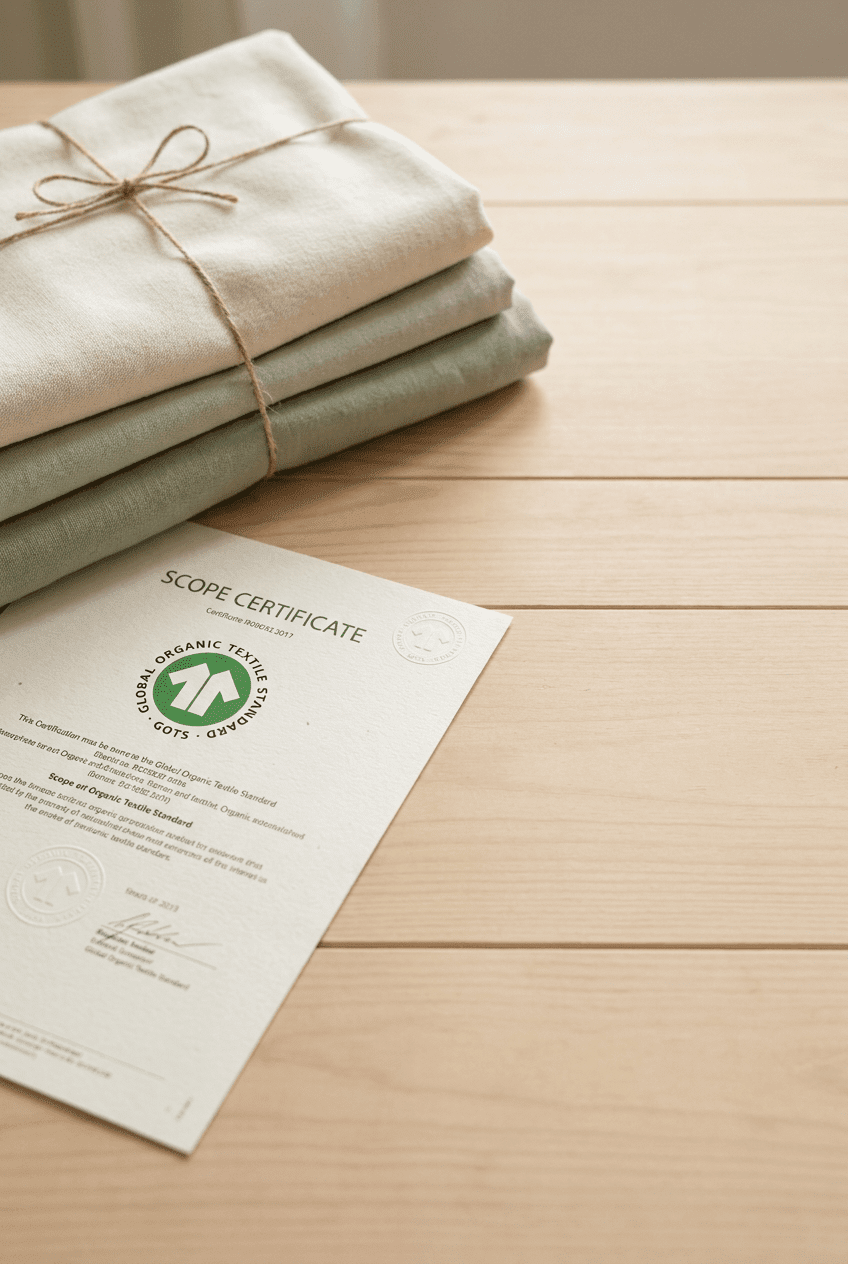
Choosing a GOTS certified clothing manufacturer is no longer optional for fashion brands serious about sustainability. As of 2026, over 14,000 facilities across 79 countries hold this certification — yet only a fraction meet the rigorous social and environmental criteria that allow brands to legally use the GOTS label on finished garments. This definitive guide breaks down what GOTS certification actually means, how to verify a manufacturer’s credentials, the 5 audit criteria you must understand, and how to source the right partner for your 2026 collection.
At AJ Apparel, we are a GOTS certified womens clothing manufacturer based in Dongguan, China — trusted by global fashion brands for OEM and ODM production. We’ve written this guide to share what we wish every brand knew before signing their first manufacturing contract.
1·What Is a GOTS Certified Clothing Manufacturer?
A GOTS certified clothing manufacturer is a textile production facility that has been independently audited and approved against the Global Organic Textile Standard — the world’s leading processing standard for textiles made from organic fibers.
A GOTS certified clothing manufacturer is a textile production facility that has been independently audited and approved against the Global Organic Textile Standard — the world’s leading processing standard for textiles made from organic fibers.
For fashion brands, partnering with a GOTS certified clothing manufacturer means three guarantees:
- Material integrity: Minimum 70% certified organic fibers (“Made with Organic”), or 95%+ for the full “Organic” label
- Chemical safety: Banned use of toxic dyes, formaldehyde, chlorine bleach, and synthetic sizing agents
- Social compliance: Verified labor conditions aligned with ILO conventions — no forced labor, no child labor, fair wages, safe workplaces
According to the official GOTS database, there are now 14,485 GOTS certified facilities globally as of the latest reporting period — but only those with current valid certificates appear in the public registry.
2·Why GOTS Certification Matters for Fashion Brands in 2026
The 2026 fashion industry is under unprecedented pressure from regulators, consumers, and retailers to prove sustainability claims. The EU’s Corporate Sustainability Reporting Directive (CSRD), the upcoming Digital Product Passport, and the U.S. FTC’s revised Green Guides have all raised the bar for what counts as legitimate “organic” or “sustainable” apparel.
Working with a GOTS certified clothing manufacturer addresses three of the biggest brand risks of the year:
Greenwashing Liability
Vague claims like “eco-friendly fabric” or “natural cotton” no longer pass regulatory scrutiny. GOTS certification provides documented, third-party verified proof — the only kind of evidence accepted in EU greenwashing investigations.
Retailer Onboarding Requirements
Major retailers including Sephora, Ulta, Whole Foods, and most European department stores now require GOTS or equivalent certification for any product marketed as “organic” textile. Without it, your brand cannot enter their wholesale channels.
Consumer Trust Premium
Recent research from Textile Exchange shows that 73% of Gen Z consumers verify sustainability certifications before purchase — and brands using GOTS certified manufacturers command an average 18% price premium over non-certified competitors.
For DTC fashion brands, mid-market labels, and enterprise buyers alike, GOTS certification has shifted from “nice to have” to “non-negotiable” in 2026.
3·The 5 GOTS Audit Criteria Every Buyer Should Understand

When you evaluate a GOTS certified clothing manufacturer, these are the five audit pillars every certifier checks during the annual on-site inspection.
Criterion 1·Fiber Composition Verification
Auditors trace organic fiber origins from farm to finished textile via Transaction Certificates (TCs). For “Organic” labeled products, at least 95% of fibers must be certified organic. For “Made with Organic” labeled products, the minimum is 70%.
Criterion 2·Chemical Input Compliance
All dyes, pigments, auxiliaries, and processing chemicals must appear on the GOTS-approved positive list. Heavy metals, AZO dyes that release carcinogenic amines, and over 1,500 substances are explicitly banned. Manufacturers must maintain a chemical inventory and provide MSDS documentation for every input.
Criterion 3·Wastewater & Emissions Management
Facilities must operate functional wastewater treatment systems meeting GOTS pH, temperature, COD, and BOD limits. Air emissions, sludge handling, and energy consumption are all monitored. Many factories invest 200,000-500,000 USD in wastewater infrastructure to achieve compliance.
Criterion 4·Social Criteria & Labor Standards
Wide-leg trousers reach peak market share in 2026 womens fashion trends, replacing skinny and straight-leg silhouettes across both GOTS enforces social criteria built on the ILO core conventions — covering freedom of association, no forced labor, no child labor, no discrimination, fair living wages, regulated working hours, and verified workplace safety. Auditors interview workers privately during each inspection. and formal categories. Look for high-rise waistlines, fluid drape, and floor-grazing lengths. Pair with cropped tops for hourglass balance, or with oversized blazers for full-volume editorial dressing. Cloud Dancer cream and Klein blue lead the color preferences for wide-leg trousers.
Criterion 5·Traceability & Chain of Custody
Every shipment between certified entities must carry a Transaction Certificate (TC). The buyer can verify the entire chain — from organic cotton farm in India, to spinning mill in Bangladesh, to a GOTS certified clothing manufacturer in China, to the finished garment label. Without an unbroken TC chain, no garment can legally bear the GOTS mark.
For brands targeting the resort and travel market, GOTS-certified fabrics are increasingly requested for vacation outfit production where breathability and skin-safe dyes are non-negotiable.
4·How to Verify a GOTS Certified Clothing Manufacturer
Verifying a GOTS certified clothing manufacturer takes less than 10 minutes if you know where to look. Follow this 4-step verification process before signing any production contract.
Step 1·Request the Scope Certificate
Ask the manufacturer for their current GOTS Scope Certificate (SC). This document lists:
- Certified company name and address
- Validity period (typically 12 months)
- Certified product groups (e.g., “knitted garments”, “woven garments”)
- Certifier name (e.g., Control Union, CERES, ECOCERT)
- Unique license number
Be cautious of manufacturers who send “certificates” missing any of these fields — these are often fabricated.
Step 2·Cross-Check the Public Database
Visit the GOTS public certified suppliers database and search by company name or license number. The database is updated daily and only shows manufacturers with currently valid certification. If a company claims certification but does not appear here, the certificate is either expired, suspended, or fake.
Step 3·Confirm Certifier Credentials
GOTS only recognizes accredited certification bodies. Verify the certifier listed on the scope certificate against the official GOTS approved certifiers list. Common legitimate certifiers include Control Union Certifications, CERES, ECOCERT, ETKO, and OneCert.
Step 4·Request a Transaction Certificate Sample
For your first order, request a sample Transaction Certificate (TC) from a previous shipment. A real GOTS certified clothing manufacturer will produce TCs for every batch — this proves they actually operate within the certified system, not just hold a paper certificate.

At AJ Apparel, we provide our scope certificate, certifier contact, and sample TCs upon request — typically within 24 hours of inquiry. Transparency is a baseline expectation, not a premium feature.
5·What to Expect When Working With a GOTS Certified Clothing Manufacturer
Production with a GOTS certified clothing manufacturer differs from conventional manufacturing in five practical ways that brands should plan for.
Lead Time
GOTS production typically requires 10-15% longer lead times than conventional manufacturing. The reason: certified organic fabrics often require dedicated dye lots, cleaned production lines, and additional documentation steps. Plan for 60-90 days from PO to shipment for first orders.
Minimum Order Quantities
Because organic fabric mills run smaller batches, MOQs for GOTS production are typically 100-500 pieces per style per color — higher than conventional manufacturing’s 50-piece minimums but accessible to most established DTC brands and boutique buyers.
Cost Structure
Expect a 15-30% premium over conventional manufacturing. This covers organic fiber sourcing, certified dyes, audit fees, and TC documentation. The premium is offset by the 18% price uplift GOTS certified products command at retail.
Documentation Requirements
Every order generates a Transaction Certificate that you’ll need for retailer onboarding, customs (some markets), and your own consumer-facing claims. A professional GOTS certified clothing manufacturer issues TCs automatically with each shipment.
Sample Process
Sample development takes 2-4 weeks longer because certified fabric must be sourced for samples too — no using “similar” conventional fabric to save time. Budget for this in your launch timeline.
6·5Questions to Ask Before You Hire a GOTS Certified Clothing Manufacturer
Use this checklist on every supplier call before you commit. Any manufacturer that hesitates on more than one question should be removed from your shortlist.
Can you send your current GOTS Scope Certificate within 24 hours?
Real certified manufacturers have this ready instantly. Delays signal trouble.
What is your MOQ for GOTS certified production per style per color?
Typical answer: 100-500 pieces. Anything below 50 is suspicious for genuine GOTS lines.
Mandatory. If they say TCs are “extra cost” or “optional”, they may not be operating within the certified chain.
Which fabric mills do you source organic cotton from, and are they GOTS certified?
Legitimate manufacturers can name their mill partners. Evasive answers mean broken chain of custody.
If a manufacturer answers all five clearly with documentation, you’ve found a legitimate partner. If you’d like to skip the screening process, our team at AJ Apparel responds to all five questions in our standard inquiry response — typically within 12 hours.
7·Top Sourcing Regions for GOTS Certified Clothing Manufacturers in 2026
GOTS certification is concentrated in five global regions, each with distinct strengths.

India
Hosts the largest number of GOTS certified facilities globally — over 4,200 as of 2026. Strongest for organic cotton woven garments, knitwear, and home textiles. Lead times: 75-120 days. Best for: large-volume basics.
Approximately 2,800 GOTS certified facilities, concentrated in Guangdong, Zhejiang, and Jiangsu provinces. Strongest for womenswear, activewear, and complex construction garments. Lead times: 45-90 days. Best for: mid-volume fashion-forward production with rapid sampling. AJ Apparel operates in this region.
Around 1,200 certified facilities. Strong in dyeing and finishing for European brands. Lead times: 45-75 days. Best for: European brands seeking nearshore production.
Over 1,500 certified facilities. Specialized in knitwear and t-shirts at large scale. Lead times: 90-120 days. Best for: high-volume basics with tight unit economics.
Smaller numbers (200-400 combined) but premium positioning. Best for: luxury and contemporary brands targeting European retail.
When evaluating a GOTS certified clothing manufacturer, the right region depends on your volume, lead time requirements, and target retail price point.
8·Internal Resources
For more on building a sustainable women’s fashion brand, explore our related guides:
Boho Dress Summer 2026: Complete Style & Sourcing Guide,fabric and production considerations for boho-inspired collections
Summer Vacation Outfits 2026: 10 Effortless Resort-Ready Looks,vacation-ready styling and production planning
12 Coveted 2026 Womens Fashion Trends You’ll Love,annual trend forecast and sourcing implications
For recycled polyester needs alongside GOTS organic cotton, see our GRS Recycled Polyester Manufacturer 2026 Guide.
Frequently Asked Questions
What does GOTS certified mean for clothing?
GOTS certified means the clothing has been produced in facilities independently audited against the Global Organic Textile Standard — covering fiber origin, chemical safety, wastewater management, and labor conditions. To carry the GOTS logo, garments must contain at least 70% certified organic fibers (“Made with Organic”) or 95%+ (“Organic”), with every supply chain link from farm to factory holding valid certification.
How do I verify a GOTS certified clothing manufacturer is legitimate?
Request the manufacturer’s current GOTS Scope Certificate, then cross-check the company name and license number against the public GOTS database at global-standard.org. The database is updated daily and only displays currently valid certifications. Also request a sample Transaction Certificate (TC) from a previous shipment to confirm they actively operate within the certified chain.
What is the MOQ for GOTS certified clothing production?
Typical MOQs for GOTS certified clothing production range from 100 to 500 pieces per style per color, depending on the fabric type. Organic fabric mills run smaller batches than conventional mills, which keeps minimums higher than fast fashion’s 50-piece runs but still accessible for established DTC brands and boutique buyers planning growth orders.
How much more does GOTS certified clothing cost to produce?
Expect a 15-30% production cost premium over conventional manufacturing. The premium covers organic fiber sourcing, GOTS-approved dyes and chemicals, annual audit fees, and per-shipment Transaction Certificate documentation. This cost is typically offset by the 18% retail price premium GOTS certified products command in sustainability-focused markets.
Yes, but plan for the higher MOQs (typically 100-300 pieces per style for boutique-friendly factories) and 60-90 day lead times. Many GOTS certified manufacturers, including AJ Apparel, accept emerging DTC brands with realistic launch quantities. Start with 2-3 hero styles rather than a wide assortment to meet minimums efficiently.
10·Ready to Work With a GOTS Certified Clothing Manufacturer?
AJ Apparel is a GOTS certified womens clothing manufacturer based in Dongguan, China, with 10+ years of OEM and ODM expertise. We hold ISO 9001, OEKO-TEX Standard 100, SMETA-Sedex, and GOTS certifications — and we work with global fashion brands across all tiers, from emerging DTC labels to enterprise buyers.
Request our capability deck, scope certificate, and current product catalog: contact our team — typical response within 12 hours.


Leave a Reply