
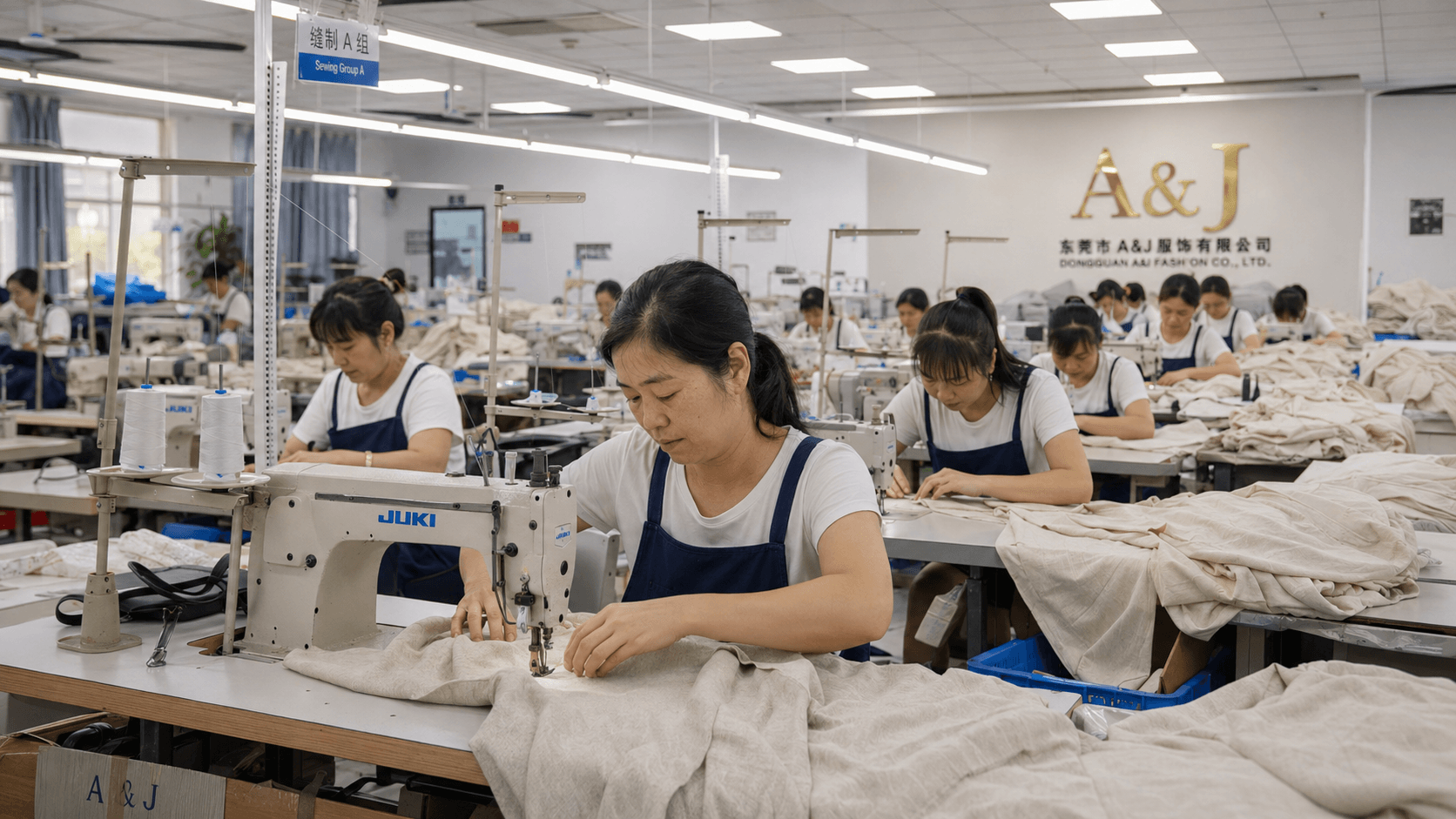
TL;DR: Spain wholesale womens clothing programmes at A&J start at a 50-piece MOQ per style, ship from our Dongguan factory in 30-35 days to Valencia, and land with Spanish-language fibre labels, GINETEX care symbols and EPR-ready packaging already handled.
Sourcing Spain wholesale womens clothing is not the same job as sourcing for France or Germany, even though all three sit inside the same customs union. Spanish retail runs on a different calendar, a different fibre mix and a different set of national labelling rules layered on top of EU law. A&J International Apparel has manufactured for European buyers from our Dongguan facility since 2006, and the Spanish accounts we work with share three demands that rarely appear together: early spring delivery, Mediterranean fabric weights, and paperwork that survives a customs inspection in Valencia.
What Makes a Spain Wholesale Womens Clothing Supplier Different in 2026
The Spanish market is shaped by proximity to Inditex, Mango and Desigual. Those groups trained an entire buyer generation to expect four to six drops per season instead of two, which means a Spain wholesale womens clothing supplier has to quote small, repeatable runs rather than one large seasonal buy. Our answer is a 50-piece MOQ per style per colourway, with a 15-working-day repeat window on any style whose fabric is already in stock.
The second difference is the calendar. A Galician or Andalusian retailer puts spring stock on the floor in mid-February, roughly three weeks earlier than a German buyer of the same product. Working backwards through a 30-35 day ocean transit and a 20-25 day production window, that pushes a Spain wholesale womens clothing purchase order to a late-November confirmation. Buyers who confirm in January are not late for spring — they are early for summer, and they usually pay air freight to fix the gap.
Third is fibre. Linen, linen-cotton, viscose-linen and lightweight tencel twill outsell heavy cotton jersey in Spain by a wide margin in every quarter except December and January. If you are cross-shopping our wholesale linen dress programme, that catalogue is the natural starting point for an Iberian buy.
Spanish Labelling and EPR Rules Every Spain Wholesale Womens Clothing Order Must Clear
Fibre composition labelling across the EU is governed by Regulation (EU) No 1007/2011, and Spain requires that information in Castilian Spanish. In practice that means 60% lino / 40% algodon, not 60% linen / 40% cotton, sewn into a permanent label. Spain also retains Real Decreto 928/1987, which adds national expectations around importer identification on the label — the EU importer name or registered trademark must be traceable.
Care symbols follow the GINETEX system, the same five-symbol sequence used across France and Italy. We print the sequence in the fixed GINETEX order (wash, bleach, dry, iron, professional care) because retail QC teams in Spain check order, not just presence.

The newer variable is extended producer responsibility. Spain’s Ley 7/2022 on waste and contaminated soil brought textiles into scope, and the collective SCRAP schemes now expect the first party placing goods on the Spanish market to register and report tonnage. That party is the importer, not the factory — but the factory controls the data. Every Spain wholesale womens clothing shipment we release includes a packing-level weight breakdown split into garment, polybag and carton, so your EPR declaration is a copy-paste exercise instead of a warehouse weighing session.
| Requirement | Legal basis | Who is responsible | What A&J supplies |
|---|---|---|---|
| Fibre content in Spanish | EU Reg. 1007/2011 | Importer | Sewn label, Castilian text |
| Care symbols | GINETEX convention | Importer | Fixed five-symbol sequence |
| Importer identification | Real Decreto 928/1987 | Importer | Blank field printed to your spec |
| Textile EPR reporting | Ley 7/2022 | Importer | Per-style weight breakdown |
| Restricted substances | REACH Annex XVII | Both | OEKO-TEX STANDARD 100 test reports |
Our full chemical position is documented on the OEKO-TEX certified manufacturing page, and organic cotton lines run against the GOTS certification guide. Buyers can verify any certificate number directly through the OEKO-TEX label check tool{:target=”_blank” rel=”noopener”}.
Fabric and Fit Choices That Sell Through in Spain
Three construction decisions separate a Spanish programme from a northern European one.
Fabric weight. We default to 165-190gsm for linen-cotton woven dresses and 210gsm for viscose twill, against 240-280gsm for the same silhouettes shipped to Germany. Anything above 200gsm sits unsold in Seville from May onward.
Shrinkage control. Linen blends are enzyme-washed and pre-shrunk to a 2.5% residual shrinkage tolerance tested to ISO 6330, because Spanish consumers wash at 30°C far more often than they dry-clean.
Sizing. Spain sells EU 34-46 with a fuller hip-to-waist ratio than the German block. We grade a separate Iberian fit block with +1.5cm hip and -0.5cm shoulder against our base European block, at no pattern surcharge on orders of three styles or more.

Buyers building a full offer usually pull from three of our capability programmes at once — the womens dress programme for the volume core, the womens suiting programme for autumn workwear, and the womens outerwear programme for the short but real Spanish winter.
Costing a Spain Wholesale Womens Clothing Programme: Duty, VAT and Landed Cost
Spain applies the EU Common Customs Tariff, so woven womens dresses of cotton enter at 12% duty, the same rate as every other member state. IVA is 21% and is recoverable for VAT-registered businesses, which means it should never appear in your margin calculation — only in your cash-flow plan.
Here is a realistic landed cost for a 300-piece linen dress buy across three colourways:
| Line item | Per piece (EUR) | Notes |
|---|---|---|
| FOB Shenzhen | 11.80 | 175gsm linen-cotton, lined bodice |
| Sea freight + insurance | 0.65 | LCL, Shenzhen to Valencia |
| Duty at 12% | 1.49 | On CIF value |
| Customs clearance | 0.22 | Amortised over the shipment |
| Landed cost | 14.16 | Excludes recoverable IVA |
At a 2.6x wholesale multiplier that supports a €36.80 wholesale price and a €95-105 retail. A Spain wholesale womens clothing buyer who wants to compete on the same rail as Mango needs the FOB under €13 — which is achievable at 50 pieces per colourway, and improves roughly 6-9% at 300 pieces per colourway.
Payment terms matter more in Spain than in most EU markets. Ley 15/2010 caps commercial payment terms at 60 days, and Spanish retailers use that ceiling routinely. We work on 30% deposit and 70% against bill of lading copy, which sits comfortably inside a 60-day downstream cycle.
Lead Times and Sea Freight to Valencia, Barcelona and Algeciras
| Route | Transit | Typical use |
|---|---|---|
| Shenzhen → Valencia | 30-35 days | Central and eastern Spain, Madrid distribution |
| Shenzhen → Barcelona | 31-36 days | Catalonia, showroom accounts |
| Shenzhen → Algeciras | 28-33 days | Andalusia, transhipment to Canary Islands |
| Air freight (HKG → MAD) | 5-7 days | Repeat orders and replenishment |
Total door-to-door for a first order is 55-65 days: 20-25 days production, 30-35 days ocean, 3-5 days clearance and inland. Repeat orders on stocked fabric compress to 40-48 days.

Which Spanish Brands Our Spain Wholesale Womens Clothing Clients Compete With
Our Iberian accounts are typically positioned adjacent to Mango, Sfera, Bimba y Lola and Scalpers on quality, and above the fast-fashion tier on construction. That positioning is a manufacturing decision, not a marketing one: French seams on unlined linen, 12-14 stitches per inch on principal seams, and interlining specified by hand feel rather than by lowest cost.
Comparable positioning work for neighbouring markets is documented in our Italy wholesale guide, the France wholesale guide, the Germany wholesale guide and the UK wholesale guide. All five sit under the European wholesale programme hub, which is the fastest way to compare market requirements side by side. Sustainability claims should be benchmarked against published data rather than supplier promises — the Textile Exchange knowledge centre{:target=”_blank” rel=”noopener”} is our reference point for fibre impact figures.

How to Start a 50-Piece Spain Wholesale Womens Clothing Order
- Send references. Tech pack, competitor sample, or a photo plus target price. All three work.
- Receive a costed quotation in 48 hours. FOB, fabric options and a landed-cost estimate for Valencia.
- Approve a sample in 7-10 days. Sampling fee is credited against the bulk order.
- Confirm bulk with a 30% deposit. Production window is 20-25 days for 50-500 pieces.
- Ship and clear. We issue the commercial invoice, packing list with EPR weight split, and certificate of origin.
Frequently Asked Questions
What is the minimum order quantity for Spain wholesale womens clothing?
Fifty pieces per style per colourway. That 50-piece MOQ applies to linen dresses, blouses, coord sets and tailoring alike, and has been our standard since we began exporting from Dongguan in 2006.
Which certifications should a Spanish importer ask a clothing manufacturer for?
OEKO-TEX STANDARD 100 for chemical safety, GOTS if the range is marketed as organic, and a REACH Annex XVII declaration. Spanish retail buyers increasingly request a Sedex SMETA audit report as well.
How long does shipping to Spain take from a Chinese clothing factory?
Thirty to thirty-five days by sea to Valencia or Barcelona, plus 20-25 days of production. Air freight from Hong Kong to Madrid runs five to seven days for urgent replenishment.
Does A&J handle Spanish-language labels and EPR data?
Yes. Fibre content is printed in Castilian Spanish, care symbols follow the GINETEX sequence, and every shipment includes a garment, polybag and carton weight breakdown for your Ley 7/2022 EPR declaration.
Can I order just 50 pieces of one dress to test a Spanish retailer before committing to a full season buy?
Yes — a 50-piece test run is exactly how most of our Spanish accounts start. You get the same 50-piece MOQ pricing structure, the same Spanish labels and the same EPR paperwork as a 3,000-piece order, so if the retailer reorders, nothing about the product or the compliance file has to change. The only difference is the FOB, which improves roughly 6-9% once you cross 300 pieces per colourway.
Ready to price a Spanish range? Send your tech pack or reference photos and we will return a costed quotation within 48 hours, including a landed-cost estimate for Valencia.


Leave a Reply