
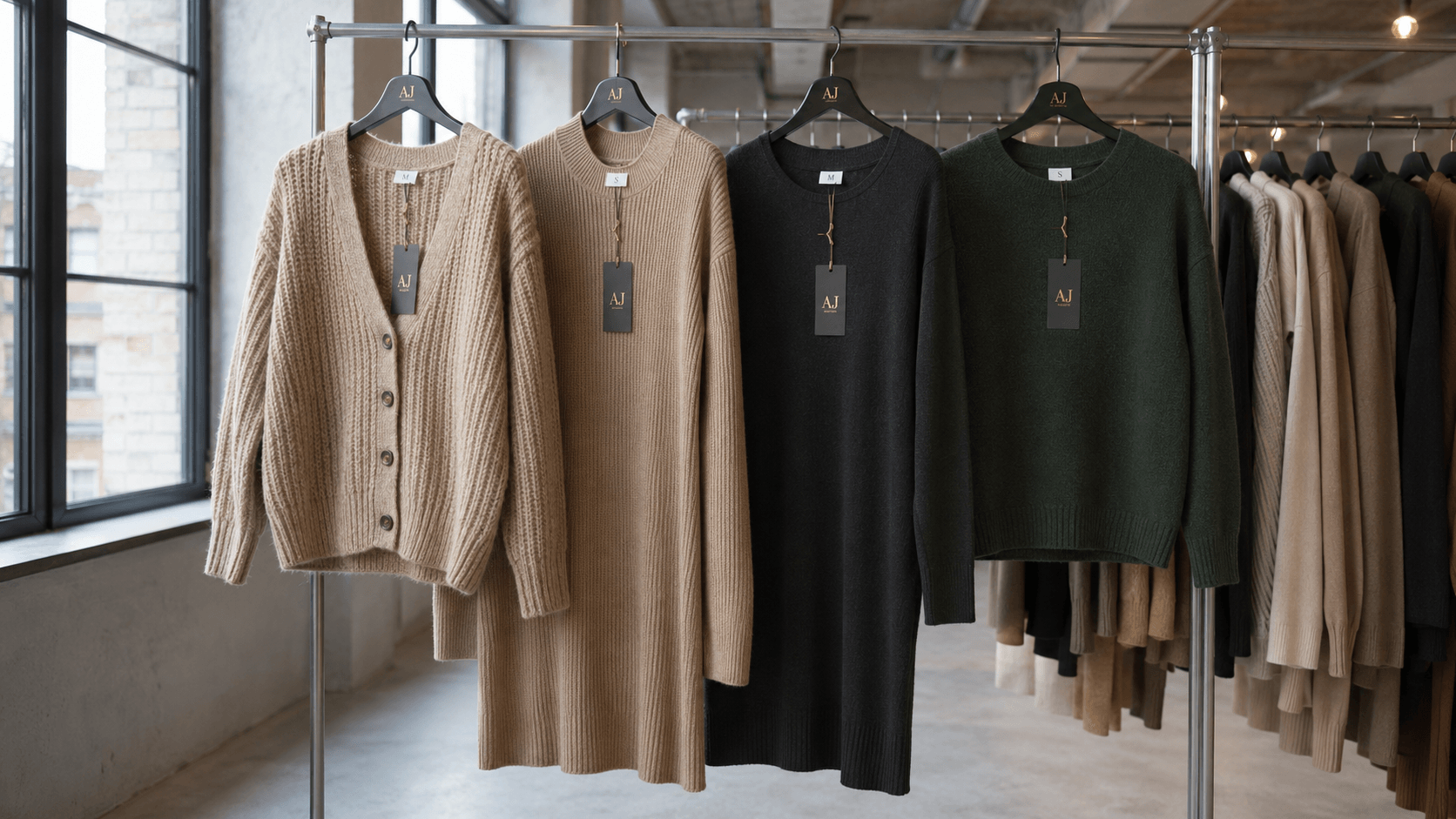
TL;DR: A&J is a womens knitwear manufacturer running 3gg to 14gg knitting in Dongguan since 2006, covering cardigans, sweater dresses, cashmere sweaters and fine-gauge knit dresses under one 50-piece MOQ, with ISO 12945-2 pill testing on every programme.
Knitwear is the hardest category to buy well. A woven dress that is cut badly still looks like a dress; a knit that is programmed badly grows two sizes in the first wash and pills across the underarm by week three. That is why brands treat their womens knitwear manufacturer as a longer-term relationship than any other supplier on their list — the knowledge sits in the stitch programme, not in the tech pack.
This page is the index to everything A&J knits. Five capability pages sit underneath it, and each one goes deeper than this summary. Use this hub to work out which programme you need, then follow the link into the detail.

What a Womens Knitwear Manufacturer Programme Covers at A&J
Our knit division is separate from our cut-and-sew division. It runs its own knitting hall, its own linking floor, its own yarn store and its own QC lab, because knit faults are found by different tests than woven faults. As a womens knitwear manufacturer we hold machinery across four gauge bands — 3gg and 5gg for chunky, 7gg for mid-weight, 12gg for fine, and 14gg for ultra-fine — plus whole-garment capability for seamless bodies.
The commercial structure is deliberately simple. Fifty pieces per style per colourway is the minimum, whether that is a chunky lambswool cardigan or a 14gg silk-cashmere shell. Sampling takes 10-14 days for knit, longer than the 7-10 days our woven programmes need, because a knit sample is a programme being written rather than a pattern being cut. Bulk production runs 25-30 days.
Every buyer working with a womens knitwear manufacturer should ask three questions before pricing: what gauge, what yarn count, and whether the garment is fully-fashioned, cut-and-sew, or whole-garment. Those three answers move cost more than any negotiation will.
The Five Knitwear Capabilities Under This Hub
Core Knitwear
Our knitwear manufacturing page is the base programme: crewnecks, V-necks, polo knits, turtlenecks and shells across lambswool, merino, cotton and viscose blends. This is where most first orders land. Standard construction is fully-fashioned at 7gg or 12gg with linked shoulders and a hand-linked neck trim at 12 stitches per inch. Weight range runs 280g to 520g per garment depending on gauge. It is also the cheapest route into a knit range, because the yarns are held in stock in eleven core colours and lead time drops to 20-22 days on stocked shades.
Cardigans
The cardigan manufacturing page covers the hardest knit to get right, because a cardigan has a front edge that must not ripple. We knit the button band integrally rather than sewing it on, then block it under controlled steam so the placket hangs flat under its own weight. Buttonholes are knitted in, not cut, on all fully-fashioned styles. Chunky 3gg and 5gg cardigans use a two-ply lambswool at 380-450g per garment; 12gg merino cardigans sit at 260-300g. Button choice is specified by shank depth relative to band thickness, which is the detail most suppliers skip.
Sweater Dresses
Our sweater dress programme solves a different problem: length stability. A knit dress carries its own weight, so a body that measures correctly on the table can drop 3cm on a hanger within a week. We counter this with a higher twist yarn, a tighter stitch density through the skirt, and a 48-hour hang test on every first sample before bulk approval. Rib-knit column dresses at 7gg are the volume seller; 12gg fine merino column dresses are the higher-margin option.
Cashmere Sweaters
The cashmere sweater programme is our top of range. We buy Inner Mongolian grade-A cashmere at 15.5-16.5 micron with a 36mm minimum fibre length, because short fibre is the single largest cause of pilling in cheap cashmere. Two-ply 26NM is standard for 12gg crewnecks at 240-280g. Every cashmere lot arrives with a fibre analysis report, and we will supply that report to you rather than summarising it. A womens knitwear manufacturer that will not show micron data on cashmere is usually blending in yak or fine wool.
Knit Dresses
The newest addition, our knit dress programme, uses 12gg 19.5-micron superfine merino on whole-garment machinery, producing a seamless body with no side seams at all. Recovery tested at 92% after thirty wear cycles, and the fabric is enzyme-washed for pill resistance rather than silicone-softened, because silicone washes out and enzyme treatment does not.

Gauge, Yarn and Machine Selection: the Real Cost Drivers
| Gauge | Typical yarn | Garment weight | Best for | Relative cost |
|---|---|---|---|---|
| 3gg | Chunky lambswool, 2/8NM | 450-600g | Statement cardigans, chunky crews | 1.0x baseline |
| 5gg | Lambswool or wool-alpaca | 380-480g | Cardigans, oversized crews | 1.1x |
| 7gg | Merino, cotton, wool blend | 300-400g | Sweater dresses, mid-weight crews | 1.25x |
| 12gg | Superfine merino, cashmere | 220-300g | Knit dresses, cashmere crews, shells | 1.6x |
| 14gg | Silk-cashmere, superfine merino | 180-240g | Layering shells, luxury capsule | 2.1x |
Finer gauge means more knitting time per garment, which is why a 14gg shell can cost more than a 3gg cardigan despite using a third of the yarn. Construction method layers on top: cut-and-sew is cheapest but wastes 12-18% of the knitted panel, fully-fashioned wastes under 5%, and whole-garment wastes almost nothing but ties up the most expensive machine time.

Quality Testing Every Womens Knitwear Manufacturer Should Run
| Test | Standard | Our pass threshold | What it catches |
|---|---|---|---|
| Pilling | ISO 12945-2 | Grade 4 minimum at 2,000 rubs | Short-fibre yarn, weak twist |
| Dimensional stability | ISO 6330 | Under 3% in any direction | Under-blocked panels |
| Seam strength | ISO 13935-2 | 180N minimum on linked seams | Loose linking tension |
| Colour fastness to rubbing | ISO 105-X12 | Grade 4 dry, grade 3-4 wet | Over-dyed dark shades |
| Fibre composition | ISO 1833 | Declared value within 3% | Substituted or blended yarn |
Pilling is where most knit programmes fail, and it is almost always a yarn decision rather than a knitting decision. We reject yarn lots at intake rather than rejecting garments at final inspection, because by final inspection the yarn cost is already spent.

MOQ, Lead Time and Costing Across the Knit Programme
| Programme | MOQ | Sampling | Bulk lead time | Indicative FOB |
|---|---|---|---|---|
| Core knitwear 7gg | 50 pcs / style / colour | 10-14 days | 25-30 days | USD 12-19 |
| Cardigan 5gg | 50 pcs / style / colour | 12-16 days | 28-32 days | USD 17-26 |
| Sweater dress 7gg | 50 pcs / style / colour | 12-16 days | 28-32 days | USD 19-28 |
| Cashmere sweater 12gg | 50 pcs / style / colour | 14-18 days | 30-35 days | USD 48-82 |
| Knit dress 12gg whole-garment | 50 pcs / style / colour | 14-18 days | 30-35 days | USD 26-41 |
Pricing improves 7-11% at 300 pieces per colourway and a further 5-8% at 1,000. Yarn is 45-60% of the FOB on knitwear against 25-35% on woven, which means yarn choice — not labour negotiation — is where a womens knitwear manufacturer can actually move your cost.

Which Markets Buy Which Knitwear
Knit demand splits sharply by geography, and our regional guides break down the labelling and duty position for each. UK and German buyers take the heaviest weights and order earliest; Italian and French buyers skew fine-gauge and later; Spanish buyers take the least knit overall but pay well for 12gg merino in transitional weights.
| Market | Weight preference | Peak order window | Regional guide |
|---|---|---|---|
| UK | 7gg-5gg, 350-480g | May-June | UK wholesale guide |
| Germany | 5gg-7gg, 380-500g | April-May | Germany wholesale guide |
| France | 12gg, 240-300g | June-July | France wholesale guide |
| Italy | 12gg-14gg, 200-280g | June-July | Italy wholesale guide |
| Spain | 12gg, 220-280g | July-August | Spain wholesale guide |
All five sit under the European wholesale programme hub. Buyers layering knit into a full seasonal offer usually pair this hub with the womens outerwear programme for coats — including our cashmere coat programme — the womens dress programme for wovens and the womens suiting programme for tailoring.
Chemical compliance across all knit yarns is documented on our OEKO-TEX certified manufacturing page, and organic cotton knits run against the GOTS certification guide. Certificate numbers can be verified independently through the OEKO-TEX label check tool, and fibre impact data should be benchmarked against the Textile Exchange knowledge centre rather than supplier claims.
How to Brief a Womens Knitwear Manufacturer
- Send the reference garment, not just a photo. Knit is judged by hand feel. A physical reference cuts two sampling rounds.
- State gauge or state the look, never both loosely. Tell us “chunky, like a 5gg” or “fine, drapes like a tee” and we will specify the gauge.
- Confirm yarn budget before sampling. Yarn is up to 60% of cost; changing it after sampling restarts the programme.
- Approve the hang test, not just the flat measurement. We supply 48-hour hang data with every knit sample.
- Lock the colour lab dip in daylight and store lighting. Knit surface scatters light differently to woven, and shades that match on a woven swatch often read warmer in knit.
Frequently Asked Questions
What is the minimum order quantity for a womens knitwear manufacturer at A&J?
Fifty pieces per style per colourway, across every knit programme from chunky 3gg cardigans to 14gg silk-cashmere shells. That 50-piece MOQ has been our standard since we began exporting from Dongguan in 2006.
Which gauge should I choose for a first knitwear order?
7gg is the safest starting point. It reads as substantial without being seasonal-specific, sits in the middle of the cost curve, and sells across UK, German and French accounts. Move to 12gg once you know your customer buys layering weights.
How do you stop knitwear from pilling?
Yarn selection first, finishing second. We specify a 36mm minimum fibre length on cashmere and a higher-twist two-ply on merino, then enzyme-wash rather than silicone-soften. Every programme is tested to ISO 12945-2 and must reach grade 4 at 2,000 rubs.
How long does knitwear sampling take compared with woven?
Ten to eighteen days depending on gauge, against seven to ten days for woven. A knit sample requires a stitch programme to be written and trialled, which is machine time rather than cutting-table time.
Can I mix different knit styles to reach the minimum, or does each style need its own 50 pieces?
Each style and colourway needs its own 50 pieces, because a stitch programme and a yarn dye lot are style-specific — mixing them would mean setting up the machine twice for one run. What you can do is spread a first order across three or four styles at 50 pieces each, which is how most new accounts start, and the yarn is often shared across those styles so you still get a volume yarn price.
Ready to build a knit range? Send a reference garment or a target weight and we will return a costed quotation within 48 hours, plus a gauge recommendation for your market.


Leave a Reply