
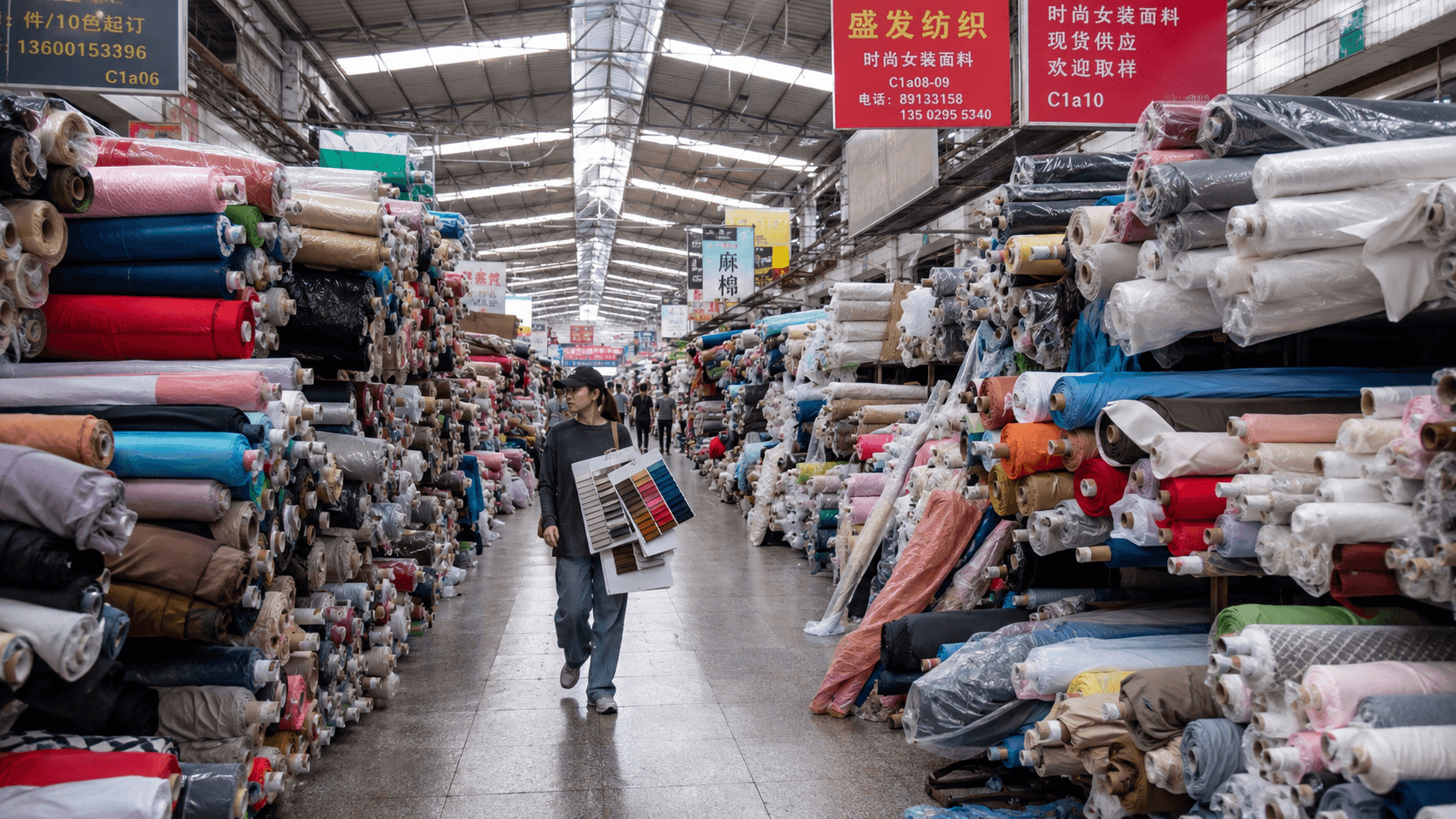
Chinese Womens Clothing Manufacturer: How to Evaluate One in 2026
TL;DR: Choosing a Chinese womens clothing manufacturer comes down to four checks you can complete in under a week — verify the business licence and export record, audit the actual production floor rather than a showroom, set AQL inspection tiers before production starts, and test communication quality with a deliberately ambiguous question.
Nobody searching for a Chinese womens clothing manufacturer needs persuading that China can make clothes. The industry supplies most of the world’s apparel and has done for three decades. The real question is narrower and harder: out of thousands of factories that all present competently over email, which one will actually deliver your order to specification?
A&J International Apparel has manufactured womenswear from Dongguan, China since 2006, and we lose deals regularly — usually to price, occasionally to proximity. What we rarely lose to is a buyer who ran a proper evaluation, because a proper evaluation surfaces the things that separate a real factory from a trading company with a good website. This page is that evaluation process, written out in full, including the parts that are inconvenient for us.

Factory, Trading Company or Agent: What You Are Actually Talking To
The first distinction matters more than any other, and it is deliberately blurred by a large part of the market. Three business types present themselves as a Chinese womens clothing manufacturer, and only one of them owns machines.
| Type | Owns production | Typical markup | When it makes sense |
|---|---|---|---|
| Direct factory | Yes | None | You know your category and want control |
| Trading company | No, subcontracts | 8-20% | You need many categories from one contact |
| Sourcing agent | No, matches you | 5-15% commission | You have no China experience at all |
| Factory with trading arm | Partly | Varies by item | Common and legitimate if disclosed |
None of these is inherently dishonest. A good trading company solves real problems for a buyer ordering dresses, bags and jewellery in one shipment. The problem is only ever non-disclosure — because when your Chinese womens clothing manufacturer is actually subcontracting, you cannot audit the floor your goods are made on, and quality drift becomes untraceable.
Three questions surface the truth quickly. Ask which building their sample room is in and whether you can video-call from it. Ask what their machine count is by type. Ask what they cannot make — a real factory answers this instantly and specifically, because every factory has boundaries. A reseller gives you a vague reassurance that they can make anything.
Verifying a Chinese Womens Clothing Manufacturer Before You Send a Tech Pack
Verification is genuinely quick in 2026 because Chinese company registration data is public.
Business licence. Every registered Chinese company has a unified social credit code, an 18-character identifier on its business licence. Ask for a copy. The registered scope of business will state whether manufacturing is included, and the registered capital and establishment date give you the company’s actual age rather than the “20 years of experience” claimed in an email signature.
Name consistency. The legal entity on the licence should match the entity that will issue your proforma invoice and appear on the bill of lading. A mismatch is not automatically fraud — many factories invoice through an affiliated export company — but it must be explained before you pay a deposit, not after.
Export history. A factory exporting regularly to your region has already solved the documentation problems specific to your market. Ask which countries they ship to most and what percentage of output that represents.
Certification scope. Certificates are only meaningful with their scope statements, and the numbers are checkable in public databases. Our own position across every scheme we hold is documented on the certified womens clothing manufacturer hub, and any OEKO-TEX number can be verified independently through the OEKO-TEX label check tool.

The Factory Audit: What to Actually Look At
Most buyers cannot fly to China for a first order, and a video walkthrough covers most of what matters if you direct it rather than letting it be performed at you.
Ask to see the cutting room first, not the sewing floor. Cutting is where quality is decided and where corners are least visible in a finished garment — look at whether markers are printed or hand-drawn, how deep the lays are, and whether cut bundles are ticketed. Then ask to see the QC area and, specifically, the reject rail. Every factory produces defects. A factory that cannot show you where they go is either hiding something or has no systematic QC.
| What to inspect | Good sign | Warning sign |
|---|---|---|
| Cutting room | Printed markers, ticketed bundles | Hand-drawn markers, loose stacks |
| Machine types | Specialised machines per operation | All general lockstitch |
| Work in progress | Small batches moving between stations | Large piles at one station |
| QC area | Dedicated space, visible reject rail | Inspection at the packing bench |
| Sample room | Separate from bulk line | Samples made on the bulk line |
| Fabric store | Labelled, lot-tracked shelving | Rolls on the floor unlabelled |
The sample room point deserves emphasis. A Chinese womens clothing manufacturer that makes samples on its bulk line will give you a sample made by whichever operator was free, which is why the sample looks different from the production. A separate sample room with dedicated pattern makers is a meaningful capability signal.
Regional Clusters: Where in China Matters
China is not one manufacturing location, and specialisation by region is real. This affects who you should be talking to before anything else does.
| Region | Specialisation | Typical strength |
|---|---|---|
| Guangdong (Dongguan, Guangzhou, Humen) | Womenswear, fashion apparel, knitwear | Fast fabric access, broad category range |
| Zhejiang (Ningbo, Hangzhou) | Suiting, outerwear, volume production | Large-scale efficiency |
| Jiangsu (Suzhou, Wuxi) | Silk, embroidery, high-end finishing | Craft-intensive work |
| Fujian (Quanzhou, Jinjiang) | Sportswear, footwear, technical fabric | Performance materials |
| Shandong (Qingdao) | Knitwear, workwear, heavy cotton | Cost-efficient basics |
We are in Dongguan, in the Guangdong cluster, which is the densest womenswear ecosystem in the country. The practical consequence is fabric access: a swatch request that takes a week elsewhere takes two days here, because the fabric market is a short drive away rather than a province away.

Setting Inspection Standards With a Chinese Womens Clothing Manufacturer
Inspection terms should be agreed before the deposit, in writing, because renegotiating quality standards after production has started never goes well for the buyer.
The industry standard is AQL sampling under ISO 2859-1. For womenswear, the common commercial setting is AQL 2.5 for major defects and AQL 4.0 for minor defects, with zero tolerance for critical defects. What those numbers mean practically: on a 500-piece order inspected at general inspection level II, roughly 50 pieces are checked, and the batch passes if major defects stay within the AQL 2.5 acceptance number.
Three inspection points are worth specifying:
- Pre-production, after fabric arrives and before cutting. Confirms the right fabric in the right quantity.
- During production, at roughly 20% completion. This is the highest-value inspection by a wide margin — a construction fault caught here costs a day of rework, the same fault caught at final inspection costs three weeks.
- Final random inspection, at 100% production and 80% packed.
For a first order with any Chinese womens clothing manufacturer, a during-production inspection is worth more than a final one. Book it explicitly, because most factories will not offer it.

The Communication Test That Predicts Everything
Here is a test worth running before you commit: send a deliberately incomplete brief and see what comes back.
Ask for a quotation on “a midweight cotton blouse, relaxed fit, around 300 pieces” and nothing more. A weak supplier returns a price. A strong one returns questions — what weight exactly, what fit measurements at chest and hip, what collar, what cuff, what button, is the placket concealed, what market and season.
The supplier who asks is the one who will catch the ambiguity in your actual tech pack before it becomes 300 wrong garments. The supplier who quotes immediately has made a set of silent assumptions, and you will discover what they were when the shipment lands.
Response time matters less than response quality, though both are measurable. A 24-hour reply with three good questions beats a two-hour reply with a number in it.
Cost Structure and What Drives Price
Buyers frequently assume price differences between Chinese suppliers come from margin. Usually they come from specification.
| Cost driver | Impact on FOB | Notes |
|---|---|---|
| Fabric quality and weight | 40-55% of unit cost | The single largest variable |
| Construction complexity | 15-25% | Lining, seam finishes, closures |
| Order quantity | Up to 30% between 50 and 2,000 pcs | Detailed on our short-run page |
| Trims and hardware | 5-12% | Branded buttons, zips, labels |
| Certification requirements | 3-8% | Certified fibre carries a premium |
Two quotations that differ by 30% are almost never the same garment. Ask for the fabric composition, weight in gsm and construction details behind each number before concluding one supplier is expensive.
Order quantity deserves its own note because it is where expectations most often mismatch. Our full cost curve from fifty pieces upward is published on the small quantity womens clothing manufacturer page, including the honest 17% difference between a 50-piece and a 300-piece run.
What A&J Does as a Chinese Womens Clothing Manufacturer
We produce womenswear across five capability programmes from our Dongguan facility, all at a 50-piece minimum per style per colourway: the womens dress programme, the womens suiting programme, the womens outerwear programme, the womens knitwear manufacturer hub and the womens activewear programme.
Buyers importing into Europe should also read the European wholesale programme hub, which covers labelling and producer responsibility obligations market by market. Sustainability claims of any kind should be checked against published impact data such as the Textile Exchange knowledge centre rather than accepted from a supplier deck.

A Four-Step Evaluation You Can Run This Week
- Request the business licence and check the unified social credit code, registered scope and establishment date.
- Run a directed video audit — cutting room, QC area with reject rail, sample room, fabric store. In that order.
- Send the ambiguous brief and grade the questions that come back rather than the price.
- Agree inspection terms in writing before the deposit, including a during-production inspection on the first order.
Frequently Asked Questions
How do I know if a Chinese womens clothing manufacturer is a real factory or a trading company?
Ask for the business licence and check whether manufacturing appears in the registered scope. Then ask for a live video call from the sample room and the cutting floor. A trading company can produce photographs of a factory but cannot produce an unscripted live walkthrough of one.
What is a reasonable minimum order from a factory in China?
It varies enormously by factory structure rather than by country. Volume-oriented units quote from 300-1,000 pieces per style, while factories with dedicated short-run lines quote from 50. Ask what their smallest order last month actually was, not what their stated minimum is.
Should I use an inspection company or rely on the factory’s own QC?
Both. Factory QC catches routine defects continuously, which third-party inspection cannot. Third-party inspection is independent, which factory QC cannot be. For a first order, a during-production third-party inspection at 20% completion is the highest-value check available.
Which part of China should I source womenswear from?
Guangdong for fashion womenswear and knitwear, Zhejiang for suiting and volume outerwear, Jiangsu for silk and embroidery-intensive work, Fujian for sportswear and technical fabric. Regional specialisation in China is real and choosing the wrong cluster costs both money and lead time.
I have only ever bought from wholesalers and I am nervous about dealing directly with a factory overseas for the first time — what actually goes wrong?
The failure mode is almost never fraud, which is what most first-time buyers worry about. It is ambiguity. Something in your brief that seemed obvious to you got interpreted differently, nobody asked, and 300 garments were made against that interpretation. The defence is unglamorous: over-specify everything in writing, insist on a physical sample before bulk, and book a during-production inspection so any misinterpretation surfaces at 20% completion rather than at the port. Do those three things and the practical risk of a first order drops to roughly the same level as ordering from a domestic supplier.
Want to test us against this checklist? Send a brief — however incomplete — and see what questions come back. We will return a costed quotation within 48 hours.


Leave a Reply