
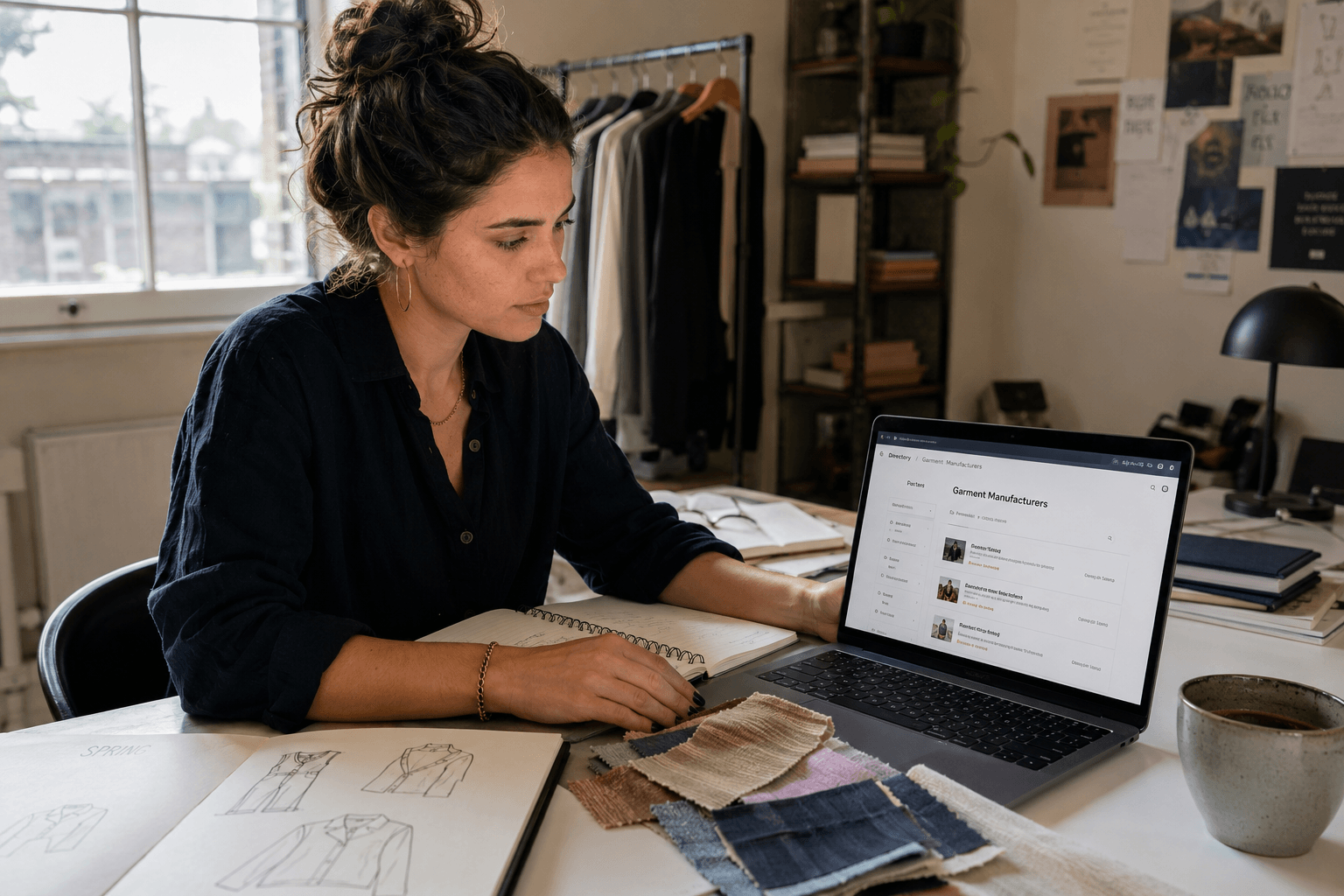
TL;DR: How to find a clothing manufacturer in seven steps — define the product precisely, decide domestic versus overseas, search the right channels, filter factories from traders, prepare a minimum viable tech pack, sample with two or three suppliers in parallel, then verify before placing bulk. Most failures happen at step one, not step seven.
Learning how to find a clothing manufacturer is less about discovering a secret directory and more about knowing what disqualifies a supplier before you waste six weeks on them. The manufacturers are easy to find. The hard part is telling which of them will actually make your product to specification, on time, at the quantity you can afford.
This guide is written to be useful whether or not you ever contact us. A&J International Apparel manufactures womenswear from Dongguan, China, so we are not neutral — but the process below is the one we would follow if we were on your side of the table, including the parts where the answer is “not a factory like ours”.
Step 1: Define the Product Before You Search
The single most common mistake in how to find a clothing manufacturer is starting the search before the product is defined. Factories specialise narrowly, and a supplier who is excellent at knitwear will be mediocre at tailoring.
Before any outreach, write down five things:
- Product category — woven, knit, cut-and-sew jersey, tailored, or outerwear. These are different factories, not different departments.
- Quantity per style per colour — the single number that determines which suppliers will reply to you at all.
- Target FOB or landed cost — a range is fine, silence is not.
- Quality tier — reference two brands whose construction you want to match.
- Timeline — the date stock must be in your warehouse, not the date you would like to order.
A supplier who receives all five answers can quote in 48 hours. A supplier who receives “I want to make dresses” cannot quote at all, and the polite ones will ask while the busy ones will ignore you.
Step 2: Decide Domestic or Overseas Before You Shortlist
This decision changes your entire supplier list, so make it early rather than comparing incomparable quotations later.
| Factor | Domestic (US/UK/EU) | Overseas (Asia) |
|---|---|---|
| Typical minimum | 100-300 pcs per style | 50-500 pcs depending on factory |
| Unit cost index | 1.8-2.5x | 1.0x baseline |
| Lead time to warehouse | 25-45 days | 50-65 days |
| Fabric range | Limited domestic mills | Very broad |
| Travel to visit | Feasible | Usually not for a first order |
| Origin marketing claim | Available | Not available |
Neither answer is correct in general. Domestic wins on speed, visitability and the origin claim. Overseas wins on cost, minimum flexibility and fabric breadth. Many established brands use both — domestic for urgent restocks, overseas for planned ranges.
If you go overseas, country choice matters less than factory choice, but it does matter. Our guidance on evaluating suppliers in the largest sourcing market is set out on the Chinese womens clothing manufacturer page.
Step 3: Search the Right Channels
There is no single directory that solves how to find a clothing manufacturer. Each channel has a different failure mode.
| Channel | Best for | Main weakness |
|---|---|---|
| B2B marketplaces | Breadth, first contact | Heavy trading-company presence |
| Trade shows | Assessing people directly | Expensive, calendar-locked |
| Industry referrals | Pre-vetted quality | Depends on your network |
| Garment label research | Finding who makes what you admire | Labels rarely name the factory |
| Sourcing agents | No-experience buyers | Adds 5-15% and a layer of distance |
| Direct search | Factories with real websites | Requires you to do the filtering |
The most underused channel is the fifth one inverted: instead of asking who made a garment, ask a factory which brands they produce for. Most will not name accounts under confidentiality, but the way they decline tells you whether they have real accounts to protect.

Step 4: Separate Factories From Trading Companies
Roughly half of suppliers presenting as manufacturers do not own production. This is not automatically disqualifying — a good trading company solves real problems — but you need to know which you are dealing with, because you cannot audit a floor your supplier does not control.
Three questions settle it quickly:
“Which building is your sample room in, and can we video-call from it?” A factory says yes today. A trader schedules.
“What is your machine count by type?” A factory answers with numbers — so many lockstitch, so many overlock, so many specialised. A trader answers with adjectives.
“What can you not make?” This is the strongest single question in how to find a clothing manufacturer. Every real factory has boundaries and states them immediately. Anyone who says they can make anything is reselling.
Step 5: Prepare a Minimum Viable Tech Pack
You do not need a professional tech pack to get a usable quotation. You do need enough specificity that the supplier is not guessing.
A minimum viable brief is one page containing:
- A flat sketch or reference garment photo, front and back
- Four to six key measurements at your target size
- Fabric weight in gsm and composition, or a physical swatch
- Trim notes — buttons, zips, labels
- Quantity per style per colour and target price
- Quality reference — “construction like brand X”
Send the same brief to every shortlisted supplier. Quotations against different briefs are not comparable, and comparing them is how buyers conclude one factory is expensive when it is simply quoting a better fabric.

Step 6: Sample With Two or Three Suppliers in Parallel
Sampling with one supplier gives you a sample. Sampling with three gives you a comparison, and the comparison is where the real information is.
Budget for this properly. Sampling fees typically run 3-8x the eventual unit price and are usually credited against a bulk order. Three samples at 5x a €15 unit price is roughly €225 plus shipping — cheap relative to a wrong 300-piece order.
Grade each sample on four axes, in this order:
- Accuracy to brief — did they build what you asked for, or what was convenient?
- Construction quality — turn it inside out. Seam finishing tells you more than the outside.
- Communication during sampling — did they ask questions or make silent assumptions?
- Turnaround honesty — did they hit the date they promised, and if not, did they tell you before the deadline or after?
Axis three and four predict your bulk experience better than axis two does. A slightly imperfect sample from a supplier who asked six good questions beats a perfect sample from one who asked none.
Step 7: Verify Before You Place Bulk
Four checks, all completable within a week of deciding.
Legal entity. Ask for the business registration document. The entity on it should match the entity issuing your invoice and appearing on shipping documents.
Certification scope. Certificates are meaningful only with their scope statements, and numbers are checkable in public databases. Which certificates you actually need depends on your market and claims — that mapping is set out on our certified womens clothing manufacturer hub. OEKO-TEX numbers can be verified through the OEKO-TEX label check tool and GOTS scope certificates through the Global Standard public database.
Payment terms. The standard structure is 30% deposit and 70% against shipping documents. Full payment upfront is a warning sign at any order size.
Inspection agreement. Agree AQL levels in writing before the deposit, and book a during-production inspection at roughly 20% completion on your first order. A fault caught there costs a day; the same fault at final inspection costs three weeks.

Common Mistakes in How to Find a Clothing Manufacturer
Leading with price. Asking “what is your best price” before defining the product invites a quotation against the cheapest possible interpretation of your brief.
Comparing quotations that are not comparable. Two numbers 30% apart are almost never the same garment. Compare fabric composition, weight and construction before concluding anything about margin.
Underestimating minimums. A brand planning a five-style launch at 50 pieces each needs a supplier structured for short runs, not a volume factory making an exception. The economics of that are explained on our small quantity womens clothing manufacturer page.
Skipping the sample. Every experienced buyer has one story about the order they approved from a photograph.
Ignoring compliance until shipment. Labelling and producer responsibility obligations apply identically at 50 pieces and 5,000. First-time importers into the EU are caught by this constantly — the market-by-market requirements are documented on our European wholesale programme hub.
Realistic Timeline From Search to Delivered Stock
| Phase | Duration | Notes |
|---|---|---|
| Product definition | 1-2 weeks | Do this before searching |
| Search and shortlist | 1-2 weeks | Aim for 5-8 suppliers, filter to 3 |
| Quotation round | 1 week | 48 hours each if your brief is complete |
| Sampling | 2-4 weeks | Includes one revision round |
| Verification | 1 week | Runs parallel to sampling |
| Production | 3-5 weeks | Varies by category and quantity |
| Shipping | 3-6 weeks sea | Or under a week by air |
| Total | 12-20 weeks | First order; repeats run roughly half |
Brands consistently underestimate the first two phases and overestimate their ability to compress the last two. If you have a fixed launch date, count backwards from it and add a thirty-day buffer.

Where A&J Fits
We are a womenswear factory in Dongguan, China, producing at a 50-piece minimum per style per colourway across dresses, tailoring, outerwear, knitwear and activewear. That makes us a reasonable fit for brands testing multiple styles in small quantities, and a poor fit for anyone needing menswear, footwear, domestic production or single-week turnaround.
If the category fits, the womens dress programme, womens suiting programme, womens outerwear programme and womens knitwear manufacturer hub each set out what we produce and how. If it does not, the process above still works with whoever you find.
Frequently Asked Questions
How long does it take to find a clothing manufacturer?
Two to four weeks from starting the search to selecting a supplier, assuming your product is already defined. Add two to four weeks for sampling before you can commit to bulk with confidence. Total time from first search to delivered stock is typically 12-20 weeks on a first order.
Do I need a tech pack before contacting manufacturers?
No, but you need a one-page brief with a sketch or reference photo, key measurements, fabric weight and composition, quantity and target price. Suppliers can quote from that. Without it, any quotation you receive is a guess.
What minimum order should I expect from a clothing manufacturer?
It depends far more on factory structure than on country. Volume-oriented factories quote from 300-1,000 pieces per style, while factories with dedicated short-run lines quote from 50. Ask what their smallest recent order actually was rather than relying on a published minimum.
How can I tell if a supplier is a real factory?
Ask for a live video call from the sample room and cutting floor, request their machine count by type, and ask what they cannot make. Real factories answer all three immediately and specifically. Then verify the legal entity on their business registration matches the entity that will invoice you.
I have a design and about five thousand dollars to spend — is that enough to actually get a clothing line made, or am I wasting my time?
It is enough for a genuine first run, provided you spend it in the right order. Roughly speaking, three to five hundred goes on sampling with two or three suppliers, and the remainder buys somewhere between fifty and two hundred finished pieces depending on the garment and the fabric. What that budget cannot absorb is a mistake — so the money is better spent on one carefully sampled style at fifty pieces than on three styles rushed without samples. The brands that fail at this budget level are almost never the ones who ordered too little; they are the ones who skipped sampling to afford more units.
Working through this process? Send whatever brief you have — even a rough one — and we will return a costed quotation within 48 hours, or tell you plainly if your product is outside what we make.


Leave a Reply