
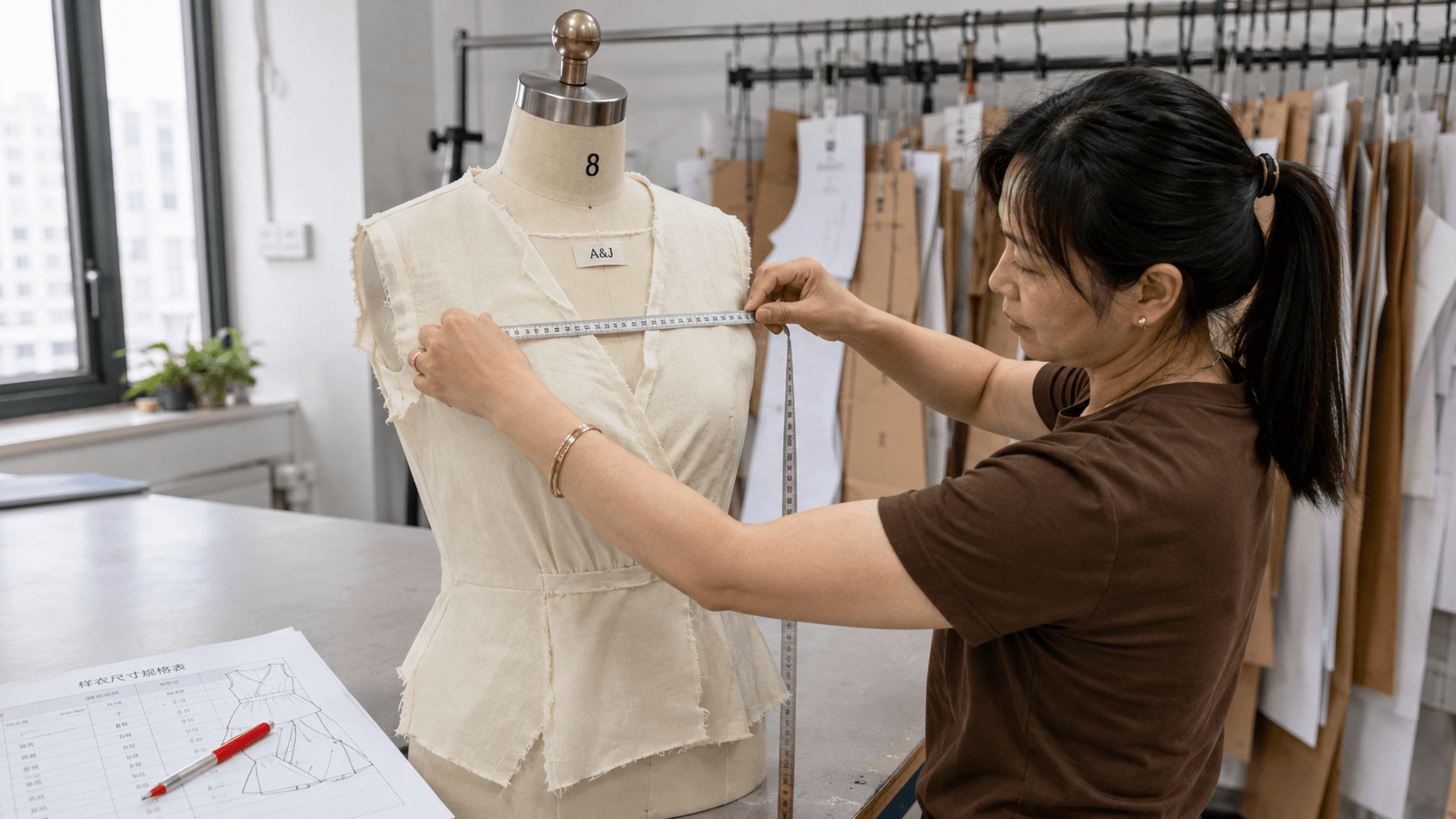
TL;DR: Most brands ask how much does it cost to make a clothing sample and receive a single number, which is why the invoice surprises them. A&J International Apparel has run sampling from Dongguan, China since 2006 alongside a 50-piece production minimum. This guide breaks the cost into its five real components, explains why the second sample is usually the expensive one, and covers when paying for a sample is the wrong move.
If you are wondering how much does it cost to make a clothing sample, the honest answer is that it depends on which of five separate charges apply to your style, and most quotes bundle them so you cannot tell.
The reason how much does it cost to make a clothing sample has no single answer is that a sample is not a single object. It is a sequence: a first physical interpretation of your idea, then a corrected version, then a fabric confirmation, then a final one made the way bulk will actually be made. Each stage has a different cost and a different purpose, and skipping any of them moves the risk into your production run.

This is written from the factory side, including the cases where we would tell you not to pay for a sample at all.
The Five Costs Behind How Much Does It Cost to Make a Clothing Sample
Ask three factories the same question and you may get USD 60, USD 180 and USD 450 for what sounds like the same garment. The spread is usually not margin. It is which of these five lines each quote includes.
| Cost component | Typical range | What it buys |
|---|---|---|
| Pattern making | USD 45-160 per style | Your block, digitised and reusable |
| Sample cutting and sewing | 3-8x the bulk unit price | One garment on a sample-room bench |
| Fabric sourcing | USD 0-150 | Zero if drawn from standing stock |
| Trim and label setup | USD 40-120 | Woven label die, hangtag origination |
| Lab dip | USD 40-70 per colour | Colour matching before bulk dyeing |
A simple jersey top drawn from standing fabric might total USD 90-160. A structured wool coat with a bespoke colour and custom hardware can reach USD 500-700 before a second round. That range is the real answer to how much does it cost to make a clothing sample, and the variable driving it is complexity, not factory greed.
Note the second line carefully. Sample sewing costs three to eight times the bulk unit price because one garment occupies a skilled operator for an hour or more, on a bench, with no line efficiency at all. That multiplier is arithmetic, not a surcharge.
Why the Pattern Changes How Much Does It Cost to Make a Clothing Sample Next Time
Of the five components behind how much does it cost to make a clothing sample, pattern making is the only one that permanently changes what you own. The others are consumed. The pattern persists.
This is why the answer to how much does it cost to make a clothing sample looks very different on your second order. Pattern and grading are already paid for, so a repeat sample in the same block drops to sewing cost plus fabric, often 40-60% less than the first round.
It is also why pattern ownership should be settled in writing before you pay anything, whatever the answer to how much does it cost to make a clothing sample turns out to be for your style. Our position is that patterns developed at a brand’s cost belong to that brand and we release digitised files on request. Not every factory works that way, and discovering otherwise when you want to move suppliers is an expensive lesson.
Our tech pack for clothing guide covers the nine sections and the measurement tolerances that determine whether the first sample matches your intent or the factory’s house block.
What Changes the Number Most
Six variables move the cost more than anything else. If you want to bring the sample charge down, these are the levers, in order of effect.
- Fabric availability — standing stock costs nothing to source; a commissioned fabric adds sourcing time and often a minimum
- Construction complexity — lining, interfacing, structured shoulders and welt pockets each add bench hours
- Bespoke colour — a lab dip cycle adds USD 40-70 and 10-18 days per colourway
- Custom hardware — bespoke zips, buckles and rivets carry their own origination costs
- Number of fittings — each corrected round is a fresh sample charge
- Size range — grading before sampling costs more than grading after fit approval
The sixth catches people out. Grade after the fit is approved, not before, or you pay to grade a pattern that then changes. It is the most common way brands inflate how much does it cost to make a clothing sample without gaining any information.

The Sampling Sequence and What Each Round Costs
Understanding how much does it cost to make a clothing sample means understanding that you are rarely buying one sample.
| Round | Purpose | Typical cost | Duration |
|---|---|---|---|
| Proto sample | First interpretation of the spec | Full sample charge | 8-14 days |
| Fit sample | Corrections applied | 60-80% of first | 7-12 days |
| Fabric approval | Lab dip, hand feel, shrinkage | USD 40-70 per colour | 10-18 days |
| Pre-production sample | Made on the bulk line | 50-70% of first | 7-10 days |
Plan for two to three rounds. A brand quoting itself one round is planning for an outcome that almost never happens, and the pre-production sample is the one most often skipped to save money. It should not be, because it is the only sample made the way your bulk will actually be made.
Four to eight weeks of sampling total, then 25-40 days of bulk production. A realistic first order runs 12-18 weeks end to end.
Are Sample Costs Refundable Against Bulk
Often partly, and the arrangement varies enough that you should ask directly rather than assume. It materially changes the net answer to how much does it cost to make a clothing sample.
Common structures are full credit against a bulk order above an agreed quantity, partial credit of 50%, or no credit with a lower headline sample price. None of these is inherently better. A factory offering full credit has usually priced the sample slightly higher to carry the risk of you not ordering.
What matters is that the arrangement is stated before you pay. When you ask how much does it cost to make a clothing sample, follow up immediately with whether any of it comes back.
When Asking How Much Does It Cost to Make a Clothing Sample Is the Wrong Question
Three situations where sampling is the wrong spend. We would rather say this than take the fee.
You have not decided on the design. A sample confirms a specification. If the spec is still moving, you are paying a factory to guess, and every guess costs a full round. Settle the flat sketch and the measurements first.
You are testing whether a graphic sells. Buy a blank and decorate it. That answers the demand question for a fraction of the cost, and no custom pattern is involved. Our comparison of private label vs white label clothing explains where the boundary sits. We do not hold a blanks range, so this is a referral away from us.
You cannot fund production afterwards. A sample is the first 5% of a project. If the remaining 95% is not funded, the sample becomes an expensive photograph. Wait until the production funding exists.

How to Reduce Sample Cost Without Reducing Quality
Five practical moves that reduce how much does it cost to make a clothing sample without weakening the information you get back. We recommend all of them on a first call.
- Draw from standing fabric for the first round, then switch to a bespoke quality once the fit is confirmed
- Sample one size only, typically the middle of your range, and grade after approval
- Combine styles in one round so pattern and setup effort is shared across several garments
- Send a reference garment to measure rather than describing the fit in prose
- Approve a strike-off separately from the garment sample when a print is involved
The first of these is the largest single saving. Sourcing a bespoke fabric for a sample can cost more than the sample itself, and the fit information you gain is identical when the weight and construction are comparable.
Our small quantity womens clothing manufacturer page carries the full cost curve from 50 to 2,000 pieces, and clothing manufacturer for startups covers what breaks structurally below 300 pieces.
How Much Does It Cost to Make a Clothing Sample by Category
Indicative ranges for a first sample including pattern, assuming fabric from standing stock and one colour.
| Category | First sample total | Main driver |
|---|---|---|
| Jersey top or tee | USD 90-170 | Simple construction |
| Knit dress | USD 140-260 | Grading complexity |
| Activewear legging | USD 180-320 | Stretch factor, recovery testing |
| Blazer or tailored jacket | USD 320-560 | Interfacing, lining, structure |
| Wool or padded coat | USD 400-700 | Panel count, hardware, weight |
These figures answer how much does it cost to make a clothing sample for the most common categories we produce. Structured outerwear sits at the top because a coat can carry three times the panel count of a dress before any lining is added.
Category detail sits in our womens dress program, womens suiting program, womens outerwear program and womens activewear program hubs.
What a Sample Should Come With
A sample without documentation is just a garment, and it wastes most of what you paid for. Whatever the answer to how much does it cost to make a clothing sample was, ask for these four items alongside it.
- Measured specification sheet showing what the factory actually achieved against your target
- Fabric details naming composition, weight and supplier reference
- Trim list with every component identified
- Comments on manufacturability flagging anything that will cause problems at scale
The fourth is the most valuable and the least often supplied. A factory that has made your style once knows where bulk will struggle, and that information is worth more than the garment.
Certification questions arise at the same stage. Our certified womens clothing manufacturer hub explains which certificates cover what, and any certificate number can be verified against the public OEKO-TEX database. Textile Exchange publishes the organic and recycled content standards in full.

Where A&J Fits
We are a womenswear factory in Dongguan, China, founded in 2006, running a 50-piece minimum per style. We charge for samples and credit part of the cost against bulk, and we tell you how much does it cost to make a clothing sample in your specific case before any payment is taken, itemised across the five lines above.
We are a poor fit for menswear, footwear, single-piece commissions and brands wanting a sample without any intention of producing. If you need one garment for a photoshoot, a sample room service is the right supplier and we will point you toward one.
One thing we will say that a sales page usually will not: a first sample that comes back perfect is mildly suspicious. It generally means the factory built to its own block rather than to your measurements, and the difference will surface at bulk when the grading does not behave.

Frequently Asked Questions
How much does it cost to make a clothing sample for a simple garment?
Asking how much does it cost to make a clothing sample for a jersey top or tee drawn from standing fabric typically returns USD 90-170 including pattern making. A knit dress sits around USD 140-260. The pattern portion is one-off and carries forward to every future sample in the same block.
Why do factories charge three to eight times the bulk price for a sample?
Because one garment occupies a skilled operator on a bench for an hour or more with no line efficiency. Bulk pricing assumes a production line running the same style repeatedly, and none of that applies to a single piece.
Are clothing sample costs deducted from the bulk order?
Often partly. Common arrangements are full credit above an agreed quantity, 50% credit, or no credit with a lower sample price. Ask before paying, because factories offering full credit usually price the sample higher to carry the risk.
How many sampling rounds should I plan for?
Two to three. A proto sample, a corrected fit sample, and a pre-production sample made on the bulk line. Skipping the last one is the most common false economy, because it is the only sample produced the way your bulk actually will be.
Can I get a sample made if I only have a photo and no technical drawings yet?
Yes, but expect the first round to be an interpretation rather than your design, and allow for an extra correction cycle. Sending measurements and a reference garment alongside the photo typically saves one full round, which is usually more than the cost of preparing them.


Leave a Reply