
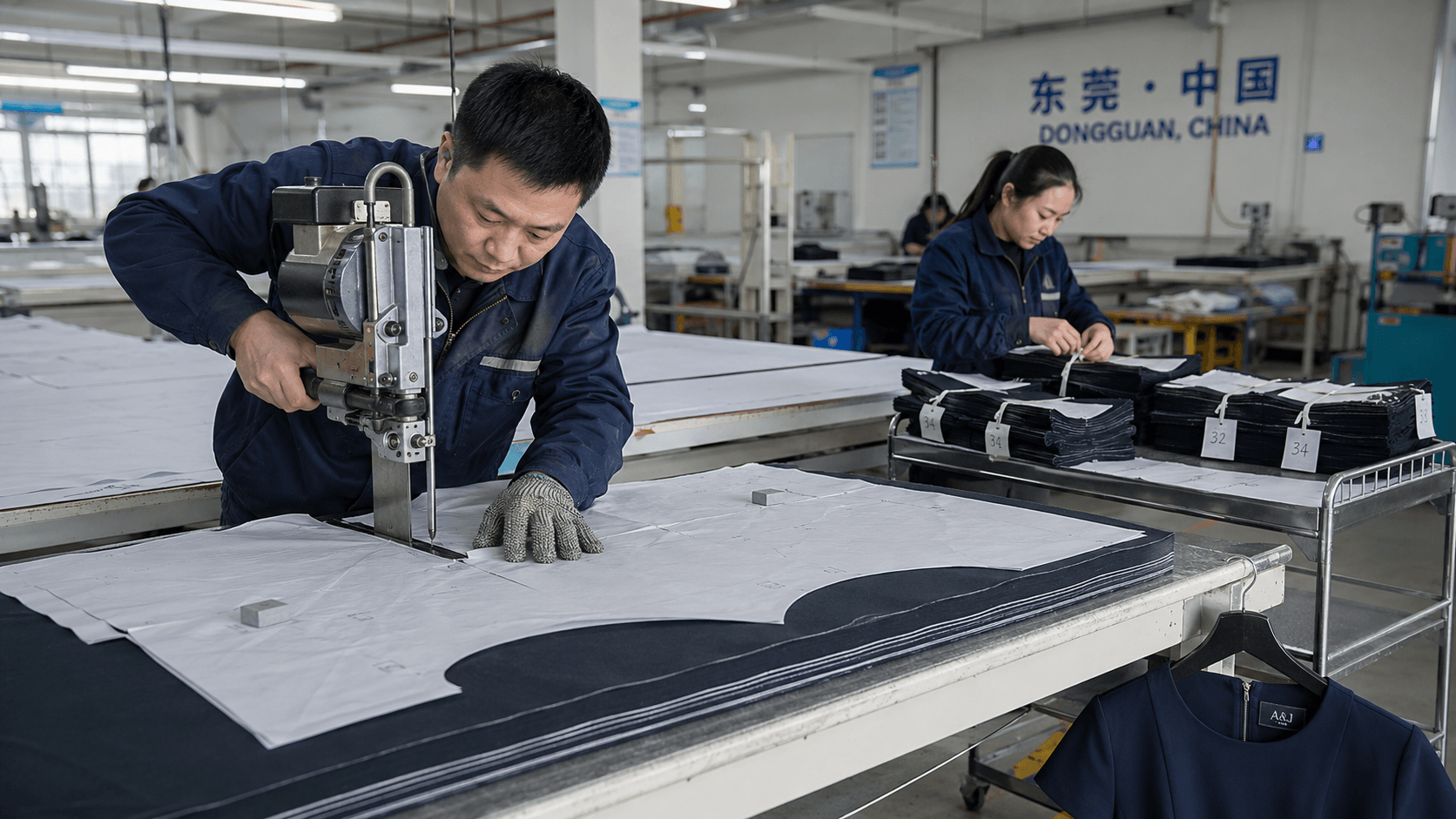
TL;DR: Searching for a clothing manufacturer no minimum usually means one of three things is true, and only one of them is a factory. A&J International Apparel has produced womenswear from Dongguan, China since 2006 at a 50-piece minimum per style. This guide explains what genuinely sits behind a zero-minimum offer, what it costs you, and when it is the right answer anyway.
Type clothing manufacturer no minimum into a search bar and the results look encouraging. Dozens of suppliers promise one-piece orders, no commitment, no risk. Some of them are telling the truth about what they do. Almost none of them are factories.
This guide is written by a factory that cannot offer zero minimum, so read it with that bias in mind. We are not going to pretend our 50-piece floor is secretly better than no floor at all. It is a constraint. What we can do is explain exactly what sits behind a clothing manufacturer no minimum promise, because the mechanics are rarely disclosed and they decide whether the offer suits you.

The short version: minimums exist because of fixed costs that do not disappear when the order shrinks. Any clothing manufacturer no minimum offer has either removed the fixed cost, moved it into your unit price, or is not doing the work in house.
What Sits Behind a Clothing Manufacturer No Minimum Promise
There are exactly three business models that can honestly advertise as a clothing manufacturer no minimum, and they are not interchangeable.
| Model | What actually happens | Your unit cost | You control |
|---|---|---|---|
| Print on demand | Blank purchased, decorated per order | Highest, flat | Artwork only |
| Sample-room service | Factory sample room sells one-offs | 3-8x bulk price | Most things, at sample rates |
| Trading intermediary | Order pooled or resold to a real factory | Bulk price plus margin | Whatever they pass through |
The first is a fulfilment service attached to someone else’s garment. The second is a real factory charging you sample rates for production quantities, which is honest but expensive. The third is the one worth scrutinising, because a trading intermediary advertising as a clothing manufacturer no minimum is describing its willingness to take your order, not its capacity to make it.
None of these are scams. All three serve genuine needs. The problem is that search results present them as equivalent to factory production, and they are not.
Why Minimums Exist at All
Before judging any clothing manufacturer no minimum offer, it helps to know why the floor exists elsewhere. A minimum is not a gatekeeping device. It is arithmetic. Five fixed costs sit in front of every production run and none of them shrink when the quantity does.
| Fixed cost | Typical size | Behaviour below 100 pieces |
|---|---|---|
| Fabric dye lot | 500-1,000m per colour | You need 90-150m, mill will not cut it |
| Line changeover | 1.5-2.5 hours setup | Same setup for 20 pieces or 2,000 |
| Woven label order | 1,000 pieces minimum | You need 60, supplier will not split |
| Pattern digitising | Per style, one-off | Identical cost at any quantity |
| Inspection scope | Fixed per style | Cannot be reduced proportionally |
A supplier offering a clothing manufacturer no minimum arrangement has dealt with these five costs somehow. Either it holds standing fabric and pools trim orders across clients, or it is buying finished blanks, or it is charging you enough per unit to absorb the whole fixed load. Ask which. The answer tells you what you are actually buying.
When a Clothing Manufacturer No Minimum Really Is the Right Answer
Four situations where we would send you to a zero-minimum supplier rather than take your order. These are not hedges.
You are testing artwork, not a garment. If the question is whether a graphic sells, print on demand answers it for the cost of one sample. Commissioning custom production to test a print is spending four figures to answer a two-figure question.
You genuinely need one piece. Costume, fitting sample, photography prop, personal commission. A clothing manufacturer no minimum service exists precisely for this, and a production factory is the wrong tool.
Your catalogue is wide and shallow. Two hundred designs selling two pieces each is a print-on-demand business model. It cannot be produced as cut and sew at any sensible cost, and no factory arrangement fixes that.
You have no capital for inventory. Zero minimum means zero inventory risk. That is a real advantage, and it is worth paying a high unit price for while cash is tight.

What a Clothing Manufacturer No Minimum Arrangement Costs You
The unit price is the visible cost of a clothing manufacturer no minimum arrangement. Four less visible ones matter more once you are past the testing phase.
- Fit is not yours. You inherit the blank supplier’s block. Your tee fits identically to every competitor using the same platform.
- Fabric is not yours. You choose from a catalogue. Weight, hand feel and composition are fixed.
- Margin compresses at scale. Flat per-piece pricing never improves. At 500 pieces you pay the same rate as at 5.
- Reordering is not guaranteed. If the platform discontinues a blank, your product disappears with it.
None of these matter while you are validating. All of them matter once something sells. The transition point away from a clothing manufacturer no minimum platform is usually around 100-200 pieces per style, which is where the unit gap starts costing more than the inventory risk saves.
Our page on small quantity womens clothing manufacturer sets out the full cost curve from 50 to 2,000 pieces, and it shows where the crossover sits for most categories.
How Our 50-Piece Floor Compares to a Clothing Manufacturer No Minimum Offer
We are not a clothing manufacturer no minimum operation and will not claim to be. Here is the honest comparison.
| Dimension | Zero-minimum supplier | A&J at 50 pieces |
|---|---|---|
| Upfront commitment | One piece | 50 pieces per style |
| Unit price | Highest, flat | Falls 16-20% by 300 pieces |
| Fit control | None, blank block | Full, your pattern |
| Fabric choice | Platform catalogue | 40+ standing qualities, or commissioned |
| Development cost | None | USD 200-400 per style |
| Inventory risk | Zero | Real |
| Reorder pricing | Unchanged | Development cost drops to zero |
Fifty pieces across four sizes is roughly twelve or thirteen garments per size. That is the smallest quantity at which the five fixed costs above can be absorbed without pricing at sample rates. It is not a marketing number, and it is the honest reason we cannot advertise as a clothing manufacturer no minimum.
The honest framing is that a clothing manufacturer no minimum arrangement trades unit economics for zero risk, and a 50-piece floor trades a small amount of risk for unit economics that improve with every reorder. Which is correct depends entirely on whether you have proven demand yet.
How to Verify What You Are Actually Dealing With
Four questions separate a factory from an intermediary, regardless of what the website says. Ask any clothing manufacturer no minimum supplier these before paying anything, and ask us the same.
- Where is the sewing floor, and can I see it on a video call? An intermediary deflects. A factory opens a laptop.
- Do you hold fabric, or do I supply it? This single answer determines whether minimums are structural or negotiable.
- What happens to my order when a large order arrives the same week? A dedicated short-run line has an answer. A pooled arrangement changes the subject.
- Who owns the pattern developed at my cost? The reply tells you how difficult leaving will be.
Send a deliberately vague requirement as a fifth test. A trading intermediary returns a price. A factory returns questions. This works on a clothing manufacturer no minimum listing exactly as well as it works on us.
Our guide on how to find a clothing manufacturer covers the full seven-step vetting process, and the chinese womens clothing manufacturer page explains business licence verification for suppliers based in China.

What You Need Before Moving Off a Clothing Manufacturer No Minimum Platform
The transition catches brands out because a clothing manufacturer no minimum platform requires almost no documentation and factory production requires a lot. Six things you will need that you probably do not have yet.
- Measurement specification with tolerances, not just a size chart
- Bill of materials naming fabric composition, weight and every trim
- Construction notes covering seam types, stitch density and finishing
- Graded size range with your own increments, not the platform’s
- Label and packaging artwork at print resolution with placement
- Target landed cost so the factory can flag spec-price conflicts early
Our tech pack for clothing guide covers all nine sections and the measurement tolerances that make a package usable in production. Brands making this move should also read clothing manufacturer for startups, which explains the five things that break structurally below 300 pieces.
Compliance Applies at Every Quantity
This is where a clothing manufacturer no minimum arrangement quietly shifts risk onto the brand. Fifty pieces carry the same obligations as fifty thousand, and one piece carries them too.
- FTC care labelling with fibre content and an RN or registered business name for US sales
- EU fibre composition in the language of each destination country under Regulation 1007/2011
- France Triman sorting mark plus Refashion eco-contribution per garment
- Germany LUCID packaging registration before the first sale
- CPSIA tracking label for children’s items, no volume exemption
Print-on-demand platforms generally supply a compliant care label for the blank, but the brand placing goods on the market remains responsible. Verify rather than assume, especially for EU destinations.
Certification works the same way at any quantity. Our certified womens clothing manufacturer hub explains which certificates cover chemical safety versus fibre origin versus social audit. Any certificate number can be checked against the public OEKO-TEX database in about a minute, and Textile Exchange publishes the organic and recycled content standards in full.
Where A&J Fits
We are a womenswear factory in Dongguan, China, founded in 2006, running a 50-piece minimum per style with a dedicated short-run line and a standing fabric programme covering 40+ qualities. The standing stock is the reason the floor is 50 rather than 300, because we absorb the dye lot rather than passing it to you.
Our capability pages set out what we build: the womens dress program, the womens suiting program, the womens outerwear program, the womens knitwear manufacturer hub, the womens activewear program, and the european wholesale program for brands shipping into the EU and UK.
We are a poor fit for single-piece orders, menswear, footwear, sub-six-week turnaround, and any brand that has not yet validated demand. In those cases a clothing manufacturer no minimum service is the correct answer, and we say so on the first call rather than three weeks into sampling.
One commitment worth settling in writing before any deposit: patterns developed at a brand’s cost belong to that brand, and we release the digitised files on request. Ask every supplier the same question, including any clothing manufacturer no minimum platform you are currently using. Most platforms own the block outright, which is worth knowing before you build a product on it.

Industry coverage of small-batch supply chains is worth reading alongside factory advice. The Business of Fashion reports regularly on the economics facing independent labels.

Frequently Asked Questions
Is a clothing manufacturer no minimum a real factory?
Sometimes, but rarely, and the distinction matters more than the price. Zero-minimum offers usually come from print-on-demand services using purchased blanks, factory sample rooms charging sample rates, or trading intermediaries pooling orders. All three are legitimate, but only the second involves a factory making your garment to your pattern.
What is a realistic minimum order quantity for custom production?
Fifty pieces per style is a workable floor for knitwear and jersey, and 80-100 for structured woven items where fabric consumption is higher. Below that, fixed costs such as dye lots, line changeover and trim minimums cannot be absorbed without sample-rate pricing.
At what quantity should I move off a clothing manufacturer no minimum platform?
Usually between 100 and 200 pieces per style. Below that, zero inventory risk outweighs the unit price gap. Above it, the flat per-piece rate costs more than the inventory risk saves, and reorder economics start favouring cut and sew.
Can I keep my current fit when moving from a blanks platform to a factory?
Only approximately. A factory can measure your existing garment and pattern to it, but the result will differ slightly because fabric and construction differ. Expect one extra sampling round, and tell returning customers the fit has been updated.
Do I really need 50 pieces, or can I just order 10 to see if my design works first?
Ten pieces is a sampling quantity rather than a production run, and we can make them at sample rates, though the per-piece cost will be several times higher. If the goal is testing a design rather than selling stock, that is often the sensible spend before committing to 50.


Leave a Reply