
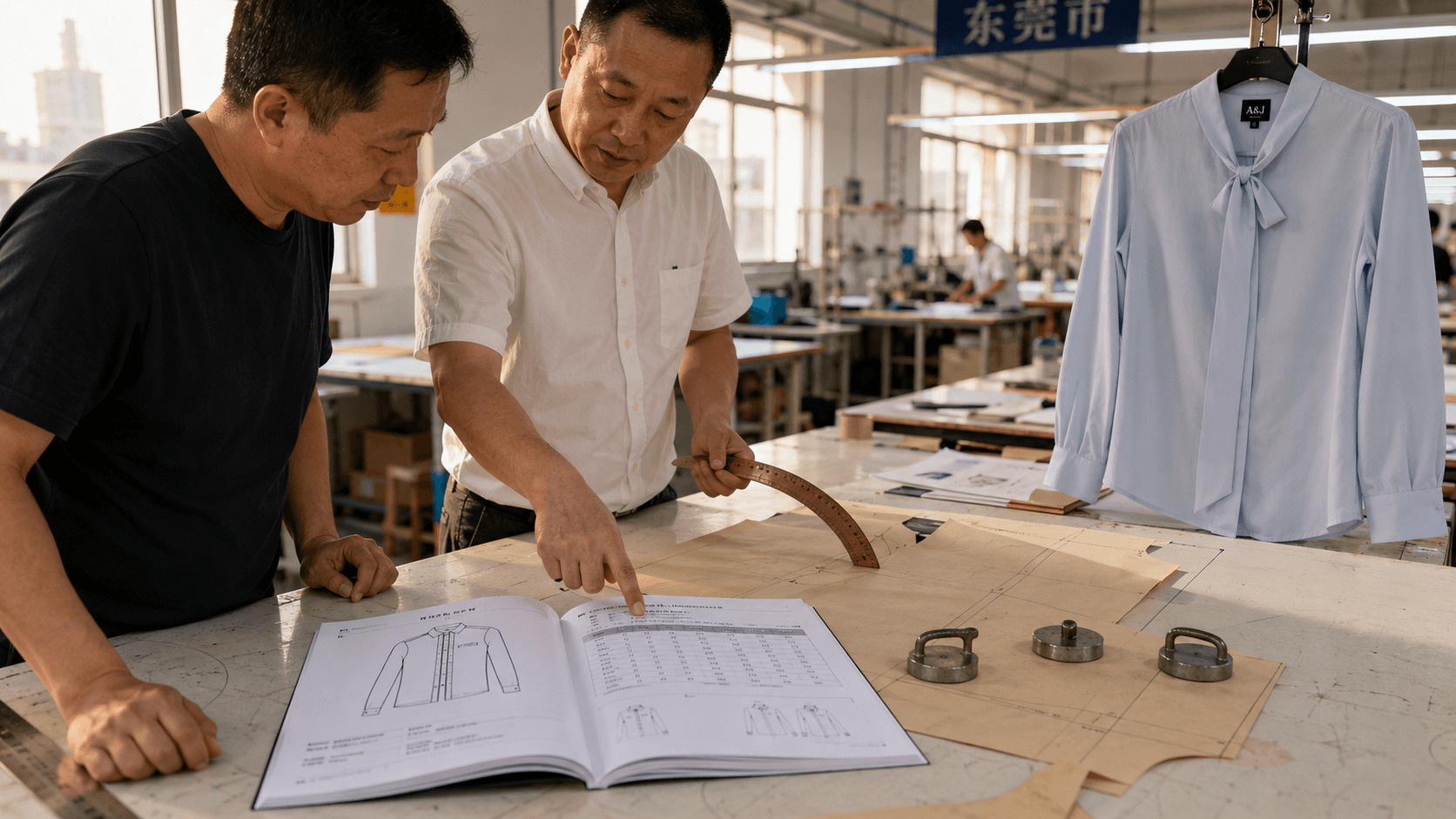
TL;DR: A tech pack for clothing is the specification document a factory works from: measurements, materials, construction, labelling and packing. Get it right and your first sample lands close. Get it wrong and you pay for rounds of correction. A&J International Apparel has been producing in Dongguan, China since 2006 with a 50-piece minimum, and this guide reflects what we actually need to see before cutting.
Most first-time buyers send us a mood board and a size chart and expect a sample. What they need is a tech pack for clothing that answers the questions a pattern cutter will otherwise have to guess at. Every guess is a risk, and every wrong guess costs a sample round.

This guide covers what belongs in the document, what a factory does with each section, and where beginners most often leave gaps. It is written from the receiving end, which is a different perspective from most design-school templates.
What a Tech Pack for Clothing Actually Does
A tech pack is a translation layer. You are converting an idea that exists visually into instructions that a cutter, a sewer and a quality inspector can each act on independently, often without speaking your language.
That framing explains most of the rules that follow. If a section cannot be measured, checked or photographed, it does not belong in the document. “Relaxed fit” is a mood. “Chest 58cm at 2.5cm below armhole” is a specification.
It also explains why a tech pack for clothing is worth building even at 50 pieces. The document is what makes a result repeatable. Without it, your second production run depends on whoever happens to remember the first one, and that person may not be at the factory next season.
The Nine Sections Every Tech Pack for Clothing Needs
| Section | What it contains | What the factory does with it |
|---|---|---|
| Cover sheet | Style name, code, season, target market, sizes | Routes the job and sets the grade rule |
| Flat sketch | Front, back, and any detail views | Becomes the pattern cutter’s reference |
| Measurement chart | Points of measure with tolerances | Drives pattern drafting and QC |
| Bill of materials | Every fabric, trim and thread | Sourcing and costing |
| Construction detail | Seam types, stitch density, finishes | Machine selection and line setup |
| Labelling | Main label, care label, size label placement | Compliance and finishing |
| Artwork | Print or embroidery files with placement | Decoration department |
| Packing | Folding, polybag, carton specification | Finishing and shipping |
| Colourways | Pantone references per component | Lab dip and approval |
Nine sections sounds heavy for a first product. It is not. A single-style tech pack for clothing usually fits on four to six pages once you stop writing prose and start filling tables. Build the tech pack for clothing as a template once and each later style becomes a copy with new numbers.
Measurements: Where Most Documents Fail
The measurement chart is the section that decides whether your sample fits. Two rules matter more than the rest.
First, define the point of measure, not just the value. “Chest 58cm” is ambiguous. “Chest: measured flat, 2.5cm below armhole, seam to seam, doubled” is not. Different factories default to different conventions, and the difference can be three centimetres.
Second, give tolerances. Fabric moves, and no factory hits a number exactly across a 300-piece run. Typical allowances are plus or minus 1cm on chest and body length, 0.5cm on neck and cuff openings, and 0.5cm on sleeve length. Without stated tolerances, you have no basis to reject a batch, and the factory has no basis to know what “close enough” means.

A third habit separates a workable tech pack for clothing from a decorative one: measure a real garment. Pull something from your wardrobe that fits the way you want, lay it flat, and record the numbers. Inventing measurements from a size chart you found online produces a sample that fits nobody in particular, and you will spend two rounds discovering that.
Bill of Materials: Be Specific or Be Surprised
The BOM is where cost lives. A line reading “cotton jersey” tells us almost nothing. A usable line reads: 100% combed ring-spun cotton, single jersey, 180gsm, tubular, pre-shrunk, undyed base.
Include every component, not only the face fabric. Thread type and ticket number, interlining, elastic width and denier, zip type and length, buttons with ligne size, drawcord and tips, main label, size label, care label, hangtag and string. A tech pack for clothing that omits trims produces a quotation that will change later, which frustrates everyone.
State fabric weight in gsm rather than ounces where you can, and name the construction, because 180gsm single jersey and 180gsm interlock behave completely differently.
Construction Detail: Say How, Not Just What
This section tells the line how to build the garment. Specify seam type, stitch class and stitch density per inch, plus any topstitching distance from edge.
For a jersey top, that might read: shoulder seams four-thread overlock with tape reinforcement, side seams four-thread overlock, hems twin-needle coverstitch at 12 stitches per inch with 2cm depth, neck rib 1×1 at 2cm finished with a 4cm back neck tape.
You do not need to specify every operation on your first product. You do need to specify anything that affects the look or the durability, because whatever you leave open, the factory will fill with its house standard.
Labelling and Compliance Cannot Be Left to the Factory
Care labelling requirements belong to the brand placing goods on the market, not to the producer. We can print whatever you specify, but we cannot decide what your market requires.
For the EU that means fibre composition in the language of each destination country under Regulation 1007/2011. For the US it means FTC care labelling with an RN or company name. Country of origin is mandatory in both. Placement matters too: specify whether the care label sits in the side seam or at the back neck, because moving it later means re-cutting.

One practical note on packing, which is the section beginners skip most often. Fold method, polybag size, whether bags need a suffocation warning, how many pieces per carton and what goes on the carton label all affect what arrives at your warehouse. If your tech pack for clothing is silent here, the factory applies its own default, and you may receive cartons your fulfilment partner cannot process without repacking.
Artwork Files: Vector, Sized, and Placed
Send print and embroidery artwork as vector files where possible, at final print size, with placement measured from a fixed point such as the high point of the shoulder or the centre front neck seam.
For embroidery, note that fine detail below roughly 1.2mm stroke width will not resolve cleanly in thread, and digitising is a separate step with its own cost. For screen printing, each colour is a separate screen with its own setup charge, so a four-colour design is meaningfully more expensive at low volume than a one-colour design.
Colourways and Lab Dips
Give Pantone TCX references for textile, not TPG or coated print references, and state them per component. A hoodie might have one Pantone for the body, another for the rib, and a third for the drawcord.
Expect a lab dip cycle. We dye a small swatch, send it for approval, and adjust. Two rounds is normal, three is common for difficult shades. Build two to three weeks into your timeline for this, and ask the factory to retain the approved recipe so repeat orders match.
A Realistic Tech Pack for Clothing Timeline
| Stage | Duration | Note |
|---|---|---|
| Draft tech pack | 3-7 days | Longest if measurements are new |
| Factory review and queries | 2-4 days | Expect questions; they are a good sign |
| Pattern and first sample | 10-14 days | Includes fabric sourcing |
| Fit review and comments | 3-5 days | Your side |
| Revised sample | 7-10 days | Second round |
| Final approval | 2-3 days | Sign off measurements and colour |
A well-built tech pack for clothing usually reaches approval in two sample rounds. A weak one runs to four or five, and each round adds roughly two weeks plus sample cost.

Treat the factory’s queries as a quality signal rather than an obstacle. A supplier that reads your tech pack for clothing and comes back with eight specific questions has actually read it. One that replies with a price and nothing else has probably filled your gaps with assumptions you will meet later, at the sample stage or worse, in bulk.
What It Costs to Have One Made
If you are not producing the document yourself, freelance technical designers typically charge USD 120 to 350 per style depending on complexity. A simple tee sits at the low end, a lined outerwear piece at the high end.
That fee is usually recovered in a single avoided sample round, which is why we rarely argue against it for a first style. Some factories, including us, will help build the measurement chart and construction sheet of a tech pack for clothing from a physical reference garment. That is not the same as designing your product, and it works best when you can send a sample you already like the fit of.
When You Do Not Need a Full Tech Pack for Clothing
We would rather say this plainly than sell you a process you do not need.
If you are buying blank garments and adding only a print or embroidery, you need artwork files and a placement diagram, not a nine-section document. If you are reordering an existing style unchanged, the original approved specification is your tech pack. And if you are still testing whether a design sells at all, a reference garment plus a short list of changes will often get you a usable first sample faster.
Where A&J Fits
We are a womenswear factory in Dongguan with a 50-piece minimum, so we are a reasonable fit for brands moving from concept to first production run and needing help tightening a draft specification.
We are a poor fit if you need menswear, footwear, hand-craft techniques, or domestic production for a Made in EU claim. We also do not offer design services; we build what your document describes.
Further reading from our library: how to find a clothing manufacturer, our guide to small quantity production, the difference between private label and white label, our supplier evaluation method, the certification hub, our dress programme, the knitwear programme, and the outerwear programme.
External standards references: OEKO-TEX and Textile Exchange.

Frequently Asked Questions
What software should I use to build a tech pack for clothing?
Adobe Illustrator remains the standard for flat sketches, with the tables built in Excel or Google Sheets. Canva works for simple styles. What matters to the factory is that measurements are in a readable table and artwork is vector, not which tool produced them.
How detailed does a tech pack for clothing need to be for a first sample?
Cover sheet, flat sketch, measurement chart with tolerances, and a bill of materials will get you a usable first sample. Construction detail, labelling and packing can be added before bulk production, though adding them earlier reduces sample rounds.
Who owns the pattern developed from my tech pack for clothing?
Ask before the deposit. Our position is that patterns developed at a buyer’s cost belong to the buyer and we release digitised files on request. Not every factory works this way, so get the arrangement in writing rather than assuming.
What is the difference between a tech pack and a spec sheet?
A spec sheet is usually just the measurement chart. A tech pack for clothing contains the spec sheet plus materials, construction, labelling, artwork, packing and colourways. Some suppliers use the terms interchangeably, so confirm what is expected.
Can I send a garment I already own instead of building a full tech pack for clothing from scratch?
Yes, and for a first product it is often the faster route. Send the reference garment with a written list of the changes you want, such as two centimetres more body length or a heavier fabric weight. We measure the reference, build the chart from it, and send that back for your approval before cutting anything.


Leave a Reply