
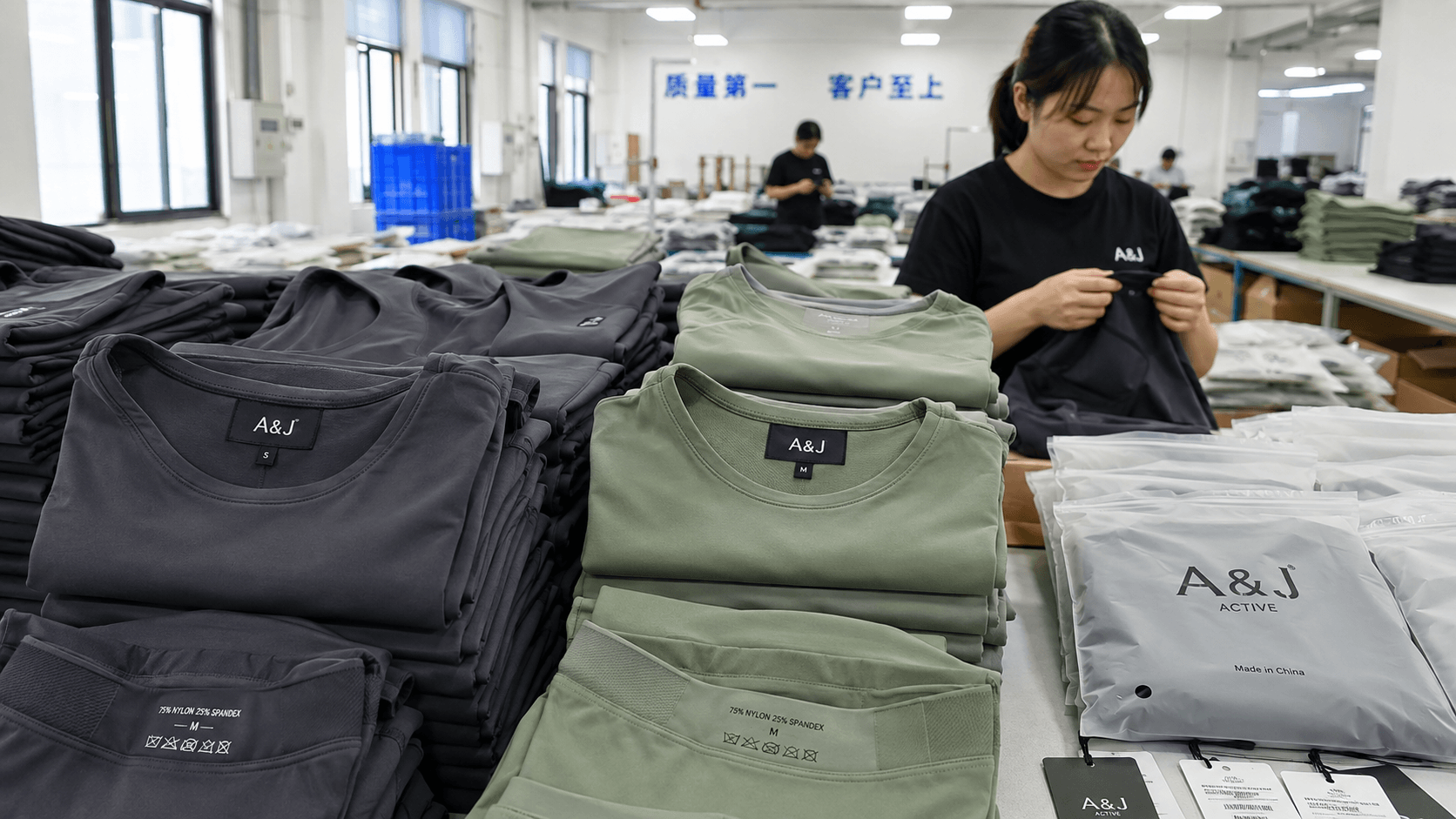
TL;DR: A private label activewear manufacturer builds to your pattern, your fabric spec and your labels — not a catalogue you rebrand. A&J runs four-way stretch and poly-spandex knits from Dongguan, China at a 50-piece minimum per colourway, with custom Pantone lab dips and recovery-tested seams. Founded 2006.
Activewear punishes shortcuts more than any other category. A woven dress that fits slightly loose still sells. A legging with 8% recovery loss after twenty wears comes back as a return. Choosing a private label activewear manufacturer means choosing a factory that measures the things a t-shirt factory never has to measure.

This guide covers what actually separates activewear production from ordinary cut-and-sew, and what to ask before you place a deposit.
A&J has run performance knits from Dongguan, China since 2006. The notes below come from production files, not from a brochure — they are the specifications our technicians argue about with brands every week.
What a Private Label Activewear Manufacturer Actually Controls
Private label means the pattern, the fabric specification and the branding belong to your programme. White label means you buy an existing body and add a label. Both are legitimate — we cover the full distinction in our private label vs white label guide.
In activewear the gap between the two is wider than in most categories:
| Element | White label | Private label |
|---|---|---|
| Pattern | Fixed body | Your block, graded to your fit model |
| Fabric weight | Whatever is stocked | Specified to gsm and composition |
| Colour | Stock card | Custom Pantone lab dip |
| Waistband height | Fixed | 5cm to 18cm, your call |
| Gusset | Often none | Diamond or four-panel |
| Pocket placement | Fixed | Positioned to your phone size |
| Lead time | 3-5 weeks | 8-12 weeks first run |
| Minimum | Often 100+ | 50 pieces per colourway |
A private label activewear manufacturer should be able to change any row in that right-hand column without telling you it is impossible. If three or more of those rows come back as fixed, you are being quoted white label with private label pricing.
The practical consequence is control over the two things that drive returns in this category: how the garment holds its shape after twenty washes, and whether the colour you approved is the colour that arrives. Neither is negotiable once bulk is cut, which is why a private label activewear manufacturer front-loads so much of the work into development.
How a Private Label Activewear Manufacturer Chooses Fabric
Most activewear complaints trace back to fabric choice, not sewing.
| Fabric | Weight | Composition | Suited to | Recovery |
|---|---|---|---|---|
| Nylon-spandex | 240-280gsm | 78/22 | Leggings, bike shorts | Highest |
| Poly-spandex | 200-240gsm | 87/13 | Training tops, sets | High |
| Brushed poly-spandex | 260-300gsm | 85/15 | Cold-weather sets | High |
| Ribbed nylon-spandex | 220-260gsm | 80/20 | Seamless-look sets | Medium-high |
| Poly-cotton blend | 180-220gsm | 60/40 | Studio and lounge crossover | Lower |
Two numbers matter more than the headline weight. Spandex percentage below 12% will not hold shape in a compressive legging. And opacity — a 240gsm nylon-spandex in black is opaque; the same construction in light grey often is not. Ask for a bend test on the actual dyed fabric, not the white greige.
Working with a private label activewear manufacturer that stocks these bases matters at low volume, because mill minimums for a custom knit start around 500-1000kg. Our stock programme is why 50 pieces is possible at all — the same structural logic explained in our small quantity production guide.
Knit structure sits underneath all of this and rarely appears on a quotation. A circular-knit jersey drapes softly and suits training tops; a warp-knit tricot is denser, more dimensionally stable and the correct choice for compressive leggings. Two fabrics can share the same 240gsm weight and the same 78/22 composition while behaving completely differently because of it, so ask your private label activewear manufacturer which structure a quoted base actually uses.

Seam Construction at a Private Label Activewear Manufacturer
| Seam type | Where it belongs | Why |
|---|---|---|
| Flatlock | Inseam, side seam, gusset | No raised ridge, no chafing |
| Coverstitch | Hems, waistband closure | Stretches without popping |
| Overlock 4-thread | Non-contact seams only | Faster, but leaves a ridge |
| Bonded | Smooth seamless look | No stitch holes, higher cost |
A private label activewear manufacturer running leggings on a plain lockstitch machine is a red flag you can spot in a sample within thirty seconds — run your thumb along the inseam. If you feel a ridge, it will chafe.
Stitch density should sit at 12-14 stitches per inch on stretch seams. Looser and the seam grins open under extension; tighter and the thread itself limits the stretch.
Thread choice matters as much as the machine. Textured polyester in the loopers gives a softer hand against skin and stretches with the fabric; a hard-twist thread will cut into the seam allowance during extension and eventually saw through it. A private label activewear manufacturer that cannot tell you which thread is loaded on the flatlock line is not running activewear as a specialism.
The gusset is the other tell. A diamond or four-panel gusset removes the four-way seam intersection at the crotch, which is both the most common failure point and the most common source of camel-toe complaints. Fixed white label bodies rarely have one.

Recovery Testing: the Spec Brands Forget
Stretch is easy. Recovery is the hard part, and it is where under-specified activewear fails.
| Test | Standard | Our target |
|---|---|---|
| Dimensional stability | AATCC 135 | 3% maximum after 5 washes |
| Colourfastness to perspiration | AATCC 15 | Grade 4 minimum |
| Colourfastness to rubbing | AATCC 8 | Grade 4 dry |
| Pilling | ASTM D3512 | Grade 4 at 30 min |
| Fabric extension and recovery | ASTM D2594 | 92% recovery minimum |
That last line is the one to write into your purchase order. A fabric can extend beautifully and still fail — if it recovers at only 85%, the knees bag out after a week. Any serious private label activewear manufacturer will have this data on file for its stock bases.
Test the finished garment, not only the roll. Cutting, seaming and heat setting all change how a knit behaves, so a fabric that passes at 94% recovery on the roll can land at 89% once it has been sewn and pressed. Ask for the wash test on a production sample from the same lot, and specify the detergent and water temperature — results shift by two to three percentage points between a 30C and a 60C wash.

Branding a Private Label Activewear Programme
| Item | Minimum | Note |
|---|---|---|
| Woven main label | 50 | Heat-transfer alternative for tag-free necks |
| Heat-transfer care label | 50 | Standard in activewear, avoids itch |
| Custom Pantone lab dip | 1 colourway | USD 40-80, recipe retained |
| Silicone waistband logo | 200 | Tooling amortised over reorders |
| Custom polybag | 500 | The one genuinely high-minimum item |
| Hangtag | 100 | Paper or recycled board |
The lab dip is the strongest low-volume differentiator available. A custom colour on a stock base costs USD 40-80 and takes 7-10 days, and we retain the recipe so reorders match. No white label programme can offer that.
Label placement deserves a decision rather than a default. Activewear has moved almost entirely to tag-free necks, so the woven main label that works on a woven dress becomes an irritant on a training top. The usual answer is a heat-transfer main label at the neck and a woven label at the side seam or waistband, where it sits against a thicker construction. Confirm with your private label activewear manufacturer that the transfer is rated for the fabric — a transfer cured for cotton will crack on nylon-spandex within a few washes.
Costing a Private Label Activewear Manufacturer Run
Development, charged once:
| Item | Cost (USD) |
|---|---|
| Pattern making per style | 55-110 |
| Grading across size run | 40-70 |
| Fit sample | 3-5x unit price |
| Lab dip per colourway | 40-80 |
| Silicone mould tooling | 90-150 |
Production, legging in 240gsm nylon-spandex, FOB:
| Quantity | Unit price (USD) |
|---|---|
| 50 | 13.80 – 16.40 |
| 150 | 11.60 – 13.50 |
| 400 | 9.70 – 11.20 |
| 800 | 8.40 – 9.60 |
The step from 50 to 400 pieces is roughly a 30% unit reduction. Full cost-line breakdown sits in our supplier evaluation guide.
Read the development column as a one-off entry cost rather than a per-unit cost. Spread across a 50-piece first run those charges look heavy; spread across the reorders that follow an approved fit and an approved colour, they disappear. This is the honest arithmetic of using a private label activewear manufacturer at low volume — the first run rarely wins on margin, and it is not supposed to. It buys you a graded block, a retained dye recipe and a tested seam construction that every subsequent order reuses at no further development cost.
Compliance for Activewear
Synthetic-heavy garments attract more chemical scrutiny than cotton. OEKO-TEX Standard 100 covers the finished garment against a defined substance list — see our OEKO-TEX certification guide and the wider certification hub for how the four certificate families differ.
Fibre content and care labelling must be in the destination language for the EU, and US shipments need an RN or company name on the label. A private label activewear manufacturer should handle this at the factory, not leave it to your warehouse.
Two claims need documentary support before they go on a hangtag. Recycled content requires chain-of-custody certification covering the specific yarn lot, not a general factory certificate — GRS is the usual route. Antimicrobial or moisture-wicking finishes need the treatment supplier’s test data, and that data must state the wash count at which performance was measured. Any private label activewear manufacturer quoting these finishes should supply both documents unprompted.
When Another Route Serves You Better
Be honest about volume and timing:
- Testing a concept in under four weeks — buy blanks and decorate. Private label cannot compress development.
- Seamless circular-knit bodies — this needs dedicated seamless machinery. We are cut-and-sew; ask a seamless specialist.
- Bra cup engineering with certified support claims — outside our scope.
- Single-piece custom sizing — we are a production factory, not a made-to-measure atelier.
For adjacent categories we do run, see our activewear programme hub, yoga set production and activewear bodysuit page. New to sourcing entirely? Start with how to find a clothing manufacturer.
Industry context on performance textiles is tracked by Textile Exchange and OEKO-TEX.

Frequently Asked Questions
What is the minimum order for a private label activewear manufacturer?
Fifty pieces per colourway. A three-colour legging programme is 150 pieces total. The limit is dyeing and cutting economics, not policy.
Which fabric works best for compressive leggings?
240-280gsm nylon-spandex at 78/22. It gives the highest recovery of the common bases and stays opaque in light colours where poly-spandex often does not.
How long does a first private label run take?
Eight to twelve weeks including pattern, fit sample and lab dip approval. Reorders in an approved colour run 25-35 days.
Do you keep our pattern if we leave?
Patterns developed at your cost belong to you. We release the digitised files on request, and we state this in writing before the deposit rather than waiting to be asked.
I have never made activewear before and I only want to test two colours of one legging — is that actually enough for you to take on, or will I be wasting your time?
It is enough. One legging in two colours is 100 pieces, which is a normal first order for us. What we would ask is that you allow the full development window rather than compressing it — the fit sample round is where first-time activewear programmes either get solved or get expensive.


Leave a Reply