
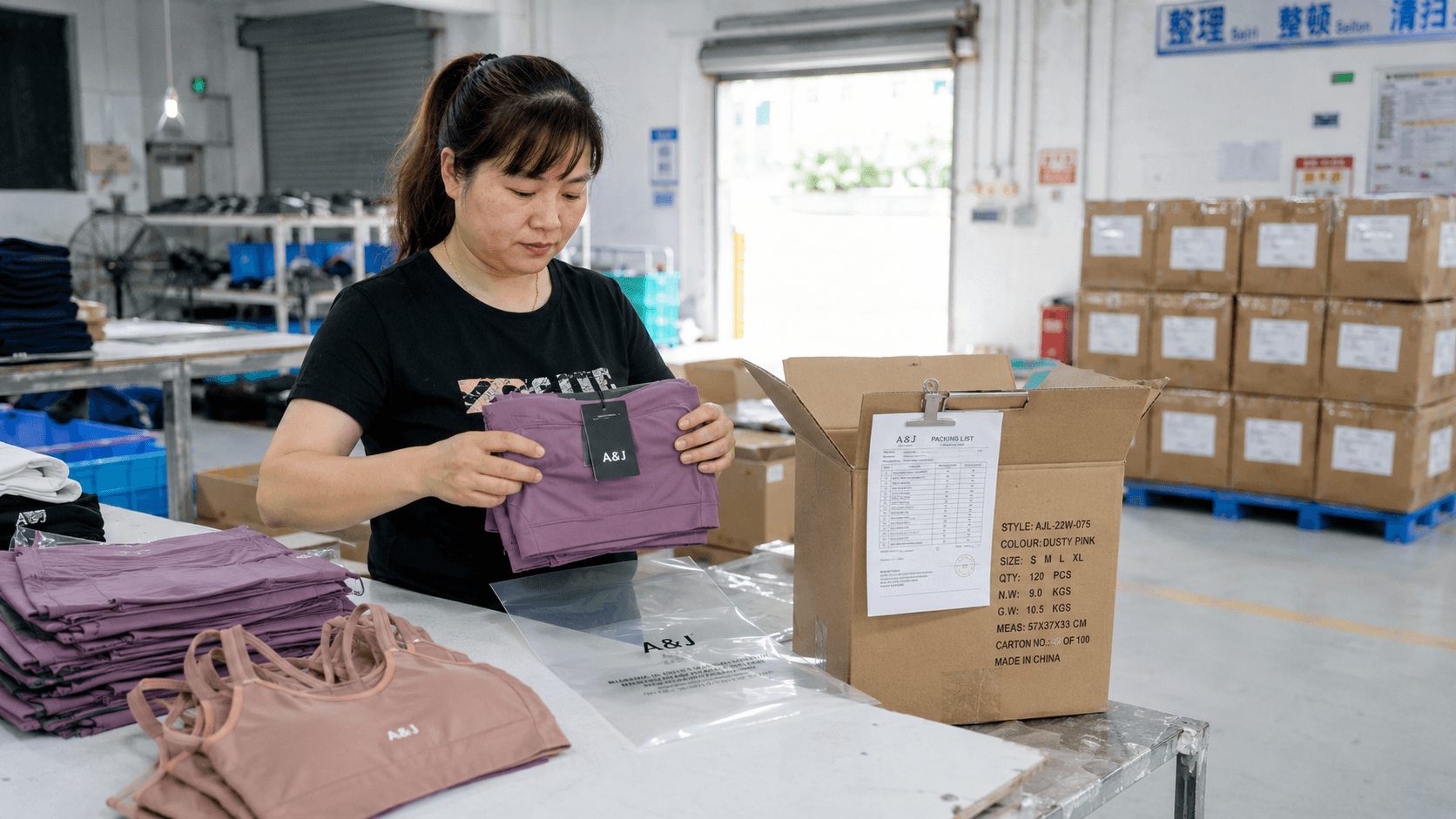
TL;DR: A&J International Apparel works as one of the activewear manufacturers for startups that holds a 50-piece minimum per style, producing from Dongguan, China since 2006. This guide covers what four-way stretch actually costs to develop, why performance fabric minimums break small orders, and the three situations where you should not commission custom activewear at all.
Activewear punishes new brands harder than any other category. A cotton tee forgives a loose measurement. A legging does not: the fabric recovers differently at every stretch percentage, the seam has to survive a squat, and the customer notices within one wear.
That is the real reason so few activewear manufacturers for startups exist at low volume. It is not unwillingness. It is that performance fabric arrives in dye lots sized for 800 pieces, and a factory without standing stock cannot break that. Every serious evaluation of activewear manufacturers for startups begins with that single constraint.

We are A&J International Apparel, founded in 2006 in Dongguan, China. This is written from the factory floor, and it includes the cases where we would tell you to go elsewhere.
What Separates Activewear Manufacturers for Startups From General Apparel Factories
A general clothing factory can sew a legging. Whether it holds up after twenty washes is a different question, and it comes down to equipment and testing rather than skill. This is the line that divides activewear manufacturers for startups from general apparel contractors willing to try.
| Requirement | General apparel line | Activewear-capable line |
|---|---|---|
| Flatlock seaming | Rarely equipped | Standard, 4-thread flatlock |
| Coverstitch waistband | Basic 2-needle | 3-needle with elastic feed |
| Bonded seams | Not available | Heat-press, no stitch perforation |
| Gusset construction | Improvised | Patterned diamond or scoop gusset |
| Stretch recovery testing | Not performed | ASTM D2594 after 5 cycles |
| Moisture management claim | Unverified | AATCC 195 tested |
If a factory cannot name the test standard behind a claim, the claim is marketing. That single question filters most candidates faster than any certificate audit, and it is the first thing to ask any activewear manufacturers for startups shortlist you assemble.
The Fabric Problem That Defines Activewear Manufacturers for Startups
Performance knits are engineered, not commodity. A nylon-spandex blend at 240gsm with a specific stretch ratio is a mill-programmed construction, and mills run them in dye lots of 600 to 1,000 metres per colour. This is the structural barrier that most activewear manufacturers for startups never solve.
At 50 pieces you need roughly 90 to 130 metres. The mill will not cut that. So the factory has three options, and which one it uses tells you what kind of operation it is.
- Refuse the order. Most bulk factories do this politely by quoting a 500-piece minimum.
- Charge you for the full dye lot. You pay for 900 metres, use 120, and store the rest.
- Cut from standing stock. The factory already owns the fabric and absorbs the inventory risk.
Only the third option makes low-volume activewear economically sane, and it is the reason genuine activewear manufacturers for startups are rare. We hold a standing programme across roughly 18 performance qualities, which is what allows the 50-piece floor. It also means your colour choice is constrained to what we stock, and that trade-off is the honest cost of the model.
Brands that need a bespoke Pantone should expect to fund a full dye lot or move to 400+ pieces. There is no third path, and any factory promising custom colour at 50 pieces without a surcharge is either absorbing a loss or planning to substitute.
Development Costs Activewear Manufacturers for Startups Charge Separately
Activewear carries a heavier development load than woven categories, because fit has to be validated in motion rather than on a mannequin. Expect activewear manufacturers for startups to itemise these lines separately rather than burying them in the unit price.
| Line item | Typical range | Why activewear differs |
|---|---|---|
| Pattern making | USD 85-160 per style | Stretch factor calculated per fabric |
| Grading | USD 55-90 per style | Recovery varies across size range |
| Fit samples | 2-4 rounds | Motion testing, not just static fit |
| Lab dip | USD 40-70 per colour | Synthetics dye differently to cotton |
| Stretch recovery test | USD 60-120 | ASTM D2594, per fabric |
Budget USD 350-600 in development per activewear style. That is meaningfully above the USD 200-400 typical of a woven top, and it is the number most new brands miss when they compare quotes.
The pattern is reusable. Your second order in the same block carries none of this, which is why the reorder economics with activewear manufacturers for startups improve sharply after the first run. Our page on small quantity womens clothing manufacturer sets out the full cost curve from 50 to 2,000 pieces.

What to Send Before Approaching Activewear Manufacturers for Startups
An activewear enquiry needs more technical detail than a general apparel one. Sending these six items turns a fortnight of email with activewear manufacturers for startups into a same-week quote:
- Fabric target — composition, gsm, and stretch direction (two-way or four-way)
- Compression level — light, medium or firm, with a reference garment if possible
- Intended activity — yoga, running and training have different seam and coverage demands
- Size range with grading intent — activewear grading is not linear
- Waistband construction — encased elastic, folded coverstitch, or bonded
- Any claim you intend to market — moisture wicking, squat-proof, UPF, so testing can be scoped
Point six matters legally as much as technically. A claim printed on your hangtag needs a test result behind it. Our tech pack for clothing guide covers the nine sections and the measurement tolerances that make a package usable in production.
Sampling Timeline for Activewear Manufacturers for Startups
Activewear sampling runs longer than woven categories, and compressing it is where small brands lose money. Realistic activewear manufacturers for startups will quote the full cycle rather than the optimistic one.
| Stage | Duration | Note |
|---|---|---|
| Pattern and first sample | 12-18 days | Stretch factor requires a physical trial |
| Fit and motion review | 7-12 days | Must be worn and moved in, not just tried on |
| Second sample | 10-14 days | Gusset and waistband corrections are common |
| Lab dip approval | 10-18 days | Synthetics need more rounds than cotton |
| Stretch recovery test | 5-8 days | Runs parallel where possible |
| Pre-production sample | 7-10 days | Made on the bulk line |
Six to ten weeks of sampling, then 30-45 days of bulk. A realistic first activewear order is 14-20 weeks from signed quote to shipped goods. Any factory quoting eight weeks total has skipped the recovery test or the pre-production sample.
Construction Standards Worth Specifying
Hold your factory to numbers rather than adjectives. These are the figures we build to, and they transfer to any of the activewear manufacturers for startups you compare us against.
- Four-thread flatlock at 12-14 stitches per inch on all body seams
- Three-needle coverstitch waistband, elastic fed under tension, 32-38mm width
- Diamond or scoop gusset patterned separately, never a folded seam intersection
- Stretch recovery above 92% after five wash cycles, tested to ASTM D2594
- Colourfastness to perspiration graded to AATCC 15, minimum grade 4
- Opacity verified under stretch at 30% elongation, not at rest
That last point is the one that generates returns. Squat-proof is not a fabric property, it is a combined result of gsm, knit density and dye depth. It has to be verified on the actual production fabric.

Compliance and Testing Do Not Scale Down
Fifty pieces carry the same obligations as five thousand, and no arrangement with activewear manufacturers for startups shifts that duty off the brand. For activewear specifically, three areas catch new brands.
- Fibre composition labelling in the destination language, mandatory across the EU under Regulation 1007/2011 and in the US under FTC rules
- Performance claims need documented test results; an unsupported wicking claim is an advertising exposure
- Chemical compliance matters more in synthetics, where finishes and coatings are common
Third-party certification is how buyers verify activewear manufacturers for startups without visiting the floor. Our certified womens clothing manufacturer hub explains which certificates cover chemical safety versus fibre origin versus social audit. Any OEKO-TEX certificate number can be checked in the public database in about a minute, and Textile Exchange publishes the recycled content standards in full, which matters if you are marketing recycled nylon.
When You Should Not Use Activewear Manufacturers for Startups at All
Three situations where custom production is the wrong tool and activewear manufacturers for startups cannot help you. We would rather say this than take the order.
You have not validated the concept. If you have never sold a garment, buying blank activewear and adding your logo tests demand at a fraction of the cost. Our comparison of private label vs white label clothing explains the boundary. We do not hold a blanks range, so this is a referral away from us.
You need a bespoke colour at 50 pieces. As covered above, the dye lot economics do not permit it. Either fund the lot, move to 400+ pieces, or select from stock.
Your design depends on proprietary fabric technology. Branded performance fabrics are licensed to specific mills at volume commitments. A first-run brand cannot access them, and a factory claiming otherwise is substituting a generic equivalent.
Where A&J Fits in Activewear
We are a womenswear factory in Dongguan, China, founded in 2006, running a 50-piece minimum per style with flatlock, three-needle coverstitch and bonded seam capability in-house. That vertical setup is what lets us operate as one of the activewear manufacturers for startups rather than a bulk house that occasionally accepts a short run.
Our activewear work sits in the womens activewear program hub, with category detail in the activewear manufacturer page, the wholesale yoga set manufacturer programme, the custom activewear bodysuit manufacturer page, and the private label activewear manufacturer guide for brands putting their own label on our blocks. Brands earlier in the process should read clothing manufacturer for startups first, and how to find a clothing manufacturer covers supplier vetting in seven steps.
We are a poor fit for menswear, footwear, compression medical garments, and any brand needing weekly replenishment. We will say so on the first call.
One point to settle in writing before any deposit: patterns developed at a brand’s cost belong to that brand, and we release digitised files on request. Ask every factory on your list the same question. The ones that hesitate have told you something.

How to Test Two Factories Against Each Other
Sample the same style at two suppliers simultaneously. Comparing two activewear manufacturers for startups side by side costs one extra sample, which is trivial against a wrong decision at bulk.
Score four dimensions in this order: honesty about timing, quality of the questions they ask, measurement accuracy against your spec, and finishing quality inside the garment. The first two predict bulk performance better than the last two.
For activewear specifically, add one test: ask both activewear manufacturers for startups to state the stretch recovery percentage they will guarantee and the standard they test to. A factory that answers with a number and a standard is running the test. A factory that answers with reassurance is not.

Frequently Asked Questions
What minimum order quantity do activewear manufacturers for startups typically require?
Most quote 300-500 pieces per style because performance fabric dye lots are sized that way. A&J runs 50 pieces per style by cutting from standing stock across roughly 18 performance qualities, which constrains colour choice but removes the dye lot barrier.
How much does developing a first activewear style cost?
Budget USD 350-600 per style in development, covering pattern, grading, fit samples, lab dip and stretch recovery testing. This is higher than the USD 200-400 typical of woven categories because fit must be validated in motion.
Which tests should activewear manufacturers for startups run before bulk production?
Stretch recovery to ASTM D2594 after five cycles, colourfastness to perspiration to AATCC 15, and opacity verification under 30% elongation. If you intend to market moisture wicking, add AATCC 195.
Can I get a custom Pantone colour on a 50-piece activewear order?
Not without funding a full dye lot, which runs 600-1,000 metres. At 50 pieces the sensible route is selecting from standing stock, then moving to custom colour once you reach 400+ pieces per colourway.
Can I start with just one legging style at 50 pieces and add more styles later once it sells?
Yes, and that is the pattern we see work most often. One style at 50 pieces across four sizes gives real sell-through data, and because the pattern and grading carry forward, adding a second colourway or scaling to 300 pieces later carries no repeat development cost.


Leave a Reply