
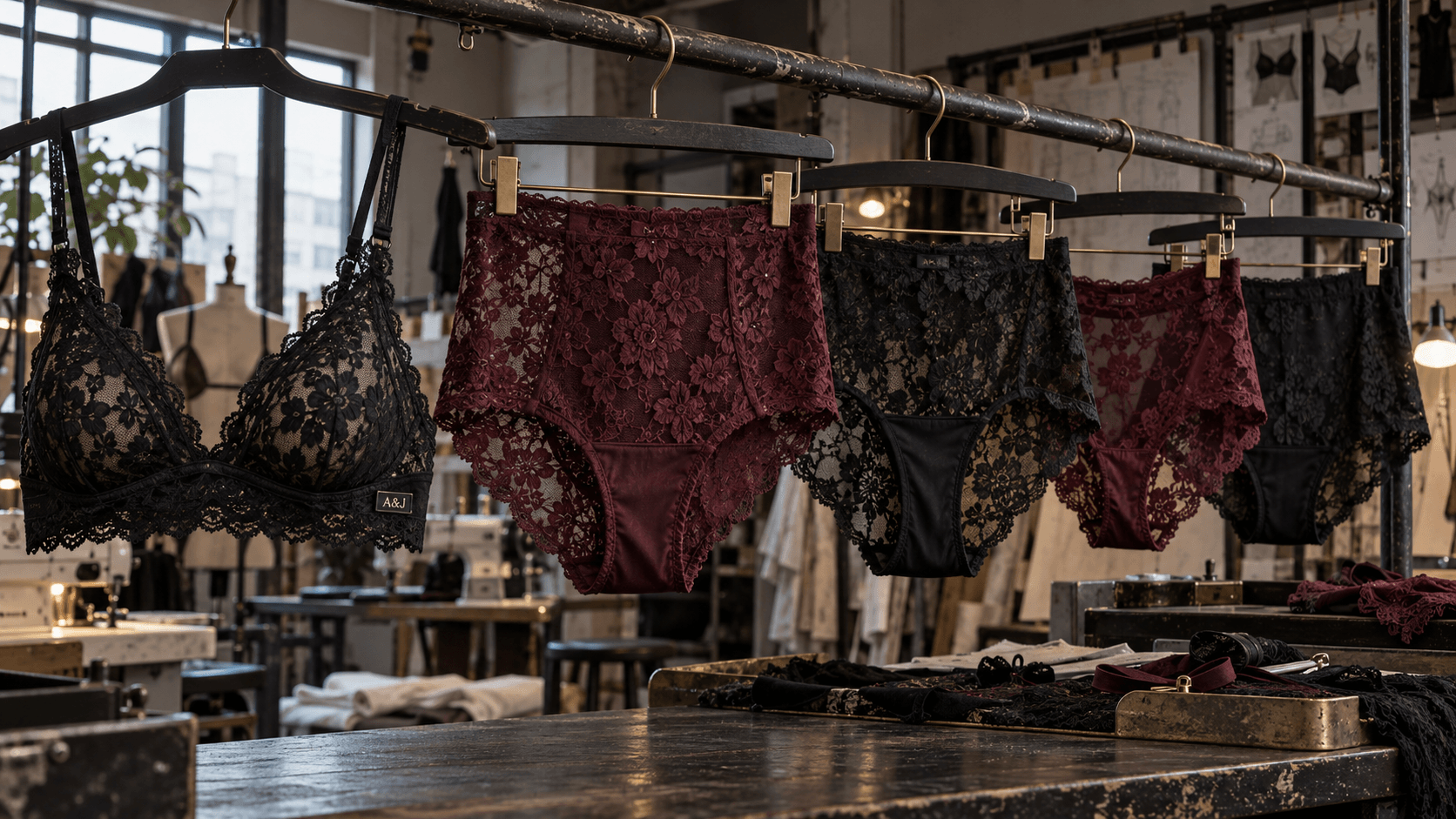
TL;DR: A lace underwear manufacturer should control six connected zones: lace identity, scallop placement, motif matching, lining and gusset construction, elastic openings, and shade-plus-reorder records. A&J International Apparel is a cut-and-sew factory founded in 2006 in Dongguan, China, with a 50-piece minimum for suitable womenswear programs.
A lace underwear manufacturer must turn a visually delicate concept into repeatable production evidence. Floral direction, scalloped borders, openwork areas, lining coverage and elastic tension can shift the look even when the basic pattern remains unchanged. The practical solution is a six-zone control file linking the approved lace, pattern placement, construction sample, fit observations, care basis and reorder identity.

This page covers cut-and-sew lace briefs, high-waist briefs, boyshorts and coordinated bralettes where appropriate. It does not claim seamless circular knitting, medical compression, complex moulded-cup engineering or disposable hygiene production. The mature visual direction comes from lace scale, scallop architecture, layered color and refined finishing—not unsupported comfort or performance claims.
Lace Underwear Manufacturer Zone 1: Freeze Lace Identity
“Black floral lace” is not a production specification. Two articles may share color and fiber wording while differing in motif scale, repeat, openwork, edge structure, stretch direction and usable width. The first release file must connect the design to one approved supplier code, color, received lot and physical swatch.
The material page should sit inside the tech pack for clothing. It needs face-side identification, motif orientation, usable direction, scalloped-edge location and any paired lining or elastic. If the lace changes after sampling, motif placement and construction evidence must be reviewed again.
| Lace field | Approval needed | Release status |
|---|---|---|
| Supplier identity | Article code and source | Record before sampling |
| Motif repeat | Approved physical swatch | Measure per received lot |
| Stretch direction | Pattern placement direction | Confirm before marker |
| Scalloped border | One edge or two edges | Record usable layout |
| Color and lot | Approved shade reference | Match current release |
| Paired lining | Color, construction and face | Confirm per style |
A lace underwear manufacturer should reject a substitute selected only from a small photograph. The replacement may alter motif scale, transparency pattern, edge shape or usable direction, changing both appearance and consumption.
Zone 2: Map Scallops and Motif Placement
Scalloped lace gives the garment a finished visual edge, but only when the pattern is engineered around it. Moving a front or back piece by a small amount may shift the floral center, remove a scallop peak or leave both sides visually unbalanced. Each major panel therefore needs an approved placement map rather than a generic instruction to “use the border.”

The lace underwear manufacturer should retain a marked pattern or photographed placement reference for the approved size. It should identify the center line, side seam, scallop start point and direction of the dominant floral feature. Larger and smaller sizes need deliberate rules because a motif cannot simply scale with the pattern.
| Placement zone | Visual decision | Evidence |
|---|---|---|
| Center front | Center motif or controlled offset | Approve marked pattern |
| Center back | Direction and visual balance | Approve rear layout |
| Side seams | Match, mirror or controlled break | Record per style |
| Waist edge | Scallop or applied elastic | Freeze construction route |
| Leg opening | Border path and curve response | Approve edge sample |
| Size progression | Motif rule across sizes | Confirm before grading |
The garment grading workflow helps separate size growth from motif decisions. A larger size may require a different placement window while retaining the same visual hierarchy.
Lace Underwear Manufacturer Zone 3: Control Symmetry and Cutting
Lace can make asymmetry obvious. The production marker must show whether paired pieces are mirrored, whether a motif is intentionally centered and which areas can tolerate variation. “Match all flowers” is not executable because the lace repeat, usable width and pattern shape may not support exact matching everywhere.
The lace underwear manufacturer should establish priorities. Center-front balance may be mandatory, while minor variation near a side seam may be acceptable if the approved reference shows the allowed window. This approach protects the strongest visual feature without pretending every openwork detail can be identical.
| Cutting control | Required record | Decision wording |
|---|---|---|
| Face direction | Nap or directional rule | Confirm before spreading |
| Paired pieces | Mirror requirement | Mark on pattern |
| Center motif | Target window | Approve visual reference |
| Scalloped edges | Cut path and usable edge | Match released layout |
| Defect avoidance | Hole, snag and yarn-break rule | Record during cutting |
| Bundle identity | Color, size and lot | Maintain through sewing |
A contrast backing sheet can be placed under the lace during inspection to make yarn breaks, openwork and edge damage easier to see. This is a viewing aid, not evidence of a universal defect rate or inspection result.
Zone 4: Engineer Lining, Gusset and Seams
The refined look depends on what sits behind the lace. Full lining, selective lining and an unlined lace panel produce different color depth and motif visibility. The gusset lining, seam allowance direction and edge enclosure also affect the finished interior. These choices need a face-and-reverse construction reference.
A lace underwear manufacturer should seal one sample showing the approved lining boundary, gusset sequence, side seam, label position and elastic finish. The record must distinguish visually intentional openwork from an accidental construction gap. Claims about feel should not replace auditable seam and material specifications.

| Construction point | Evidence retained | Release wording |
|---|---|---|
| Front lining | Full, partial or not used | Confirm per approved design |
| Back lining | Coverage boundary | Mark on pattern |
| Gusset lining | Material and attachment sequence | Record before bulk |
| Side seam | Seam type and allowance direction | Match sealed sample |
| Label position | Attachment and location | Approve placement |
| Decorative join | Stitch and motif relationship | Confirm machine setup |
The official OEKO-TEX STANDARD 100 page explains that requirements become stricter as contact with skin becomes more intensive. Any certification claim still requires verification of the actual article, scope and validity; a general supplier statement is not enough.
Lace Underwear Manufacturer Zone 5: Release Elastic Openings
Lace appearance can be lost if the waist or leg finish over-gathers the motif, flattens the scallop or creates an uneven wave. Pattern edge length, elastic length, application method, stitch choice and operator handling work as one system.
The lace underwear manufacturer needs a setup reference for every opening route. A scalloped edge left visible requires a different construction decision from an applied elastic edge. The record should use order-specific approved values rather than publishing a universal tension ratio.
| Opening route | Control item | Approval point |
|---|---|---|
| Visible scallop | Edge stability and joining point | Approve construction sample |
| Fold-over elastic | Width, color and application face | Confirm before sewing |
| Picot elastic | Decorative edge orientation | Match sealed sample |
| Enclosed elastic | Channel and join construction | Record per style |
| Waist join | Position and overlap method | Approve setup sample |
| Leg opening | Curve handling and visual wave | Record observed result |

Fit evaluation should examine wearing position, coverage, side balance, gusset position and opening response under the buyer’s defined review process. Comments must identify the exact zone and sample version. A vague request to “make it more flattering” cannot be transferred reliably into pattern or elastic changes.
Zone 6: Validate Shade, Care and Reorder Identity
Black, burgundy and deep jewel tones make lace visually distinctive, but the lace, lining, elastic and thread still need a controlled shade relationship. The approved standard should state whether components must match closely or create an intentional tonal layer. Bulk review should compare the complete garment, not isolated components under unrelated lighting.
Care instructions also need evidence for the complete construction. The U.S. Federal Trade Commission states that care instructions require a reasonable basis and must account for non-detachable lining, trim and details. The official FTC Care Labeling Rule guidance establishes that method boundary; it does not prove that a specific A&J order passed testing.
AATCC TM150 describes measurement of garment length and width changes after home laundering and notes that the method may not apply to certain stretch fabrics. Buyers should choose an applicable method and conditions for the actual lace construction. The AATCC TM150 summary can support that discussion without being used as invented enterprise data.
| Archive item | Required content | Status wording |
|---|---|---|
| Shade standard | Lace, lining, elastic and thread relationship | Approve under defined light |
| Care basis | Method, conditions and sample ID | Confirm applicable method |
| Visual review | Motif, scallop, seams and color | Enter observed result |
| Packing sample | Fold, insert, label and unit pack | Approve before packing |
| Released BOM | Current component codes and lots | Archive current release |
| Reorder map | Pattern, placement and construction versions | Record every approved change |
A lace underwear manufacturer should archive the released lace swatch, placement map, marker rule, pattern, BOM, construction sample, care basis and packing reference together. “Same floral lace as before” is not a reorder specification if the supplier code or lot has changed.
Quote the Lace System, Not Just the Silhouette
Comparable quotations require the same input. Buyers should send the silhouette, size range, lace article, scallop route, lining plan, elastics, colorways, labels, packing method, intended market and required evidence. The lace underwear manufacturer can then separate confirmed scope from development work and exclusions.
| Quote input | Include | Exclude until confirmed |
|---|---|---|
| Style scope | Brief, high-waist brief, boyshort or bralette | Unlisted future styles |
| Lace | Article, color and scallop route | Unapproved substitutions |
| Placement | Center, mirror and matching priorities | Undefined all-over matching |
| Construction | Lining, gusset, seams and elastics | Unspecified alternatives |
| Development | Pattern, sample and size-set scope | Undefined revision rounds |
| Packing | Unit and carton requirements | Unspecified retail fixtures |
A&J uses a 50-piece minimum for suitable programs, but lace availability, usable border, color and trim constraints still need order-level confirmation. The small quantity womens clothing manufacturer page explains why flexible production still depends on material and setup realities.
When Another Manufacturing Route Serves You Better
A&J is suited to cut-and-sew lace briefs, high-waist briefs, boyshorts and selected soft bralettes with clear specifications. Another route is more appropriate for seamless body-mapped products, medical compression, disposable articles, highly engineered moulded-cup systems or one-unit demand testing.
The lingerie manufacturer page covers the wider product family, while the private label lingerie manufacturer page addresses development levels, cup-and-band architecture and asset ownership. This lace underwear manufacturer page remains specific to motif, scallop, lining and edge control.

Frequently Asked Questions
What should a lace underwear manufacturer receive before quoting?
A lace underwear manufacturer should receive the silhouette, size range, lace article, colorways, scallop plan, lining and gusset specifications, elastics, labels, packing method, intended market and required evidence. Unknown fields should be marked for development or confirmation.
How does a lace underwear manufacturer control floral placement?
The factory should retain a marked placement reference showing motif direction, center line, side seams, scallop start points and matching priorities. Grade rules must explain how that visual hierarchy changes across sizes without assuming that the motif scales with the pattern.
Which lace components need lot and shade control?
Lace, lining, gusset material, waist elastic, leg elastic, thread and labels should connect to approved component references and received lots where relevant. The complete garment should be reviewed for intentional matching or tonal contrast.
What care evidence should support lace underwear labeling?
The care basis should cover the complete garment under a method and conditions applicable to its lace, lining, elastic, seams and labels. Record measurement points and observed appearance instead of copying unsupported wash or durability claims.
Can I use one floral placement map for every size if the lace article stays unchanged?
Not automatically. The buyer and lace underwear manufacturer should review motif position, scallop path, coverage and seam relationships across the size set, then document approved placement rules before bulk cutting.


Leave a Reply