
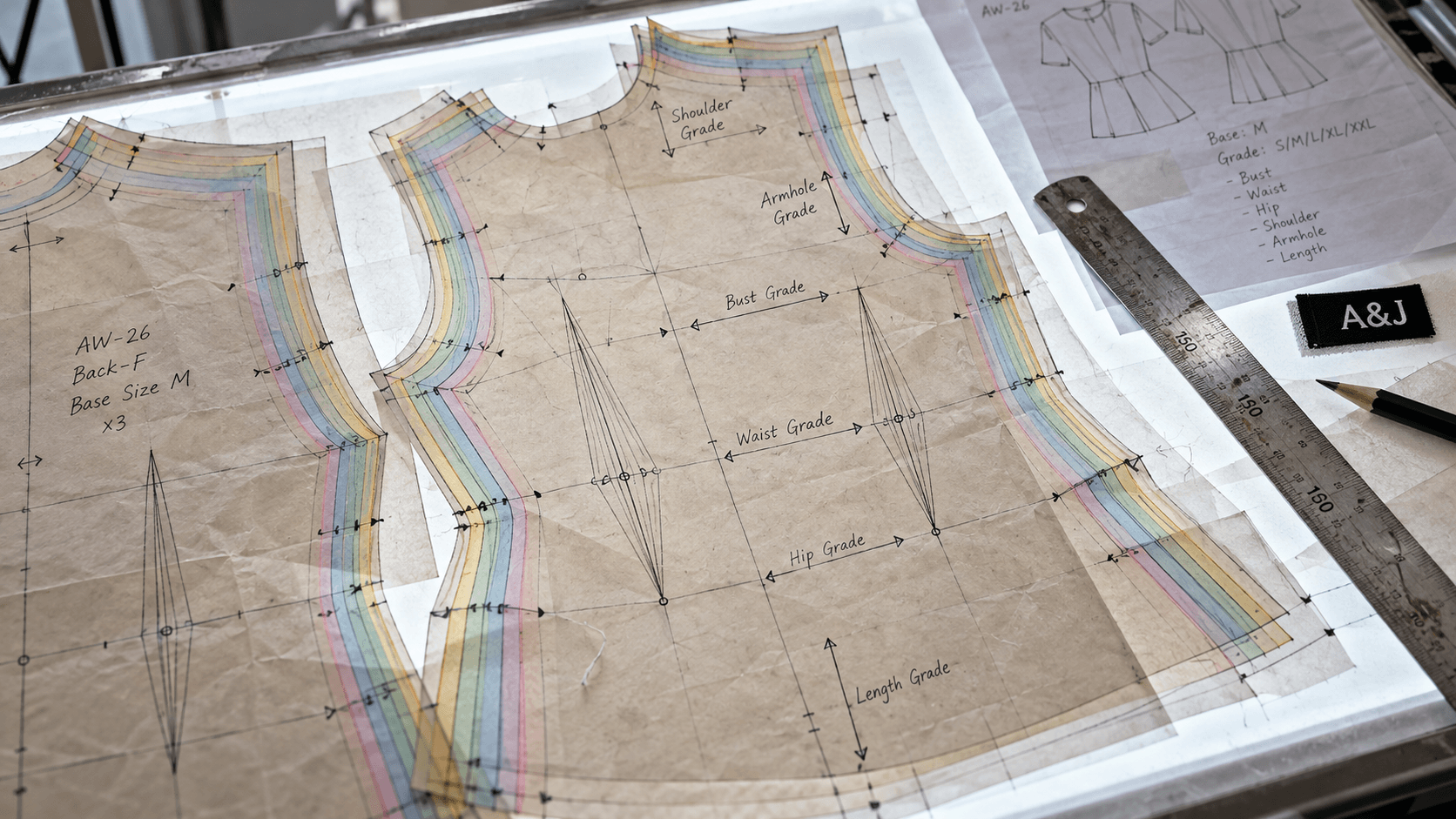
TL;DR: What is garment grading? It is the controlled process of turning one approved base-size pattern into a planned size range by applying point-specific grade rules, then checking those sizes through measurement and fitting. A&J International Apparel, founded in 2006 in Dongguan, China, uses buyer-approved measurement files and samples to support womenswear programs from a 50-piece minimum; the brand still owns the final size chart, fit direction and release decisions.
If you ask what is garment grading before ordering several sizes, the useful answer is not “making a pattern larger or smaller.” Grading changes different pattern points by different amounts so the neckline, shoulder, bust, waist, hip, rise, sleeve and length remain coherent across the intended customer range. It begins only after the base size is approved. It ends only after the grade rules, nested patterns, size-set measurements and release records agree.

This guide explains the file chain a buyer can review without pretending that one universal size table suits every market, body profile or garment category. The working sequence is base-size approval, measurement mapping, rule assignment, nested-pattern review, size-set sampling, care-response review and bulk release.
What Is Garment Grading in Apparel Manufacturing?
What is garment grading in production terms? It is a rule-based translation between an approved sample size and the other sizes offered for sale. Each important pattern point receives an increment or decrement. Those movements create a family of patterns while preserving the intended silhouette, balance and function.
Grading is not the same as fitting. Fitting corrects the base garment for the intended wearer and design. Grading distributes that approved fit logic across a size range. It is also not the same as simply scaling an image. If every line grows by one percentage, a neckline may become too open, a shoulder too wide, a pocket too low and a hem too long at the same time.
A production-ready answer to what is garment grading therefore includes four connected assets:
| Asset | What it controls | Release evidence |
|---|---|---|
| Approved base pattern | The original fit, balance and construction | Signed sample and current pattern version |
| Measurement specification | Named points of measure and finished-garment targets | Approved measurement chart with method notes |
| Grade-rule table | Change by point and size step | Current rule version linked to the pattern |
| Size-set record | Whether selected graded sizes perform as intended | Measured samples, fit comments and approval status |
These assets should share one style code and version. A nested pattern without the matching rule table is difficult to audit. A measurement chart without a stated measuring method can produce disputes even when both parties use the same numbers.
The Approved Base Size Comes Before Grading
The base size is the controlled starting pattern, not an average of every future customer. A brand chooses it according to its market, fit model, product category and commercial size architecture. One womenswear label may develop dresses from size M, while another uses size S or a numeric size. The letter itself matters less than the approved body and garment assumptions behind it.
Before asking what is garment grading for a style, confirm that the base sample has passed these gates:
- The intended silhouette is approved in front, side and back views.
- Key movement actions suit the garment, such as sitting for trousers or reaching for active dresses.
- Finished garment measurements match the current specification within agreed tolerances.
- Construction details, seam allowances, closures, pockets and internal components are fixed.
- The material and care route represent the intended bulk product.
- All fit comments have been closed or deliberately carried forward as named exceptions.
Grading an unresolved base pattern multiplies the unresolved problem. A shoulder imbalance in one size becomes a family of imbalances. That is why the clothing sample cost guide separates fit approval from later sample stages, and the tech pack for clothing guide treats the measurement sheet and pattern references as controlled production inputs.

What Is Garment Grading Through Point-Specific Rules?
A stronger answer to what is garment grading focuses on grade points rather than generic size labels. A grade point is a controlled location where a pattern edge moves between sizes. The movement may be horizontal, vertical or both. Adjacent points must still create a sewable curve or seam that matches its partner piece.
For example, increasing bust circumference does not mean moving only the side seam. The required change may interact with the armhole, shoulder, dart, princess seam or panel line. A trouser hip change affects side seam, rise shape, pocket position and sometimes leg balance. A dress with an integrated inner short needs two connected grade systems that still join correctly.
| Pattern area | Rule question | Evidence to record |
|---|---|---|
| Neckline and shoulder | How much width and drop change per size? | Coordinate movement by grade point |
| Bust and armhole | How is circumference distributed across panels? | Front/back allocation and seam matching |
| Waist and hip | Is growth linear across the full range? | Size-step rule by zone |
| Sleeve | How do bicep, cap and length remain compatible? | Sleeve-to-armhole seam check |
| Rise and crotch | How do depth, extension and curve change? | Front/back balance review |
| Pockets and trims | Do position and component size change? | Placement rule or fixed-size decision |
| Garment length | Is length graded every size or by size group? | Vertical increment and exception note |
The rule table should never be reverse-engineered from a visual nest alone. It should identify the current base size, offered size range, units, points of measure, increments, exceptions and approver. If plus sizes use a different body block or non-linear increments, record the break rather than forcing one rule through the entire range.
Build a Measurement Map Before the Pattern Nest
For what is garment grading to be auditable, a measurement map must connect finished-garment checks to pattern changes. Names must be unambiguous. “Width” is not enough; “half chest measured 2.5 cm below armhole” defines a repeatable location and method. The same discipline applies to waist, hip, thigh, rise, bicep, sleeve, inseam and garment length.
When a buyer asks what is garment grading at the specification stage, the measurement map should answer:
- Which points control fit and which are reference-only?
- Are measurements full circumference or half measurement?
- Is the garment relaxed, stretched or fastened during measurement?
- Does the measure include rib, elastic, binding or other components?
- Which dimensions use a constant step and which use a changing step?
- Which sizes form the first size set for physical review?
A&J does not impose one anonymous chart on every womenswear order. The buyer can provide a proprietary chart, an approved reference garment or a target-market brief. The working chart must then be reconciled with pattern geometry and product function. For category context, compare the fitting logic used in womens pants manufacturing, tennis dress production and maternity clothing development. Their grading priorities differ even when a few measurement names overlap.
Use a Size Set to Test the Grading Logic
A practical explanation of what is garment grading needs a size set: selected graded garments that verify the range before bulk release. It need not include every offered size, but it should expose whether the rule behaves as intended. Inspect the approved base, smaller and larger boundaries, and any size at a block change or unusual increment. Record the selection in the order file.

For what is garment grading to be testable, a size-set review should separate three questions:
| Review layer | Check | Status wording |
|---|---|---|
| Measurement | Does each named point meet the approved target? | Enter measured result |
| Fit and movement | Does the design retain its intended balance and function? | Record per reviewed size |
| Construction | Do graded seams, components and placements remain compatible? | Confirm before bulk release |
This is where what is garment grading becomes observable rather than theoretical. A measurement can be within tolerance while a pocket looks too low on the smallest size. A sleeve and armhole can each match their numeric target while their curves sew together poorly. A skirt can gain hip width yet lose visual balance because length, opening or panel proportions did not change coherently.
Comments should identify size, location, issue, requested action, owner and version. Avoid a note such as “make L better.” A usable comment reads more like: “Size L front armhole shows excess at the lower curve during forward reach; pattern team to review front-only distribution without changing approved bicep target.”
What Is Garment Grading After Material and Care Response?
Pattern rules control planned geometric change, but material and care can alter the sewn result. Stretch recovery, relaxation, shrinkage, skew and construction may affect sizes differently, especially across unlike panel orientations or component materials.
The AATCC TM150 summary describes a method for determining garment length and width changes after home laundering under standard parameters. It does not provide an A&J result and may not apply to every stretch garment. Use the current approved method, conditions and acceptance criteria for the actual product, then attach measured results to the order file.

For what is garment grading to remain valid after care, record:
- Material identity and lot for each reviewed sample.
- Pre-care and post-care measurement method.
- Test or care procedure used.
- Actual result by size and measurement point.
- Pattern compensation decision, if any.
- Re-test status after a rule or material change.
Do not copy an unverified shrinkage allowance into every style. The fabric sourcing decision system explains why material identity and lot control must travel with garment evidence. If the fiber content, care instruction or origin statement changes, the label file also needs review. The FTC textile labeling guidance explains U.S. requirements concerning fiber content, country of origin and responsible business identity.
What Is Garment Grading as a Versioned Release?
The final answer is a traceable release, not merely pattern files. The factory, buyer and quality team must know which version governs cutting and which evidence approved it.
Use this release chain:
- Freeze the approved base pattern and sample reference.
- Freeze the measurement chart and measuring method.
- Issue the grade-rule table with base size, range and exceptions.
- Generate nested patterns and verify seam compatibility.
- Produce the selected size set from identified materials.
- Record measurements, fit observations and closed corrections.
- Release the approved pattern, chart, rule and size-set record together.
- Link bulk checks and repeat orders to that same release version.
The clothing manufacturing process places this control before cutting, while the garment quality control checklist carries approved measurement and sample references into production inspections. For a first production run, the small-quantity womenswear guide shows how the 50-piece minimum can support controlled market testing without reducing documentation discipline.

When a Different Sizing Route Is More Suitable
Not every project should begin with a full proprietary grade. If a brand is testing only a graphic concept on an existing blank, a blank supplier’s established size system may be more suitable. If a product requires true seamless body mapping, fully fashioned knit programming, medical compression or individual made-to-measure tailoring, a specialist route is needed. A standard cut-and-sew grade should not be presented as equivalent.
Likewise, what is garment grading cannot solve an undefined target customer. If the brand has no body assumptions, fit reference, market feedback or decision owner, creating more sizes adds files but not clarity. Start with a base-size brief and a testable measurement map. A&J is suitable when the order is a cut-and-sew womenswear program with an approvable base sample, controlled materials and a defined size range. The factory should not invent the brand’s customer profile in place of buyer approval.
Frequently Asked Questions
What is the difference between garment grading and fitting?
Fitting corrects the base garment for the intended body, silhouette and movement. Grading applies approved point-specific rules to create additional sizes. If the base fit remains unresolved, grading multiplies that uncertainty across the range.
Which files are required for garment grading?
Use an approved base pattern, finished-garment measurement chart with measuring methods, grade-rule table, nested pattern set and size-set approval record. Keep the style code, size range, units, material identity and version aligned across the files.
How many sizes should a size set include?
There is no universal count. Select the approved base, boundary sizes and any size where the block or increment changes. Record the chosen sizes and the reason for selection before samples are made.
How does washing affect garment grading?
Care can change garment dimensions after the planned pattern grade is applied. Use the approved material, procedure and acceptance criteria; measure identified samples before and after care; then document whether pattern compensation or re-testing is required.
Can I approve one base-size sample and skip the size set if my measurement chart already looks complete?
You can issue a chart, but skipping physical size-set evidence leaves proportion, movement, seam compatibility and placement risks untested. For what is garment grading to become a production release, selected graded sizes should be measured and reviewed before bulk cutting.


Leave a Reply