
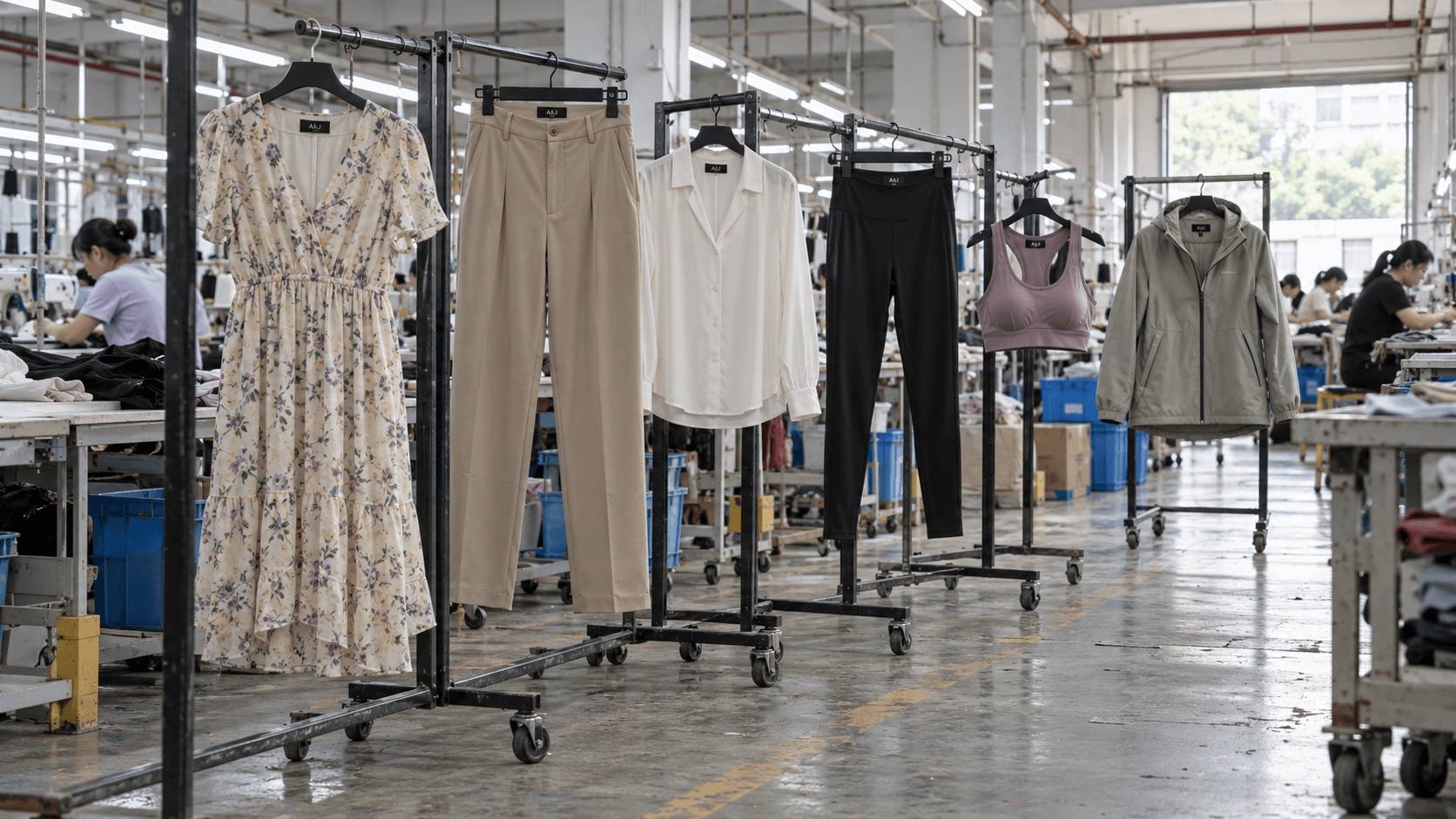
TL;DR: A garment quality control checklist should connect the approved sample, incoming materials, cutting and decoration, sewing, finishing and final inspection in one traceable record. A&J International Apparel has produced womenswear in Dongguan, China since 2006 with a 50-piece minimum per style. This guide provides blank inspection fields rather than invented defect rates, sample sizes or pass results.
A garment quality control checklist is not a final-day tick sheet. It is an order-level control file that states what was approved, when each production gate is checked, how a finding is identified and who closes the action. A final inspection cannot repair a wrong fabric lot, shifted pattern or repeated seam defect after every piece is complete.

This article covers ordinary cut-and-sew womenswear. Product-specific safety, medical, protective, children’s or regulated performance requirements need an additional compliance plan. Each brand must define the destination market, product claim, acceptance criteria and authorised release owner before production begins.
What Is a Garment Quality Control Checklist?
A garment quality control checklist is a controlled record linking six inspection gates to the same purchase order, style, colour, size range, material lot, pattern revision and approved sample. It prevents one team from approving colour while another checks construction against an obsolete file.
| Gate | Evidence to identify | Decision before moving forward |
|---|---|---|
| 1. Approved reference | Tech pack, pattern, BOM, colour, sample and comments | Is one current standard frozen? |
| 2. Incoming material | Supplier, article, colour and received lot | Does the received material match the approved identity? |
| 3. Cutting and decoration | Marker, ply, panel direction and artwork | Are cut parts and decoration tied to the correct revision? |
| 4. Sewing | Operation, seam, measurement and in-line finding | Is the process stable before defects multiply? |
| 5. Finishing and packing | Pressing, labels, care copy and assortment | Is the sale-ready configuration correct? |
| 6. Final inspection | Defined sample, defect record and release authority | Is the order released, held or corrected? |
Start with the tech pack for clothing guide, which explains how measurements, BOM, construction and revisions are written. The clothing manufacturing process maps the wider production sequence; this page turns its control points into inspectable evidence.
A useful form contains identification fields, the requirement, the observation, defect location, quantity observed, photograph reference, containment action, corrective action, owner, due date and closure status. A checkbox without those fields proves that someone looked, not that the risk was controlled.
Gate 1: Freeze the Approved Reference Before Inspection
Quality control starts by defining the correct answer. Freeze the purchase order, style code, tech-pack revision, pattern revision, BOM, size chart, colour standard, artwork, label copy, packing instructions and signed physical sample. Mark superseded files clearly so they cannot return to the line.
A garment quality control checklist should name one controlling revision for every gate. If the approved sample differs from the digital file, stop and resolve the conflict instead of letting the inspector choose. Record who approved the decision and when the updated reference became effective.
| Reference field | Required entry | Status |
|---|---|---|
| Purchase order / style | ______ | Open / frozen |
| Tech-pack revision | ______ | Open / frozen |
| Pattern and grade revision | ______ | Open / frozen |
| BOM revision | ______ | Open / frozen |
| Colour and artwork standards | ______ | Open / frozen |
| Approved sample identifier | ______ | Open / frozen |
| Release owner and date | ______ | Open / frozen |
The clothing manufacturer selection guide explains why parallel sampling and revision discipline predict bulk performance. Reference control remains necessary even for the flexible production structure described in the small-quantity womenswear guide; a 50-piece run does not justify an incomplete specification.
Gate 2: Inspect Incoming Material by Identity and Intended Use
Incoming inspection confirms identity before material becomes irreversible cut parts. Record supplier, article, composition statement, structure, width, weight requirement, colour, finish, received lot, roll or bundle identifiers and the approved use within the garment.

Separate visual, dimensional and claim-related checks. Shade continuity, surface faults and usable width are not the same question as fibre content, restricted-substance scope or dimensional change after care. A certificate can support a defined claim, but it cannot prove that an unlinked delivery lot matches the approved garment material.
Use the fabric sourcing decision system to build supplier, swatch, test, claim and bulk-lot records. If certification matters, the certified womenswear manufacturer hub separates chemical safety, fibre sourcing, management systems and social due diligence.
The AATCC standards directory lists methods including TM8 for crocking, TM15 for perspiration colourfastness and TM61 for accelerated laundering. Select a method from the product risk and destination requirement; never copy an unstated pass value into the garment quality control checklist.
| Incoming-material finding | Requirement | Observation | Lot / roll | Action / owner |
|---|---|---|---|---|
| Identity and article | ______ | ______ | ______ | ______ |
| Shade and surface | ______ | ______ | ______ | ______ |
| Width / weight | ______ | ______ | ______ | ______ |
| Trim function | ______ | ______ | ______ | ______ |
| Claim document scope | ______ | ______ | ______ | ______ |
| Test reference | ______ | ______ | ______ | ______ |
Gate 3: Use the Garment Quality Control Checklist at Cutting and Decoration
Cutting controls grain, nap, stripe or print direction, panel count, notches, drill points, shade separation and marker revision before sewing hides the cause. Record the cut bundle, size, colour, material lot, marker code and first-part comparison.
Check artwork against the approved file, physical position reference, scale, colour route and application method. A print or embroidery can be visually centred on one size and drift across the graded range. Inspect representative sizes and confirm whether artwork crosses a seam or high-stretch zone.

A garment quality control checklist should connect a cutting or decoration finding to affected bundles rather than the whole order by assumption. Contain the identified range, verify the last acceptable piece, correct the process and inspect the first corrected output before restarting.
| Cutting / decoration field | Entry |
|---|---|
| Marker and pattern revision | ______ |
| Bundle, size, colour and lot | ______ |
| Grain / nap / print direction | ______ |
| Notch and panel alignment | ______ |
| Artwork file and placement | ______ |
| First corrected output | ______ |
| Containment range | ______ |
| Closure owner / date | ______ |
Gate 4: Control Sewing Through First Output and In-Line Findings
Sewing inspection should identify the operation, seam location, stitch or construction requirement, thread route, measurement point and surrounding material. Generic notes such as “sewing issue” cannot guide a correction or prove closure.
Begin with first output after a style, colour, size, material or machine-setting change. Compare it with the approved sample and current file. During production, record recurring findings by operation and bundle so the team can contain work before the same defect reaches finishing.
A measurement outside its tolerance is one finding; uneven gathering, puckering, open seam, skipped stitch, twisted panel or incorrect attachment is another. Do not combine different causes under one defect name. Record the visible condition, exact location, affected size or bundle and evidence photograph.
Build a closed correction loop around the first affected output. The garment quality control checklist should identify the last confirmed acceptable bundle, the first known affected bundle, work already moved downstream and stock waiting at the operation. After adjustment, retain the corrected piece beside the original finding and verify the next defined output before reopening production. A spoken instruction such as “watch this seam” is not closure because the next shift cannot see the cause, action or approved result.
For recurring findings, the garment quality control checklist should separate temporary containment from root correction. Rechecking finished pieces contains existing risk; changing a guide, pattern, method, attachment or training step addresses future output. Record both actions, their owners and independent verification. This distinction prevents a passed reinspection from being mistaken for proof that the process itself is stable.
The womens pants manufacturing map shows how waist, hip-crotch, leg, pocket and closure blocks interact. The sports bra manufacturing guide adds underband, strap, neckline, armhole and movement-linked controls. These product pages help convert one generic checklist into style-specific inspection points.

Gate 5: Verify Finishing, Labels and Packing Configuration
Finishing inspection confirms that pressing, thread removal, closures, attachments, surface appearance, labels, care copy, folding and packing match the released order. It must distinguish a cosmetic finishing issue from a construction defect that cannot be pressed away.
For U.S. sales, the FTC’s textile labeling guidance covers fibre content, country of origin and responsible-business identity. Its Care Labeling Rule guidance requires a reasonable basis for care instructions. The destination-market owner must approve final wording and language requirements.
Match the sewn label, hangtag, barcode, polybag mark, size sticker and carton assortment to the same style-colour-size data. Record actual placement and attachment rather than approving a loose label card. If packaging claims recycled content, certification or special handling, verify the scope separately from garment quality.
Gate 6: Final Inspection, Defect Records and Release Authority
Final inspection verifies the completed order against frozen requirements; it does not replace process control. Define the lot, inspection stage, sampling plan, acceptance rule, defect classification and release authority before the inspector begins.
A garment quality control checklist may reference a recognised sampling system, but it must not invent the sample size or acceptance number. ISO 2859-1 describes sampling procedures indexed by an acceptance quality limit for lot-by-lot inspection. The buyer and qualified quality team must select the inspection level and acceptance conditions for the actual product and risk.
Use defect classes only after defining them for the style. A condition affecting safety or legal compliance, a condition making the product unusable or unsaleable, and a minor appearance deviation do not carry the same consequence. Add photographs and location descriptions so another reviewer can reproduce the decision.
| Final inspection record | Entry |
|---|---|
| Lot identity and quantity | ______ |
| Sampling standard / plan | ______ |
| Inspection level | ______ |
| Acceptance conditions | ______ |
| Sample size | ______ |
| Critical / major / minor definitions | ______ |
| Findings by class | ______ |
| Result: release / hold / correct | ______ |
| Authorised approver / date | ______ |
A&J does not claim an order-level pass rate or inspection outcome without the corresponding records. Blank fields remain blank until the specific purchase order, quantity, product risk and agreed sampling plan are known.
How to Build a Garment Quality Control Checklist in Seven Steps
- Identify the order. Record purchase order, style, colour, size range, quantity and destination market.
- Freeze current references. List the controlling tech pack, pattern, BOM, artwork, labels and approved sample.
- Define six gates. Assign incoming, cutting-decoration, sewing, finishing-packing and final checkpoints after reference approval.
- Write observable criteria. Replace “good quality” with a measurable requirement, location, method or approved comparison standard.
- Define finding fields. Capture defect, location, affected range, photograph, containment, correction, owner and due date.
- Set release authority. Name who may approve materials, restart production, close corrective action and release the order.
- Archive the reorder pack. Retain the completed garment quality control checklist with approved files, material identity and signed changes.

A complete archive lets the next order compare changes against evidence rather than memory. Keep the original finding and the closure proof; deleting the first record makes the correction impossible to audit.
Frequently Asked Questions
What should a garment quality control checklist include?
It should include order identity, approved revisions, material lots, six inspection gates, observable requirements, findings, affected range, photographs, containment, corrective action, owner, closure and release authority.
When should garment quality control begin?
It begins before bulk work, when the brand freezes the tech pack, pattern, BOM, colour, artwork, labels and approved sample. Incoming and process checks then prevent late discovery.
How are garment defects recorded?
Record the visible condition, exact location, style-colour-size, bundle or lot, observed quantity, photograph, requirement, containment range, corrective action, owner, due date and closure evidence.
Does a garment quality control checklist replace an AQL sampling plan?
No. The checklist organises requirements and evidence. The buyer and qualified quality team must separately define the lot, sampling standard, inspection level, sample size and acceptance conditions.
Can I use one garment quality control checklist for trousers, dresses, leggings and sports bras without changing the inspection points?
Use one six-gate framework, but add product-specific controls. Trousers need waist, crotch, leg and closure checks; stretch garments need material response, movement and seam-extension evidence.


Leave a Reply