
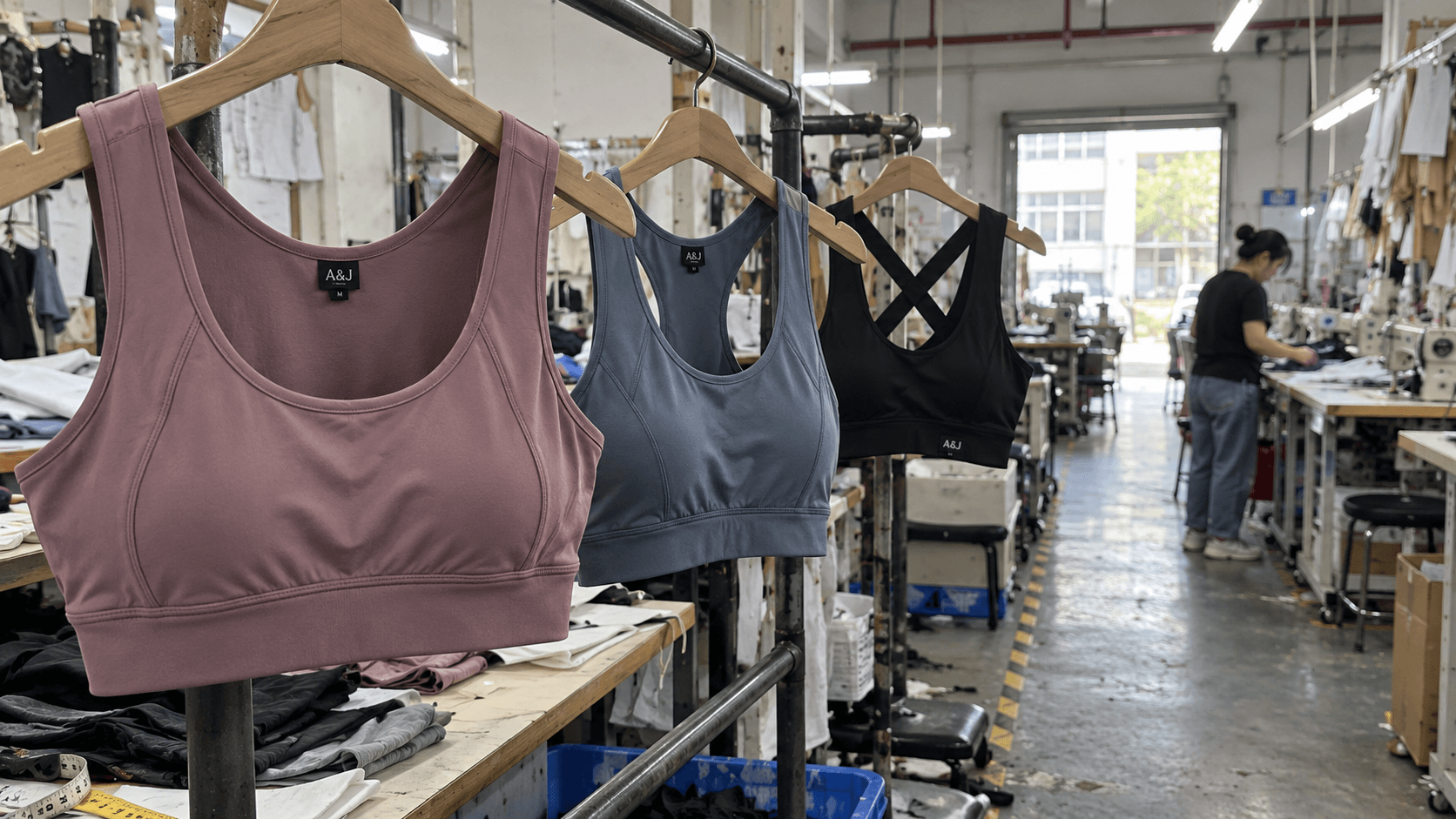
TL;DR: A sports bra manufacturer should release more than one standing fit sample. A controlled cut-and-sew program links six motion points: underband, straps, front and soft-cup structure, neckline and armhole, back, and movement-plus-care evidence. A&J International Apparel has produced cut-and-sew womenswear in Dongguan, China since 2006 with a 50-piece minimum per style. This guide provides blank testing fields rather than unsupported support, recovery, opacity or wash-life claims.
A sports bra manufacturer turns stretch materials, elastics, body movement and a size range into one repeatable garment. A sample can look balanced in a mirror yet lift at the underband, dig at the strap, gape at the neckline, compress unevenly, expose seam bulk, or change after care. A static front photograph cannot release those linked risks.

This page covers cut-and-sew soft-cup sports bras and activewear crop tops. It does not claim medical compression, impact-protection certification, complex molded-cup engineering or seamless body mapping. Every support statement needs a defined use case, sample size, material identity, movement protocol and acceptance field.
Why a Sports Bra Manufacturer Needs a Six-Point Motion File
A sports bra is not released by fabric stretch alone. The underband anchors the garment, straps route load, front structure distributes volume, neckline and armhole edges control coverage, the back changes stability and entry, and care can alter every relationship. A sports bra manufacturer should connect these decisions in one file so a change in one area triggers review of the others.
| Motion point | Evidence to freeze | Risk if left open |
|---|---|---|
| 1. Underband | Elastic identity, length, join, tension and position | Riding, rolling or pressure |
| 2. Straps | Width, material, adjustment, angle and attachment | Digging or slipping |
| 3. Front / soft cup | Panel shape, lining, pocket and optional pad route | Uneven volume or shifting |
| 4. Neckline / armhole | Edge finish, coverage and stretch route | Gaping, cutting or exposure |
| 5. Back | Racerback, crossback, scoop or closure architecture | Restricted entry or weak stability |
| 6. Motion / care | Named actions, sizes, sample state and after-care record | Unsupported performance claims |
Start with the tech pack for clothing so every pattern, measurement, elastic and stitch route has a revision owner. Use the fabric sourcing system to record supplier, article, lot, structure, finish and intended panel instead of approving a generic “performance fabric.”
Point 1: Stabilise the Underband Without Guessing Tension
The underband is a system rather than a finished circumference. Record elastic supplier and article, width, thickness, surface, stretch direction, join type, overlap, seam allowance, attachment stitch, cut length and garment position. If an internal elastic is enclosed by self-fabric, list both components and the construction route.
A sports bra manufacturer should not solve riding by shortening the band without checking fabric recovery, front-to-back balance, body reference and edge construction. A shorter elastic may improve one size while creating pressure, seam distortion or a difficult entry path in another. The approval record must tie the underband to the exact sample size and fabric lot.
Use a blank underband record:
| Field | Approved entry | Review condition |
|---|---|---|
| Sample size / pattern | ______ | Correct revision identified? |
| Elastic article / lot | ______ | Same as intended production input? |
| Cut length / join | ______ | Method and overlap recorded? |
| Attachment route | ______ | Stitch and feed condition defined? |
| Standing observation | ______ | Level, rolling or local pressure? |
| Motion observation | ______ | Lift or displacement during named action? |
| After-care entry | ______ | Change measured under stated method? |
The table is a template, not an A&J test result. Any allowable change, pressure target or recovery threshold must be supplied or approved for the specific product.
Point 2: How a Sports Bra Manufacturer Routes the Straps
Straps connect the front, shoulder and back. Their angle changes with neckline width, back style, cup volume and body proportions. Record strap width, material, elasticity, length, adjustment range, ring and slider identity if used, attachment point and reinforcement. A narrow strap, wide self-fabric strap and bound shoulder route do not share one grading rule.

Review the strap on the body rather than only on a hanger. Observe whether it moves toward the neck, falls toward the shoulder edge, twists at a ring, creates local pressure or pulls the neckline. A sports bra manufacturer should document left and right behaviour during overhead reach and torso rotation because asymmetry may reveal attachment or sewing-feed variation.
For size transitions, a sports bra manufacturer should define whether strap width stays fixed, increases, or changes construction. The same slider may not serve every width. If hardware is specified, record finish, colour, contact surface and lot. Do not infer skin comfort or durability from appearance alone.
Point 3: Build Front and Soft-Cup Structure as a Layered System
A cut-and-sew front may use a single shell, shell plus lining, compression panel, separate cup pieces, removable-pad pocket or fixed soft insert. Each route changes seam bulk, stretch, opacity, drying and care. Record the purpose of every layer instead of treating lining as a hidden substitute material.
A sports bra manufacturer should map each layer to pattern code, grain or stretch direction, seam route and size range. For removable pads, define pocket opening, pad orientation, size allocation and whether the pad is packed inserted or separate. For no-pad routes, do not promise coverage from fabric colour or weight alone; evaluate the complete sewn sample under agreed conditions.
| Front-system field | Entry | Release question |
|---|---|---|
| Shell article / lot | ______ | Is stretch direction marked? |
| Lining article / lot | ______ | Is purpose and coverage defined? |
| Panel or cup code | ______ | Does it match the pattern revision? |
| Pad route | ______ | None, removable or fixed? |
| Pocket opening | ______ | Can it remain flat through movement? |
| Seam and edge route | ______ | Is bulk controlled at junctions? |
| Opacity protocol | ______ | Which light, colour, stretch and sample state? |
The leggings manufacturing guide uses a related evidence principle for stretch bottoms, but waist, gusset and lower-body movement do not replace sports-bra underband, strap and upper-torso review. The womens activewear program connects this top route to broader material, fit and reorder controls.
Point 4: Control Neckline and Armhole Coverage Through Motion
Neckline and armhole shape affects coverage, entry and edge pressure. Record finished depth, width, armhole position, binding or elastic route, overlap, stitch and the body landmarks used for review. Edge measurements alone cannot show what happens when the shoulder and torso move.

Use named actions: overhead reach, forward reach, side bend, torso turn and controlled jog. Record neckline gaping, armhole cutting, edge rolling, underarm seam movement and front displacement. A sports bra manufacturer should identify the sample size, pattern revision, fabric lot, lining and underband for every observation. “Good support” is not a useful production record because it hides the test condition and location.
The same neckline cannot be copied automatically from a casual crop top. If the product is primarily fashion or lounge, say so. If the brand intends running, court, studio or low-impact use, name that context and define its evidence. A&J should not convert an untested marketing adjective into a performance guarantee.
Point 5: Release the Back Architecture and Entry Route
Racerback, crossback, scoop back, keyhole and hook-and-eye routes distribute tension differently. Record back pattern pieces, strap junctions, closure, reinforcement, seam intersection, entry method and whether adjustment is available. Check the garment during dressing and removal as well as wear.
A sports bra manufacturer should review whether the user can enter without overstretching the neckline, strap or underband. For pullover styles, the entry path may be the highest extension event. For closure styles, hardware position and backing can affect skin contact and local bulk. Keep these observations separate from support claims.
The private-label activewear manufacturing guide explains how product files, material identity and ownership support repeat orders. The wholesale yoga set guide provides a coordinated top-and-bottom route when colour, fabric and fit must remain aligned across a set.
Point 6: How a Sports Bra Manufacturer Records Motion and Care
A motion file needs the sample state, wearer or form reference, garment size, material lot, pattern revision, action, view, observation and approver. Use representative sizes chosen for the actual range rather than assuming that the middle size predicts every transition. Record problems by location and action so the pattern or construction team can respond.
AATCC’s official standards directory lists methods including TM135 for dimensional changes after home laundering, TM8 for crocking and TM15 for perspiration colourfastness. These sources identify methods; they do not provide a universal support, opacity, recovery or wash-life limit for every sports bra. The brand must define sample condition and acceptance criteria.
After care, compare underband, strap length, neckline, armhole, body dimensions, seam appearance and removable-pad behaviour with the approved pre-care record. A sports bra manufacturer should distinguish dimensional change from fit perception and material recovery. Unknown results stay blank until an identified sample is evaluated.

For U.S. sales, the FTC’s textile labeling guidance addresses fibre content, country of origin and responsible-business identity. Its Care Labeling Rule guidance requires a reasonable basis for care instructions. If harmful-substance certification is requested, verify the holder, article, product class, component scope and validity under OEKO-TEX STANDARD 100.
Release the Bulk and Reorder Archive
The production release should connect the six-point motion file to the BOM, pattern, grade, material identity, elastic and hardware records, labels, care copy and physical sample. Compare incoming materials and first production output against those references. Record any approved change with date, reason and owner.

A usable reorder archive includes:
| Asset | Required content | Owner |
|---|---|---|
| Product brief | Use context, silhouette, size range and market | Brand |
| Pattern / grade | Six-point revisions and representative sizes | Pattern team + brand |
| BOM | Shell, lining, elastic, binding, thread, labels and hardware | Factory + brand |
| Motion file | Actions, sample state, observations and approval | Brand + fit team |
| Care / test plan | Methods, conditions and acceptance fields | Market owner |
| Bulk sign-off | Material lot and first output comparison | QC + brand |
| Reorder record | Final files, physical reference and change history | Named custodian |
The small-quantity womenswear guide explains why a controlled 50-piece production run still needs full development and inspection discipline.
When Another Production Route Serves You Better
A&J International Apparel is suited to cut-and-sew soft-cup sports bras and activewear crop tops made from roll goods, elastics, linings and sewn panels. True seamless body-mapped products require circular-knitting specialists. Complex molded cups, underwires and multi-axis cup-size systems may require a dedicated bra engineering supplier. Medical compression and protective products need product-specific claims, facilities and validation beyond ordinary activewear.
A one-piece personalised item, instant print-on-demand launch or untested concept without a defined support context may be better served by a sample room or blank activewear route first. A sports bra manufacturer cannot replace the brand’s responsibility to define intended use, claims, test conditions, labelling market and rights to any artwork.
How to Order from a Sports Bra Manufacturer in Seven Steps
- Define the use context. State silhouette, activity, size range, coverage, entry route and target market.
- Freeze material identity. Record shell, lining, elastic, binding, hardware, colour, lot and care intent.
- Build the six-point pattern file. Link underband, straps, front, edges, back and motion requirements to one revision.
- Fit representative samples. Review named sizes during entry, standing, reaching, turning and controlled movement.
- Approve test and care plans. Define methods, sample state, conditions and blank acceptance fields before evaluation.
- Release bulk references. Compare materials and first output with the approved sample, BOM and motion file.
- Archive the reorder pack. Retain pattern, grade, BOM, test records, labels, physical reference and signed revisions.
Frequently Asked Questions
What should I send to a sports bra manufacturer?
Send the intended activity, silhouette, size range, measurements, pattern or drawing, shell and lining brief, underband and strap details, back route, labels, care market, testing needs and quantity.
How should sports bra support be evaluated?
Define the activity, sample size, wearer or form reference, garment revision, material lot, named movements, observation locations and acceptance fields. Do not rely on one unsupported support adjective.
Can one sports bra pattern cover every size?
One base can begin the range, but underband, straps, front volume, armhole, neckline and back relationships may need non-linear grading and representative physical fit checks.
Which materials should a sports bra manufacturer record?
Record the shell, lining, elastic, binding, thread, labels, hardware and optional pad or pocket materials by supplier, article, colour, lot, structure and intended location.
Can I order just 50 pieces while using custom colours, removable pads and several strap constructions in one sports bra style?
The 50-piece minimum applies per style, while fabric, dye, elastic, hardware and pad constraints remain separate. Freeze one controlled configuration or request a written allocation plan before sampling.


Leave a Reply