
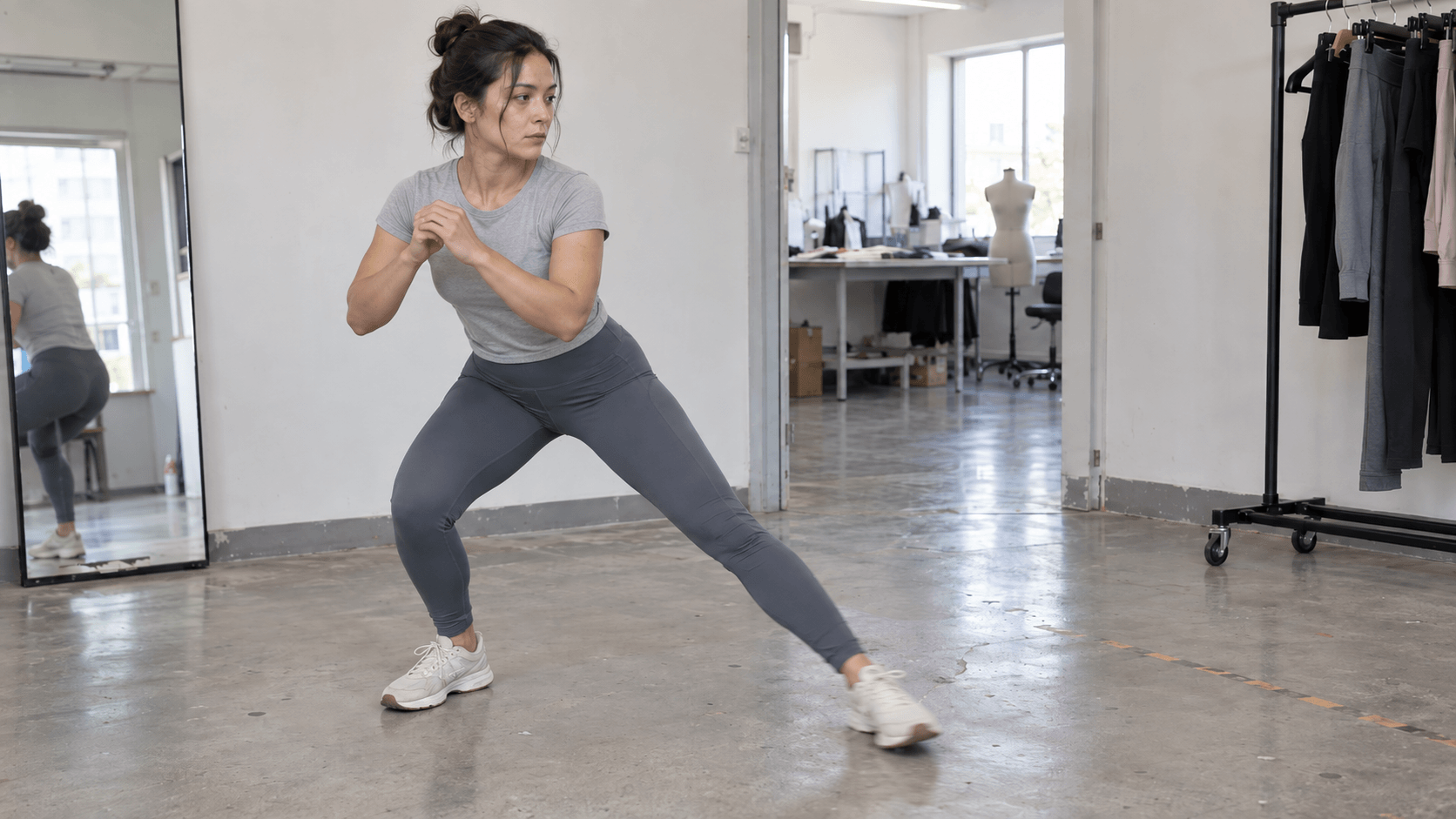
TL;DR: A leggings manufacturer should release more than one waist-and-hip measurement. A production-ready program needs six linked fit zones: waistband, abdomen, seat, gusset and crotch, knee, and ankle. Each zone must connect pattern shape, fabric stretch and recovery, seam behaviour, opacity, movement, and after-care dimensions. A&J International Apparel has provided cut-and-sew womenswear manufacturing in Dongguan, China since 2006 with a 50-piece minimum per style; seamless circular-knit and medical compression programs require different specialists.
A leggings manufacturer turns a close-fitting garment into a repeatable system. A sample can look smooth while standing and still roll at the waist, become transparent when bent, pull at the crotch, bag at the knee, twist after care, or change between fabric lots. Approving only the front view hides these risks.

This guide uses a six-zone release ledger rather than universal stretch percentages or compression claims. Every target should come from the product brief, intended market, selected fabric and approved sample. The tables below are blank decision structures, not A&J laboratory results.
What a Leggings Manufacturer Should Control
A cut-and-sew leggings program joins fabric, pattern, elastic, seam and care behaviour. None can be approved alone. A leggings manufacturer must separate extension from recovery because high extension without recovery may cause knee bagging. Strong recovery without sufficient pattern ease may increase pressure or restrict movement. A wide waistband can still roll if its layers, elastic, seam and body pattern do not work together.
| Control layer | Required record | Failure if omitted |
|---|---|---|
| Product use | Activity, coverage, rise and support intent | Wrong fit and material route |
| Fabric identity | Supplier, article, colour, lot and finish | Sample-to-bulk drift |
| Directional behaviour | Widthwise and lengthwise extension plus recovery | Distorted fit or restricted movement |
| Pattern version | Base size, grade rule and zone measurements | Untraceable fit changes |
| Seam system | Stitch, thread, needle, feed and elastic attachment | Popping, waving or chafing |
| Care route | Method, conditions and acceptance fields | Shrinkage, twist or surface change missed |
The fabric sourcing system separates material identity from marketing descriptions. The clothing tech pack guide then connects the approved article to measurements, construction and revision ownership.
Zone 1: Stabilise the Waistband Without Roll-Down
The waistband is a layered structure, not a single circumference. Record finished height, top edge, lower join, elastic type if used, layer count, seam allowance, feed ratio, side-seam position and any internal pocket. A high-rise waist also needs a body reference point so “high rise” means the same thing in every size.
For a leggings manufacturer, roll-down diagnosis should separate four causes: insufficient pattern height, excessive negative ease, unstable recovery, and layer or elastic imbalance. Adding stronger elastic can mask one sample while creating a harder edge or new pressure point. Review the garment during standing, sitting, bending and repeated torso movement.
Use a blank waistband ledger:
| Field | Entry | Release question |
|---|---|---|
| Pattern version | ______ | Is the approved waist shape identifiable? |
| Finished height | ______ | Is the reference point defined? |
| Layer and elastic | ______ | Do all components match bulk intent? |
| Attachment method | ______ | Is feed reproducible? |
| Movement observation | ______ | Does the edge roll, fold or migrate? |
| After-care measurement | ______ | Did height or circumference change? |
Zone 2: Test Abdomen Coverage and Opacity in Motion
Opacity is a garment condition, not a permanent fabric adjective. Colour, dye depth, fabric density, stretch level, seam placement, underwear contrast, lighting and viewing angle can all change what is visible. A hand-stretched swatch cannot replace a worn-garment check.

The leggings manufacturer should freeze an assessment method: garment article and colour, sample size, wearer or form condition, movement, light direction, viewing distance, and pass/fail wording. Record the result for the approved combination only. Do not transfer a dark-colour approval automatically to a lighter colour or a revised fabric.
A leggings manufacturer must connect abdomen fit to rise, front curve, waistband seam and panel placement. A compressive feel must not be described with a medical or therapeutic claim unless the product and evidence follow the relevant regulatory route. A&J’s womens activewear program provides the broader cut-and-sew framework, while this page isolates leggings-specific release evidence.
Zone 3: Balance Seat Shape and Fabric Recovery
The seat zone must accommodate body volume without allowing the waistband to dip, the back rise to pull down, or the print and surface to distort beyond the approved appearance. Review back rise, hip circumference, seat curve, yoke or panel seam, grain or wale direction, and the relationship between stretch and pattern ease.
A leggings manufacturer should not grade the seat by adding the same value everywhere. The lower, middle and upper sizes may need different distribution across back rise, hip, thigh and waistband. Check representative sizes rather than approving only the base size.

Record recovery after the defined movement sequence and rest period. The record may describe visible bagging, seam migration and dimensional return, but any numeric acceptance limit must come from the approved specification. The plus-size clothing manufacturing guide explains why proportional fit needs zone-based grading rather than uniform scaling.
Zone 4: How a Leggings Manufacturer Engineers the Gusset and Seam Path
The gusset and crotch combine fit, hygiene, movement and seam stress. Record gusset shape, material, layer count, seam path, seam allowance, thread, stitch, needle, feed and finishing. A gusset can improve movement distribution, but it does not fix an incorrect rise or thigh balance.
A leggings manufacturer should review seam placement against the intended activity and garment surface. A seam that feels acceptable while standing may become noticeable during lunging, cycling or floor movement. Use the actual fabric and all production layers; a trial made without the intended gusset or elastic cannot approve the final seam system.
| Review point | What to inspect | Record field |
|---|---|---|
| Front rise | Pull lines and body clearance | Pattern version / observation |
| Back rise | Coverage during bending | Measurement / observation |
| Gusset | Shape, layers and alignment | Material / construction |
| Intersection | Bulk and stitch security | Seam map / machine route |
| Inner leg | Chafing or twist risk | Wear trial / comment |
| After care | Seam and rise movement | Before / after entry |
A leggings manufacturer must also control needle damage and seam extensibility. A seam can remain visually intact yet restrict the fabric, or it can stretch while damaging yarns around the stitch line. Approve the sewn assembly, not isolated material claims.
Zone 5: Control Knee Recovery and Leg Rotation
Knee bagging may come from fabric recovery, pattern length, thigh-to-knee balance, seam position or the duration and intensity of movement. Build a repeatable movement and rest sequence, photograph the same views, and record the garment condition before and after. Do not publish a universal number without a defined method.
Leg rotation is another separate risk. Grain or wale direction, cutting alignment, fabric skew, seam feeding and after-care change can shift the inseam or side seam. A leggings manufacturer should compare left and right legs and record seam position at the thigh, knee and ankle before bulk release.
AATCC’s official standards directory lists TM135 for dimensional changes after home laundering and TM179 for skew change in fabrics after home laundering. These are method references; the product brief still needs its own conditions and acceptance limits.
Zone 6: Finish the Ankle, Hem and Size-Range Transition
The ankle zone affects entry, recovery, seam bulk and the visual line of the leg. Record finished opening, hem depth, stitch route, elastic or binding if present, and the intended relationship to the wearer. Cropped, full-length and stirrup styles require different lower-leg and opening decisions.

Size grading should preserve the style’s intended fit without making the ankle inaccessible or the knee loose. Review at least a lower, middle and upper size from the intended range. Link every approved size sample to the same fabric lot and pattern revision so fit changes are not confused with material changes.
The wholesale yoga set manufacturing guide helps when leggings must coordinate with a top, while the private label activewear program covers ownership of patterns, BOMs and development files.
Build a Leggings Manufacturer Bulk-Release Record
A leggings manufacturer purchase decision should compare what is included and what remains open. Ask each leggings manufacturer to return the same record fields rather than comparing one unit price against another.
| Release file | Required content | Approval owner |
|---|---|---|
| Product brief | Use, rise, length, support and coverage intent | Brand |
| Material sheet | Article, colour, lot, structure and finish | Brand + supplier |
| Six-zone fit ledger | Measurements and movement observations by size | Brand + pattern team |
| Construction map | Gusset, seam, elastic, thread and stitch route | Factory + brand |
| Care and test plan | Method, conditions, sample state and limits | Brand / market owner |
| Bulk comparison | Approved sample against incoming lot and first output | Factory QC + brand |
| Reorder archive | Pattern, BOM, physical sample and revision history | Named custodian |

For U.S. sales, the FTC’s textile labeling guidance explains requirements for fibre content, country of origin and responsible-business identity. Its Care Labeling Rule guidance requires a reasonable basis for care instructions on the completed garment. OEKO-TEX STANDARD 100 addresses harmful-substance testing by certified article and component scope; verify certificate holder, article, class and validity rather than assuming one fabric document covers the complete product.
When Another Production Route Serves You Better
A&J International Apparel is suited to cut-and-sew leggings developed from fabric rolls with sewn waistbands, gussets, panels, pockets and related construction. A true seamless body-mapped legging is knitted into a near-finished tube on specialised circular equipment and should be placed with a seamless specialist. Medical compression products also require a regulatory and validation route beyond ordinary fashion activewear.
A single personalised piece, inventory-free print-on-demand fulfilment or an order below the confirmed production minimum may be better served by a different supplier model. For a controlled starter production run, the small-quantity womenswear manufacturing guide explains how a 50-piece program should preserve development and inspection discipline.
How to Order from a Leggings Manufacturer in Seven Steps
- Define the use and six fit zones. State rise, length, coverage, support and movement needs.
- Freeze the material identity. Record article, colour, lot, structure, finish and directional behaviour.
- Develop the pattern and construction map. Link waistband, gusset, seams, hem and pockets to one revision.
- Approve a worn fit sample. Review standing, sitting, bending, squatting and side movement.
- Approve care and test conditions. Set methods, sample states and acceptance fields before testing.
- Release the bulk reference. Match incoming material and first production output to approved evidence.
- Archive the reorder package. Retain pattern, BOM, material identity, physical sample and sign-off history.
Frequently Asked Questions
What information should I send a leggings manufacturer?
Send the intended use, size range, technical drawings, measurements, fabric brief, waistband and gusset construction, seam map, colour, artwork, label market, care intent and quantity by style and colour.
Can one leggings pattern work with different fabrics?
Not automatically. Directional stretch, recovery, weight, surface and after-care behaviour can change fit, opacity, seam response and grade rules. Review each proposed article.
How should squat-proof leggings be approved?
Define the garment article, colour, size, wearer or form condition, movement, lighting, viewing position and pass/fail wording. Approve the complete worn garment, not a hand-stretched swatch.
Does A&J manufacture seamless leggings?
A&J supports cut-and-sew leggings. True seamless body-mapped products require specialised circular-knitting capability and should be confirmed with an appropriate seamless manufacturer.
Can I start with just 50 pieces while still testing several leggings colours and waistband constructions in one order?
The 50-piece minimum applies per style, but fabric, dye, elastic and accessory minimums remain separate. Freeze one controlled version or request a written allocation plan before sampling and quotation.


Leave a Reply