
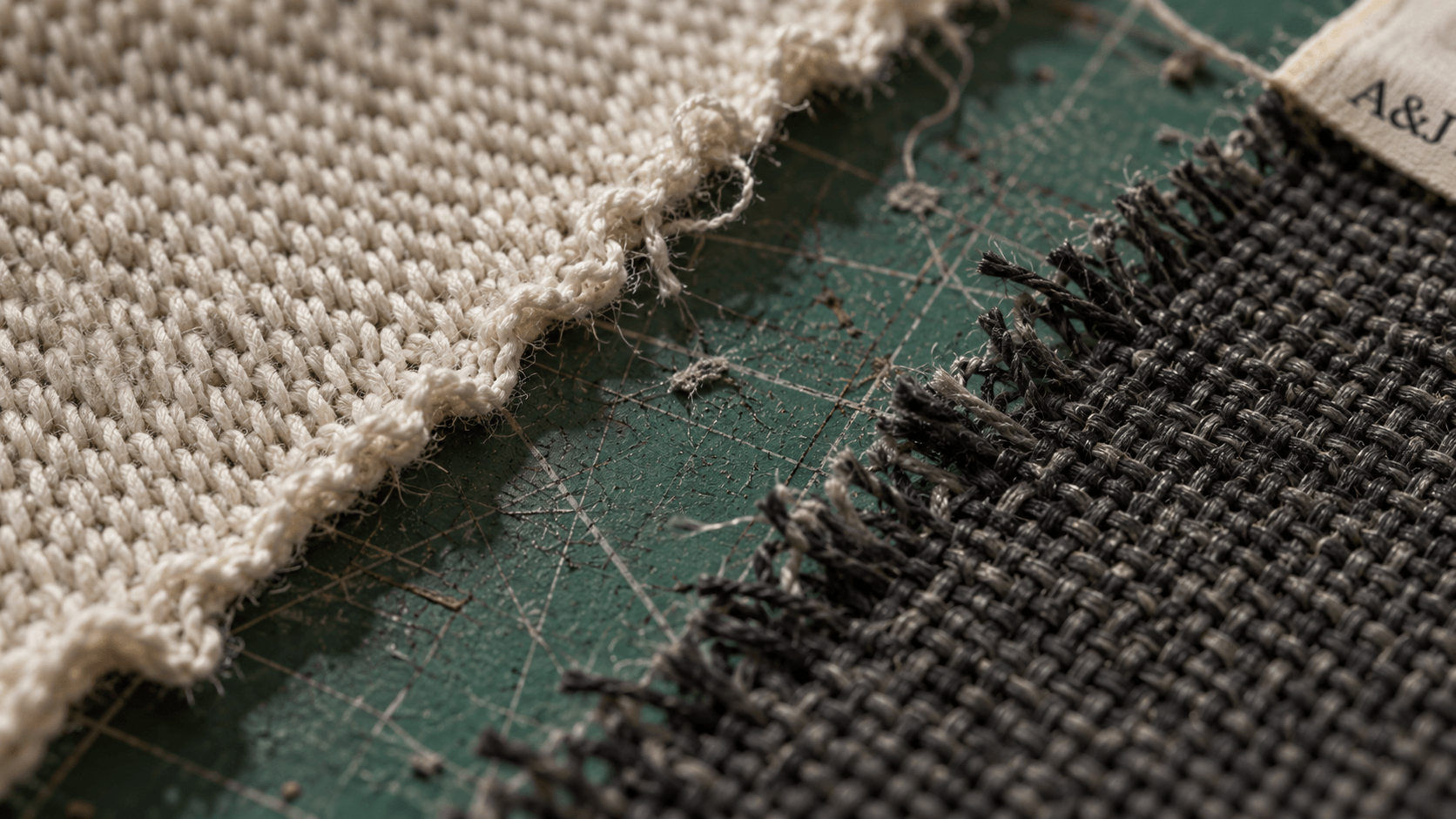
TL;DR: Knit vs woven fabric is a construction decision, not a fibre or quality ranking. Knits form through intermeshing loops and usually offer more inherent stretch; wovens interlace warp and weft and usually provide more dimensional structure. Choose through seven linked layers: silhouette, movement, pattern engineering, cutting, sewing, grading, and care/reorder control. A&J International Apparel has provided cut-and-sew womenswear manufacturing in Dongguan, China since 2006 with a 50-piece minimum per style; every fabric article, colour and finish still requires order-specific confirmation.
Knit vs woven fabric affects almost every decision after a sketch becomes a garment. A fitted top designed for stretch cannot simply move onto a stable woven without changing ease, openings and construction. A tailored blouse cannot move onto a soft jersey and retain the same collar, placket and silhouette by default.

This guide compares the two structures through production consequences rather than declaring one universally superior. Fibre content remains a separate axis: cotton, polyester, viscose, wool and blends can appear in either structure. Weight is also separate. A light woven may be more stable than a heavier knit, while finish can change hand and drape without changing the underlying construction.
What Does Knit vs Woven Fabric Actually Mean?
A knit is built from connected yarn loops. A woven is built by crossing warp and weft yarns, normally near right angles. The loop structure often allows a knit to extend and recover more easily, while the interlaced grid often makes a woven more stable in length and width. “Often” matters: elastane, yarn, density, weave, knit type and finish can change the result.
| Decision field | Knit starting tendency | Woven starting tendency | What must still be measured |
|---|---|---|---|
| Extension | More inherent give | More limited unless stretch yarn is added | Directional stretch and recovery |
| Edge behaviour | May curl or ladder | May fray or distort on bias | Cut-edge and seam trial |
| Drape | Can follow the body | Can hold a shaped silhouette | Garment-level drape |
| Stability | Sensitive to course/wale movement | Sensitive to grain and bias | Dimensional change and skew |
| Pattern ease | Often uses lower or negative ease | Often uses wearing and design ease | Fit sample on intended article |
| Sewing | Stretch-compatible seam needed | Seam slippage and fraying need control | Sewn-panel trial |
When comparing knit vs woven fabric, do not use fibre labels to infer construction. “95% cotton, 5% elastane” does not tell a pattern maker whether the fabric is jersey, rib or stretch poplin. The performance brief from the fabric sourcing system should record fibre, structure and finish as separate fields.
Layer 1: Choose Structure from Silhouette
Start with the shape the garment must hold when nobody is touching it. Knit vs woven fabric becomes easier to decide when the silhouette is described as body-following, fluid, crisp, tailored, voluminous or compressive.
In a knit vs woven fabric decision, a close-fitting T-shirt, bodysuit or soft lounge top often benefits from knit extension. A shirt with a defined collar stand, a tailored blazer or a crisp gathered dress often benefits from woven stability. These are starting directions, not fixed laws: stable ponte can create structured knit garments, while stretch woven can support fitted trousers.
| Silhouette target | Useful starting route | Reason to prototype before approval |
|---|---|---|
| Body-following top | Jersey, rib or interlock knit | Recovery and opacity change under extension |
| Fluid blouse | Lightweight woven or stable knit | Neckline and seam drape differ |
| Tailored jacket | Stable woven or structured double knit | Interfacing and pressing response differ |
| Relaxed lounge set | Soft knit or drapey woven | Ease and closure strategy change |
| Voluminous dress | Woven for shape; knit for softer fall | Hem weight changes balance |
A&J’s women tops manufacturing guide breaks the silhouette into neckline, shoulder, bust, sleeve and hem zones. Use that zone map before changing structure; a material substitution may affect each zone differently.
Layer 2: Compare Movement, Stretch and Recovery
Stretch is not a yes/no label. Record direction, extension under a stated method, recovery after release, and opacity while extended. A knit can stretch but fail to recover. A stretch woven can extend less yet return more consistently. Neither result should be assumed from touch alone.

For body movement, review reach, sitting, bending and dressing. A low-stretch woven fitted top may need a zipper or larger opening. A knit version may remove that closure, but the pattern then depends on recovery to keep the neckline and armhole from growing.
Use a sewn garment for the knit vs woven fabric decision rather than pulling an isolated swatch by hand. Seam type, elastic, lining and decoration can restrict the material. The womens T-shirt guide provides a knit route, while the blouse manufacturing guide provides a woven comparison point.
Layer 3: Rebuild the Pattern, Not Just the Fabric Field
A pattern developed for one structure should not silently travel to the other. Knit vs woven fabric changes ease, opening size, seam allowance, hem method, facings, interfacing and closure needs. Even two knits can require different blocks if their stretch and recovery differ.
Use a pattern-impact register:
| Pattern area | Knit-to-woven risk | Woven-to-knit risk |
|---|---|---|
| Neck opening | May no longer pass over the head | May grow or gape without recovery control |
| Bust and waist | Negative ease becomes restrictive | Existing ease may look oversized |
| Armhole | Reach can be reduced | Armhole may drop or ripple |
| Sleeve cap | Stretch allowance disappears | Cap ease may become unnecessary fullness |
| Closure | Pull-on route may fail | Zipper or button may become optional |
| Hem | Turnback may become bulky or rigid | Edge may wave under feed imbalance |
Brands making a knit vs woven fabric change should update the clothing tech pack with the intended article and the pattern revision created for it. Do not preserve an old pattern code while changing the fabric structure; that hides the real development change.
Layer 4: Plan Cutting Around Grain, Curl and Relaxation
Both sides of a knit vs woven fabric comparison need directional control. A woven usually has warp, weft and bias. A knit has wales and courses, plus possible spirality or edge curl. The cutting team needs a face direction, nap or print direction, relaxation rule, lay method and defect plan for the approved article.
A roll received under tension can change after relaxation. Knit lays may compress or stretch when spread. Wovens can bow, skew or shift on the bias. Instead of publishing one universal relaxation time, record the supplier article, incoming condition, lay depth and measured behaviour for the order.
The clothing manufacturing process places material release before cutting. That release should compare bulk identity with the approved sample, including width, weight, face, shade, direction and visible condition.
Layer 5: Match the Seam System to Knit vs Woven Fabric
The sewing route in a knit vs woven fabric program must support the material without creating a new failure. Knit seams need enough extensibility for the movement zone. Woven seams need appropriate edge control and resistance to seam slippage. Needle, thread, feed, stitch and seam type work as one system.

| Production symptom | Possible knit cause | Possible woven cause | Trial to record |
|---|---|---|---|
| Wavy seam | Differential feed or seam extension | Bias distortion or feed imbalance | Sewn panel after rest |
| Broken stitch | Seam cannot extend with fabric | Needle/thread mismatch | Movement trial |
| Puckering | Feed or thread tension | Differential shrinkage or tight stitch | Pressed and laundered panel |
| Opening seam | Recovery loss or needle damage | Seam slippage or fraying | Load at intended seam |
| Twisted body | Course/wale skew | Grain or bow distortion | Before/after care alignment |
Do not convert the comparison into “overlock for knit, lockstitch for woven.” Many garments combine operations, and some stable knits accept tailored construction. Approve the seam on the actual article, including any lining, elastic, tape, print or interfacing that changes flexibility.
A mixed-material garment needs a junction test as well. A knit sleeve attached to a woven body, or a woven placket mounted on jersey, concentrates different extension and feed behaviour at one seam. Record which layer should stabilize the junction, then review puckering, stretching and recovery after movement and care. This is a separate approval point, not proof that either structure failed.
Layer 6: Grade with Material Behaviour in View
Grading changes a base pattern across sizes, but fabric behaviour determines whether the mathematical increase still produces a wearable result. Knit vs woven fabric can require different grade logic at the neckline, armhole, bust, waist and opening because stretch is not distributed evenly across the body.
Within a knit vs woven fabric size review, a knit with strong widthwise extension may still have limited lengthwise movement. A woven with elastane may recover differently after pressing and care. Review at least a lower, middle and upper size from the intended range rather than approving only the base size and assuming every grade behaves identically.
The plus-size clothing guide explains why adding the same amount at every point does not create proportional fit. Record both pattern measurements and garment measurements after the proposed care route.
Layer 7: Test Care, Skew and Repeat-Order Stability
Care can change dimensions, surface and alignment. AATCC TM135 covers dimensional changes of fabrics after home laundering. AATCC TM179 applies to woven and knitted fabrics when evaluating skew change after home laundering. These methods define testing frameworks; they do not supply one acceptance limit for every garment.

The FTC’s Care Labeling Rule guidance requires a reasonable basis for care instructions and consideration of the completed garment. The FTC’s textile labeling guidance separately covers fibre content, country of origin and responsible-business identification for covered U.S. products. “Knit” or “woven” does not replace the fibre declaration.
For repeat orders, keep the knit vs woven fabric decision traceable by retaining the approved article, supplier identity, colour, lot, width, weight, finish and test record. A supplier may offer a material with the same marketing name but different construction or finish. Reconfirm any substitution before using the existing pattern and care instruction.
How to Choose Knit vs Woven Fabric in Seven Gates
Use a documented route rather than choosing from hand feel alone:
- Freeze the silhouette. Define body relationship, structure, volume and closure needs.
- Measure movement. Record stretch direction, recovery, opacity and garment actions.
- Assign the pattern route. Create or revise the block for the intended article.
- Approve cutting behaviour. Check direction, relaxation, curl, bow, skew and usable width.
- Approve the seam system. Test stitch, needle, feed, thread, edge control and pressing.
- Verify the size range. Review representative sizes and garment measurements after care.
- Release bulk and reorder evidence. Match incoming material and preserve the approved record.

A&J International Apparel can support cut-and-sew womenswear using purchased knit and woven fabrics. It is not a spinning, weaving or knitting mill. Fully fashioned knitwear, in which garment panels are shaped during knitting, also follows a different route from cutting a knitted fabric roll. The womens knitwear program should be used when that distinction affects sourcing.
Frequently Asked Questions
What is the main difference between knit and woven fabric?
Knit fabric uses intermeshing loops; woven fabric interlaces warp and weft yarns. That structural difference influences stretch, stability, edge behaviour, pattern ease and sewing.
Is knit fabric always stretchier than woven fabric?
Not always. Structure creates a tendency, but elastane, yarn, density and finish matter. Measure directional extension and recovery on the actual approved article.
Can I use the same pattern for knit and woven versions?
Usually not without review. Ease, openings, closures, sleeve shape, seam allowances, hems and grade rules may need revision for the new material behaviour.
Which structure is suitable for a fitted womenswear top?
A recovery-controlled knit often supports pull-on fitted shapes, while a stretch woven can support a more structured result. Prototype the intended fabric before deciding.
Can I change from knit to woven fabric after approving my sample without rebuilding the entire development file?
Only after a documented impact review. Update fabric identity, pattern, closure, seam, fit, grading, care and bulk-approval records wherever the structure changes them.


Leave a Reply