
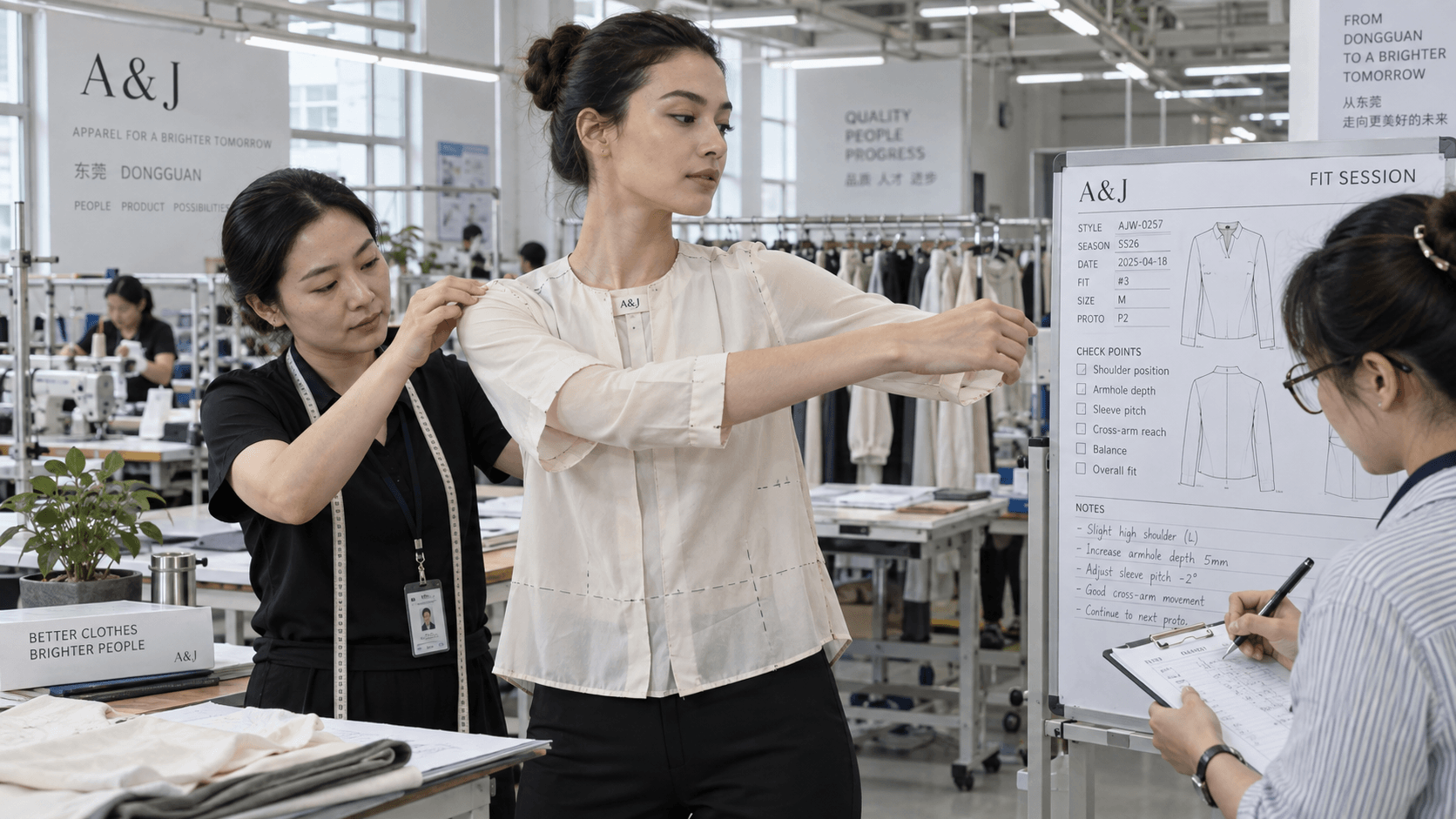
TL;DR: A women tops manufacturer should not force blouses, tees, camisoles and stretch tops through one generic block. The safer route is a seven-zone pattern ledger linking neckline, shoulder, bust, armhole, waist, hem and sleeve decisions to each fabric and sample version. A&J International Apparel has provided cut-and-sew womenswear manufacturing in Dongguan, China since 2006 with a 50-piece minimum per style; every programme still needs an approved technical brief, material route and market review.
Choosing a women tops manufacturer involves more than sending a reference photo and selecting a fabric. Two garments can share the same chest measurement yet fit differently because their shoulder slope, dart intake, armhole depth, neckline stability and hem balance do different jobs. A woven blouse cannot simply inherit a jersey tee block, and a fitted stretch style cannot be graded like a loose shell.

This seven-zone pattern ledger makes those differences visible before bulk cutting. It covers blocks, material identity, movement fit, grading, wash response, labels and release without inventing factory results, costs or timelines.
A Women Tops Manufacturer Starts by Separating Product Families
A women tops manufacturer should first classify the style by construction and wearing behaviour, not by the broad word “top.” A button-front blouse, bias camisole, stretch knit tee, lined bustier-inspired shell and relaxed woven tunic require different base blocks, seam routes and fitting actions.
The first record should state the product family, intended layer, fabric behaviour, closure, bust shaping and target silhouette. If the buyer expects several styles to share a visual identity, the file should separate brand-level constants—such as shoulder attitude or preferred body length—from style-specific engineering.
| Product family | Pattern starting point | Main control question |
|---|---|---|
| Woven blouse | Woven bodice block with dart or yoke shaping | Does the bust shape remain clean without restricting reach? |
| Jersey tee | Knit block with controlled negative or positive ease | Does recovery preserve neckline and body shape? |
| Camisole | Strap and neckline-led block | Are coverage, strap position and bias movement controlled? |
| Structured shell | Panelled or darted block with support components | Does the garment retain shape without uncomfortable pressure? |
| Relaxed tunic | Extended body block with hem and side-slit control | Does volume hang evenly without pulling backwards? |
A&J’s blouse manufacturing guide covers the blouse category, while the womens T-shirt manufacturing page addresses knit tees. This page has a different job: showing how a mixed tops programme keeps each product family technically distinct while preserving one brand fit direction.
Ledger Zone 1: Lock Neckline Shape and Stability
The neckline is both a visual focal point and a structural opening. A women tops manufacturer should record the finished shape, depth, width, edge construction, closure relationship, support material and measurement method. “Same as reference” is not a reproducible instruction.
A wide woven neckline may need stay stitching, facing, binding or an interfaced edge. A stretch neckline depends on binding length, recovery and attachment ratio. A bias-cut cowl needs controlled drape rather than a fixed flat opening. Each route requires a named sample and material version.

| Neckline route | Evidence to retain | Failure to prevent |
|---|---|---|
| Faced woven edge | Pattern, facing shape, interfacing and understitch route | Rolling facing or stretched opening |
| Bound knit edge | Binding article, cut direction and attachment method | Rippling or poor recovery |
| Button-front collar | Stand, collar, neckline seam and button position | Collar imbalance or neckline drag |
| Cowl or draped neck | Grain direction and drape reference | Collapsed or uncontrolled volume |
| Strap neckline | Strap origin, length and attachment point | Coverage shift or strap fall-off |
The women tops manufacturer approval should include front, side and movement views. A flat measurement alone cannot show whether the neckline opens during reach, sits away from the chest or pulls the garment towards the back.
Ledger Zones 2–3: Shoulder Balance, Bust Shape and Movement
Shoulder slope and bust shaping work together. If the shoulder angle is wrong, the neckline can shift, the armhole can gape and the hem can look uneven even when chest width matches the specification. The women tops manufacturer pattern ledger should therefore link shoulder width, slope, seam position, bust point and shaping method.
Bust volume may come from a side dart, waist dart, princess seam, gathers, pleats, stretch or added ease. These are not interchangeable. Moving a dart changes grain direction and balance; replacing a dart with stretch changes material dependency. The record should state which element creates the volume and how it changes across sizes.
| Fit action | Evidence on sample | Decision to record |
|---|---|---|
| Natural stance | Neckline, shoulder and side-seam position | Is the garment balanced front to back? |
| Cross-arm reach | Back width and shoulder mobility | Is movement gained without excess standing volume? |
| Forward reach | Armhole, bust and hem response | Does the front lift or neckline pull? |
| Seated posture | Bust, waist and front length | Does the garment remain comfortable and covered? |
| Layering check | Interaction with intended underlayer | Is wearing ease appropriate for actual use? |
Use production-intent fabric for fit review because drape, thickness and stretch can change the apparent result. The tech pack for clothing guide explains how measurements, tolerances, BOM entries and revisions should be controlled. This ledger adds the relationship between those fields for tops.
How a Women Tops Manufacturer Controls Armholes and Sleeves
An armhole is not an isolated curve. It interacts with shoulder width, bust shaping, sleeve-cap height, bicep room and the intended range of movement. A women tops manufacturer should release the armhole and sleeve as one system, using both measurements and worn observations.
For a sleeveless style, the opening must provide coverage without cutting into the front arm. For a set-in sleeve, the cap and armhole need compatible seam lengths and distribution. A dropped shoulder moves the sleeve join away from the body but still needs a controlled underarm and sleeve angle. A raglan route changes neckline and shoulder responsibility again.

| Sleeve route | Required record | Movement risk |
|---|---|---|
| Sleeveless | Armhole shape, binding or facing, coverage view | Gaping or underarm pressure |
| Set-in | Cap shape, bicep, elbow and pitch | Restriction or twisting |
| Dropped shoulder | Drop position, sleeve angle and underarm depth | Excess bulk or backward drag |
| Raglan | Neckline origin, seam shape and underarm balance | Neck pull or uneven rotation |
| Puff or gathered | Cap volume, gathering zone and support | Uncontrolled fullness or collapse |
The women tops manufacturer should version comments against a named sample rather than merging feedback from several fittings into one message thread. If the shoulder changes, reopen the neckline, armhole and sleeve checks that depend on it.
Ledger Zones 5–6: Waist, Hem and Material Behaviour
Waist and hem balance determine whether the garment hangs as intended. A cropped woven shell, fitted jersey top and long tunic may share a chest size but require different front length, back length, sweep, side-seam shape and closure allowance. The pattern ledger should specify where the waist is defined and how the hem should behave in motion.
Material identity must be locked alongside those shapes. Record supplier, article, fibre composition, construction, finished weight, usable width, colour, finish, stretch direction and incoming lot. The women tops manufacturer should also state whether each pattern was approved in the final article or in a temporary substitute.
| Material behaviour | Pattern implication | Bulk evidence |
|---|---|---|
| Fluid woven | Needs controlled bias growth and seam support | Roll identity and hanging review |
| Crisp woven | Holds volume but may restrict movement | Finished fit and seam-bulk check |
| Stable jersey | Allows limited stretch with clearer shape | Recovery and neckline review |
| High-stretch knit | Requires negative-ease and seam compatibility | Stretch direction and recovery record |
| Sheer material | May require lining, facing or opacity planning | Layer specification and label disclosure |
The knitwear manufacturing guide covers knitted product routes. Fully fashioned knitwear, seamless circular knitting and cut-and-sew stretch tops are different systems; a sourcing brief should name the required route instead of treating them as equivalent.
Ledger Zone 7: Grade Rules, Wash Response and Version Control
Grading is not a uniform enlargement. Neck width, shoulder slope, bust shaping, armhole depth, sleeve width, waist and body length may need different increments. A women tops manufacturer should keep a size-by-size measurement chart plus rules explaining how shaping points move.
The women tops manufacturer grade review should compare the approved base size and selected edge sizes in the intended material. Petite, tall or plus-size architecture may require separate blocks rather than extended grading from one centre size. The plus-size clothing manufacturing guide explains why body proportion and shaping placement cannot be solved by adding width alone.

Wash response should be assessed on completed garments under the agreed care route. AATCC summarises TM150 for dimensional changes of garments after home laundering, including standard washing and drying parameters. The brand still needs to select the applicable procedure, measurement points and acceptance criteria for its specific product.
| Version field | What it should identify | Release purpose |
|---|---|---|
| Pattern | File name, date and approved size | Prevents obsolete cutting files |
| Material | Article, colour, finish and lot | Links fit to actual behaviour |
| Sample | Stage and physical identifier | Anchors comments to one garment |
| Measurement | Before/after care values by point | Shows dimensional response |
| Decision | Status, approver and date | Makes reopening visible |
A women tops manufacturer should not apply one wash result to every material. A changed blend, construction, finish, colour or support component may require review; record that decision.
Labels, Claims and Seven-Gate Women Tops Manufacturer Release
For U.S. sales, FTC guidance states that most covered textile products require fibre content, country of origin and the identity of the manufacturer or another responsible business. Its textile labeling guidance also explains generic fibre names, sectional disclosures and record keeping.
FTC Care Labeling Rule guidance requires a reasonable basis for care instructions. The women tops manufacturer care file should cover the complete garment, including trims or decoration that may change the safe procedure.
If harmful-substance testing is requested, verify the exact article and component scope. The OEKO-TEX STANDARD 100 overview describes testing from yarn to finished product and stricter requirements for more intensive skin contact. It does not prove that an unnamed fabric or order is certified.
Use seven gates to release a tops order:
- Classify the product family. Confirm woven, cut-and-sew knit, structured, lined or another route.
- Freeze neckline and shoulder intent. Release shape, support and balance references.
- Approve bust and movement fit. Record shaping method and worn checks.
- Close armhole and sleeve engineering. Review opening, cap, pitch and movement as one system.
- Lock waist, hem and material identity. Connect silhouette to the approved article and lot.
- Release grading and care response. Approve size rules and completed-garment review.
- Approve labels and packing. Reconcile fibre, origin, care, SKU and carton records.
The women tops manufacturer release file should name the owner, sample, version, evidence location, status and date. It should travel with the purchase order so production teams use the same information.
A&J can assess cut-and-sew womens tops against an approved technical brief and material route. The 50-piece minimum applies per style, while fabric, colour, trim and print constraints remain order-specific. The small-quantity womens clothing guide explains how a starter production run interacts with material and component minimums.
When Another Production Route Serves You Better
A blanks supplier may be more suitable when the only difference is a printed logo on an existing tee. A fully fashioned knitwear factory is the stronger route when panels must be knitted directly to shape. A seamless circular-knitting specialist is required for engineered compression zones without conventional cut-and-sew panel seams.
A women tops manufacturer focused on fashion cut-and-sew may also be the wrong partner for molded underwire cups, regulated protective workwear or medical compression claims. Complex tailoring with extensive internal canvas may fit a suiting specialist more closely. Naming these boundaries before sampling protects the buyer from paying for a development route that cannot reproduce the intended product.
The clothing manufacturing process provides the wider stage-and-owner framework. For tops, the seven-zone ledger is the product-specific layer that connects that workflow to fit evidence.

Frequently Asked Questions
What should a womens top tech pack include?
Include the product family, base block, neckline, shoulder, bust shaping, armhole, sleeve, waist, hem, material code, size chart, grade rules, labels, artwork and acceptance fields.
Can woven blouses and knit tees share the same base pattern?
Usually not without substantial redevelopment. Their ease, stretch dependency, neckline construction, shoulder balance and armhole behaviour require different starting blocks and approval evidence.
How should a women tops manufacturer check fit across sizes?
Review the approved base size and selected edge sizes in production-intent material, then record how neckline, shoulder, bust point, armhole, waist and length change.
Which labels are required for womens tops sold in the United States?
Most covered textile products need fibre content, country of origin and responsible business identity, plus care instructions supported by a reasonable basis. Confirm product-specific requirements before sale.
Can I place 50 pieces across several different womens top designs if they use the same fabric and colour?
The 50-piece minimum applies per style. Shared material may simplify sourcing, but each pattern, sample, grading route, label set and production release remains style-specific.


Leave a Reply