
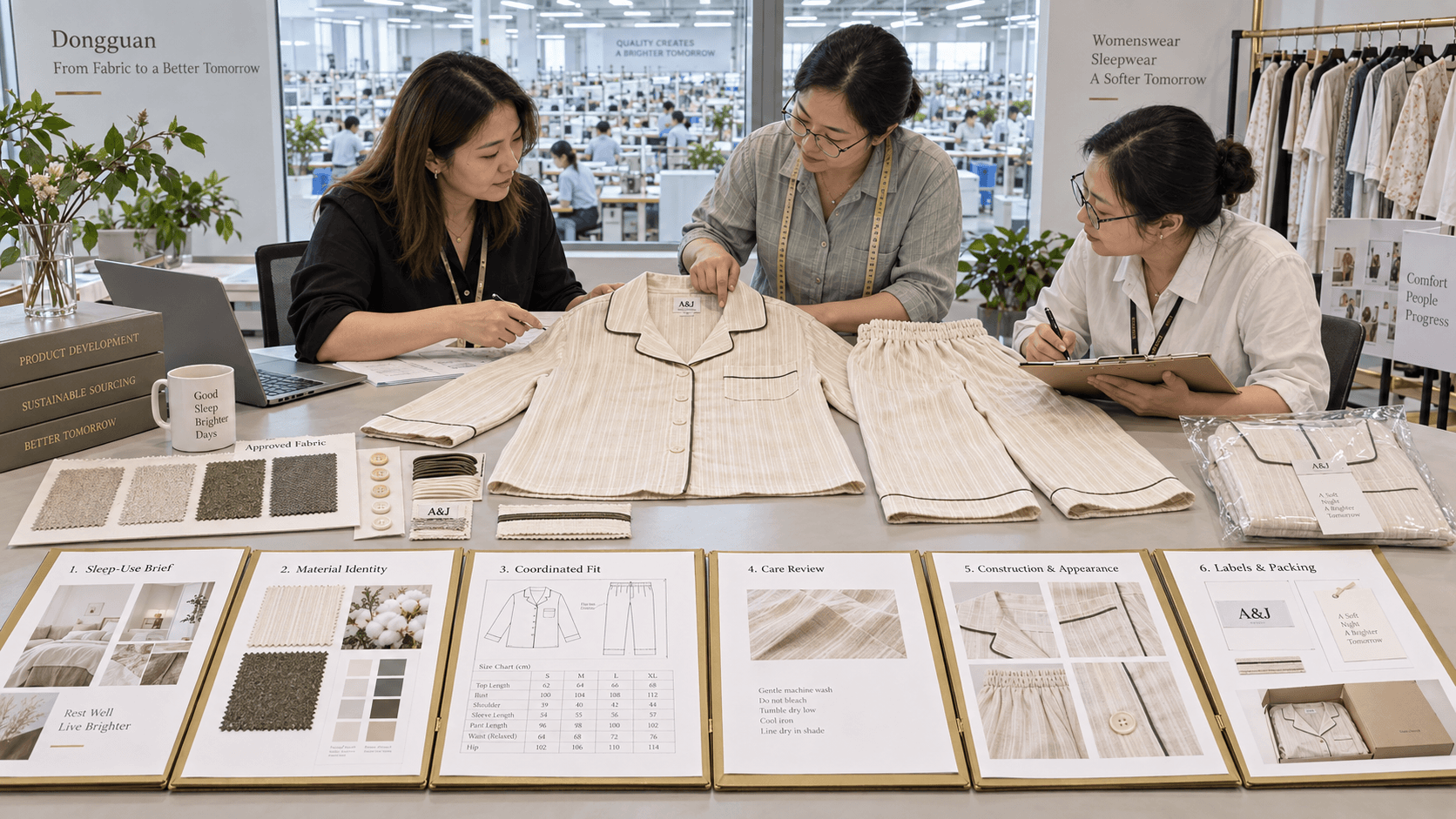
TL;DR: A pajama manufacturer should approve a two-piece sleep set as one product system, with linked records for material lots, movement fit, dimensional change, next-to-skin seams, print alignment and labels. A&J International Apparel has provided cut-and-sew womenswear manufacturing in Dongguan, China since 2006 with a 50-piece minimum per style; each adult sleepwear programme still requires an agreed specification and compliance review.
Choosing a pajama manufacturer involves more than selecting a soft fabric and approving separate shirt and trouser samples. A sleep set must remain coordinated while the wearer turns, sits, stretches and washes both pieces repeatedly. A shirt that shortens differently from its trousers, twisted piping, a restrictive rise or a scratchy neck label can make an individually acceptable garment fail as a set.

This guide uses six release records for adult womens two-piece pajamas. It covers the set brief, material identity, movement fit, wash response, construction and surface design, and labeling. It does not publish invented factory test results or treat adult and children’s sleepwear as the same compliance programme.
A Pajama Manufacturer Starts with the Sleep-Use Brief
A pajama manufacturer needs to know how the product will be used and sold before pattern work begins. A button-front woven set, stretch-knit lounge set and satin-look gift set may share a category name, but they create different movement, seam, care and packaging requirements.
The first pajama manufacturer record should define whether the shirt and trousers are always sold together, may be purchased in separate sizes, or will be offered as independent pieces. That decision changes SKU codes, care-label placement, packing, size architecture and replacement-stock planning.
| Set-brief field | Decision to record | Why it changes production |
|---|---|---|
| Intended wearer | Adult womenswear or regulated children’s product | Determines the compliance route |
| Sales format | Fixed set or selectable separates | Changes labels, SKUs and packing |
| Garment route | Woven, stretch knit or mixed material | Changes ease, seams and grading |
| Sleep silhouette | Relaxed, straight, oversized or fitted | Defines movement allowance |
| Closure system | Buttons, zipper, tie or pullover | Affects comfort and care |
| Surface design | Solid, engineered print, stripe or placement motif | Changes cutting and matching control |
A&J’s loungewear manufacturer guide introduces lounge materials, styles and sourcing. This page has a narrower job: documenting how an adult sleep set is approved as a coordinated product rather than presenting the wider loungewear category again.
Record 1: Lock Fabric, Colour and Lot Identity
The material record should name the supplier, article code, fibre composition, construction, usable width, finished weight, colour reference, finish and incoming lot. A pajama manufacturer should connect those details to the actual rolls issued for the shirt and trousers.
The hand feel cannot be the only approval point. Brushing, peach finish, print binder, stretch direction and surface sheen can change how the set looks and feels. If one piece is recut from another lot, compare it with retained production material before packing it with the original piece.

| Material evidence | Shirt record | Trouser record | Shared release question |
|---|---|---|---|
| Main fabric | Article, colour and roll lot | Article, colour and roll lot | Are both pieces visually compatible? |
| Contrast piping | Fibre, width and shade | Fibre, width and shade | Does the trim remain coordinated? |
| Elastic | Construction and width if used | Construction, width and extension method | Does care affect the set differently? |
| Buttons | Size, finish and attachment | Not applicable or matching detail | Is the component suitable for care? |
| Artwork and colour version | Artwork and colour version | Is the same approved version used? |
If a programme carries an organic, recycled or harmful-substance claim, record its scope by named article and order. The sustainable clothing manufacturers evidence guide explains why a supplier certificate cannot automatically substantiate every material or finished garment.
Record 2: Approve Movement Fit and Coordinated Grading
Sleep fit is a movement problem rather than a standing-pose problem. The shirt must allow reach and torso rotation without pulling the neckline or lifting excessively. The trousers need sufficient rise, hip, thigh and knee ease for sitting and turning without creating uncontrolled bulk.
A pajama manufacturer should keep separate measurement and grade rules for each garment, with one linked set-level approval. Applying one uniform increment to chest, waist, hip and rise can distort the relationship between sizes. The record should also state whether a customer may combine, for example, one shirt size with a different trouser size.
| Fit review | Shirt checkpoints | Trouser checkpoints |
|---|---|---|
| Static measurements | Chest, shoulder, body, sleeve and hem | Waist relaxed/extended, hip, rise, thigh and inseam |
| Sleep movement | Reach, cross-arm and torso rotation | Sit, step, knee bend and side turn |
| Pressure points | Neck, armhole, cuff and button stand | Waistband, front rise, back rise and inner thigh |
| Set balance | Shirt length relative to waistband | Rise position and trouser volume |
| Size architecture | Independent grade increments | Independent grade increments |
Use the production material for the fit sample because drape and stretch alter movement allowance. Version every comment against a named sample. The tech pack for clothing guide shows how measurements, tolerances, BOM data and revision control should be recorded before bulk cutting.
Record 3: How a Pajama Manufacturer Controls Wash Response
A pajama manufacturer should evaluate dimensional change on the completed shirt and trousers using the agreed care procedure. Fabric-only information may help development, but it does not show how seams, piping, elastic, print and garment construction behave together.
The pajama manufacturer approval plan should identify the sample, conditioning method, measurement points, wash temperature, cycle, drying route, number of cycles and acceptance criteria. AATCC describes TM150 for dimensional changes of garments after home laundering; the method offers standard home-care parameters, but the brand must still choose the applicable procedure and acceptance limits.

| Post-care checkpoint | Shirt | Trousers | Set-level decision |
|---|---|---|---|
| Length | Body and sleeve | Inseam and outseam | Does the set retain intended proportion? |
| Width | Chest and hem | Waist, hip and thigh | Does movement ease remain balanced? |
| Surface | Pilling, sheen and print | Pilling, sheen and print | Do both pieces age consistently? |
| Trim | Piping, buttons and label | Elastic, drawcord and label | Are trims still compatible? |
| Shape | Placket, neckline and hem | Rise, waistband and leg seam | Is distortion acceptable? |
Do not turn one wash result into a universal claim. A changed fabric article, colour, finish, elastic, print or construction may need a new review. Keep the test or evaluation record with the approved BOM and sample version.
Record 4: Release Next-to-Skin Seams, Piping and Closures
A sleep garment is worn for long periods against the body, so seam placement and trim ends deserve a separate release. The pajama manufacturer construction record should identify seam type, allowance, thread, stitch route, piping construction, elastic enclosure, label position and closure backing.
The pajama manufacturer should examine bulky intersections at the underarm, crotch, waistband and piping joins. A seam can look neat on a hanger yet create pressure when the wearer lies on it. Button spacing and button-stand stability should be assessed during reach and torso rotation, not only while standing.
| Construction zone | Evidence to retain | Failure to prevent |
|---|---|---|
| Neck and collar | Seam finish, label placement and piping join | Scratch, bulk or visible roll |
| Button stand | Interfacing, spacing and button attachment | Gaping or distortion |
| Underarm | Seam route and allowance | Hard intersection against skin |
| Waistband | Elastic code, enclosure and joining method | Twist, pressure or uneven extension |
| Crotch | Seam construction and reinforcement | Restriction or seam failure |
| Cuff and hem | Finished width and stitch route | Flare, tunnelling or uneven recovery |
A&J’s clothing manufacturing process explains production-stage ownership and release records. For pajamas, the general workflow must be translated into sleep-specific checkpoints rather than copied as a generic inspection list.
Record 5: Control Print, Stripe and Piping Alignment
A two-piece set creates visual relationships across separate patterns. Stripe pitch, repeat direction, piping width and motif placement should be released with measurable origins. “Match the sample” is not sufficient for grading or repeat production.
A pajama manufacturer should identify which areas must match and which may vary because of material consumption. High-visibility zones may include the centre front, collar, patch pocket, side seams and trouser legs. If exact matching is required, the quotation and marker plan should account for the resulting cutting constraint rather than hiding it.

| Visual zone | Record before cutting | Approval method |
|---|---|---|
| Centre-front print | Motif origin and repeat direction | Closed-garment front view |
| Collar and lapel | Stripe or motif orientation | Left/right comparison |
| Patch pocket | Placement origin and matching level | Template over approved front |
| Side seams | Required continuity or permitted variation | Flat and worn sample |
| Trouser legs | Stripe direction and panel orientation | Pair comparison |
| Piping | Finished width, join and corner route | Measured construction sample |
The pajama manufacturer artwork file should carry a version number and colour reference. If the shirt and trousers are printed at different times, record the approved strike-off and production lot for both pieces. A mixed version should trigger written review before sewing.
Record 6: Labels, Packing and the Adult–Child Boundary
For U.S. sales, the FTC states that most textile products require fibre content, country of origin and the identity of the manufacturer or another responsible business. Its textile labeling guidance also explains fibre naming, sectional disclosures and record keeping.
Care instructions require a reasonable basis for the complete garment. FTC Care Labeling Rule guidance notes that a multi-piece garment always sold as a unit may use one care label when all pieces share the same instructions. Separately sold coordinates, or pieces requiring different care, need their own labels.
| Release file | Adult set decision |
|---|---|
| Fibre label | Confirm body and any required sectional disclosure |
| Origin and identity | Approve market-specific wording and responsible entity |
| Care label | Support instructions for the complete set and all components |
| SKU labels | Distinguish shirt, trouser, size, colour and set relationship |
| Packing list | State fixed set or selectable separates clearly |
| Carton record | Reconcile piece counts and size combinations |
Children’s sleepwear is a separate regulatory route. The U.S. CPSC explains that in-scope children’s sleepwear is governed by 16 CFR parts 1615 and 1616, with specific flammability, production-unit, testing and labeling requirements. Review the CPSC children’s sleepwear guidance before design or material approval. This adult pajama manufacturer guide should not be used as a children’s compliance file.
Six-Gate Pajama Order Release and A&J Fit
Use six gates to convert the approved concept into a controlled order:
- Freeze the sleep-use brief. Confirm adult market, sales format, silhouette, material route and surface design.
- Lock material identity. Approve articles, lots, colours, trims and substitution rules for both pieces.
- Approve coordinated fit. Release separate shirt and trouser measurements, grades and movement checks.
- Close the care review. Compare dimensional, surface and trim response after the agreed procedure.
- Release construction and appearance. Approve seams, closures, print, stripes, piping and artwork versions.
- Approve labels and packing. Reconcile legal wording, care, SKU logic, size combinations and carton records.

Each pajama manufacturer release gate should name the responsible person, sample version, evidence location, status and date. The approved set file should travel with the purchase order so that sourcing, pattern, sample, cutting, sewing, finishing and packing teams use the same version.
A&J can assess adult cut-and-sew womens pajama programmes against an approved technical brief and material route. The 50-piece minimum applies per style, while fabric, print, trim and packing constraints still require order-specific confirmation. The small-quantity womens clothing guide explains how flexible first runs interact with material and component minimums.
When Another Production Route Serves You Better
A blanks supplier may be more suitable when the purpose is only to test a logo or gift bundle. A textile mill-led partner may be more suitable when a proprietary woven pattern or specially engineered fibre is the central value of the product. A specialist children’s sleepwear programme is required when the intended use, sizing and marketing bring the garment within children’s product rules.
A pajama manufacturer focused on cut-and-sew adult womenswear may also be the wrong route for seamless circular-knit sleep products, highly structured foundation garments or products requiring regulated medical claims. Defining these limits before sampling protects both the brand and factory from building the wrong compliance and production path.
Frequently Asked Questions
What should a pajama tech pack include?
Include separate shirt and trouser measurements, grade rules, material and trim codes, seam construction, artwork origins, care requirements, labels, packing and set-level acceptance criteria.
Should both pajama pieces use the same fabric lot?
Controlled lot identity reduces unintended differences in shade, surface and wash response. If different lots are necessary, define the comparison and approval method before cutting.
How should a pajama manufacturer check shrinkage?
Evaluate completed garments under an agreed care procedure, record named measurement points before and after care, and approve the shirt-to-trouser proportion at set level.
Does an adult pajama specification cover children’s sleepwear?
No. Children’s sleepwear may fall under separate flammability, testing, certification, tracking and labeling requirements determined by intended use, size, design and marketing.
Can I order 50 adult pajama sets while allowing customers to choose different shirt and trouser sizes?
Yes, subject to confirmed size splits and material availability. Use independent SKUs, labels and packing records while preserving one coordinated material and care file.


Leave a Reply