
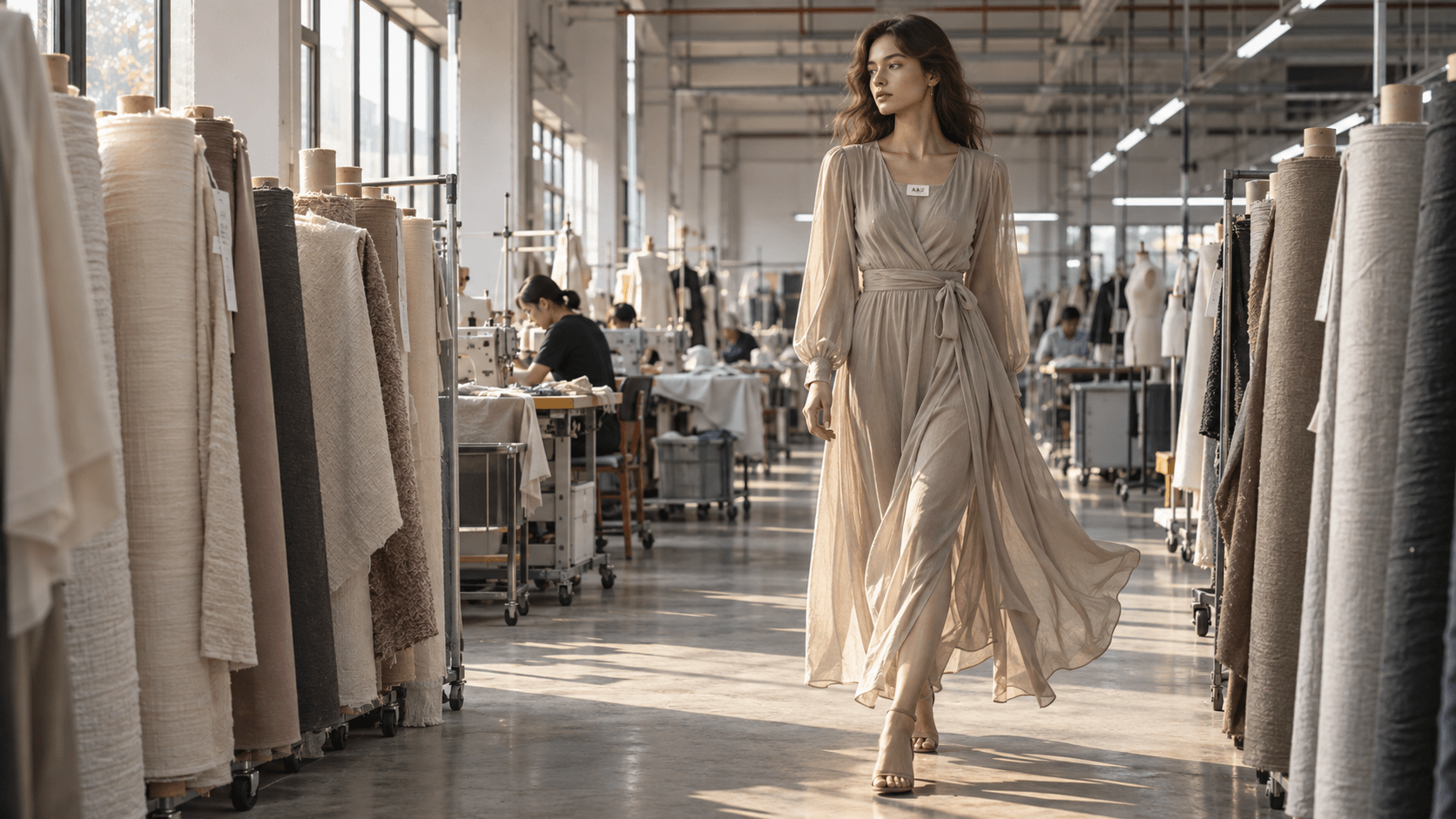
TL;DR: To source fabric for clothing, convert the design into measurable material requirements before asking mills or suppliers for swatches. Use six linked files: a performance brief, supplier identity record, sample-card register, test-and-care plan, commercial sheet and approved-bulk control file. A&J International Apparel has provided cut-and-sew womenswear manufacturing in Dongguan, China since 2006 with a 50-piece minimum per style; fabric availability, colour and processing constraints remain order-specific.
Learning how to source fabric for clothing starts with a product decision, not a fibre name. “Cotton,” “viscose” or “polyester” does not define weight, construction, finish, stretch, opacity, drape, dimensional response or colour route. Two fabrics with the same fibre content can cut, sew, wash and wear very differently.
This guide builds a six-file sourcing system that connects the design brief to a traceable bulk lot. It does not publish invented mill minimums, laboratory results, lead times or costs. Where a real supplier value is unavailable, the file remains blank until supported by a quotation, specification, certificate or test report.
Before You Source Fabric for Clothing, Define the Garment Job
A fabric brief should describe what the garment must do. Start with product type, silhouette, intended layer, season, target market, care route and decoration. Then translate each design statement into a material property that can be sampled and checked.
| Design statement | Material question | Evidence to request |
|---|---|---|
| Fluid blouse | Does the cloth hang without collapsing at seams? | Full-width swatch and sewn drape sample |
| Fitted stretch top | Does stretch and recovery support the pattern? | Directional stretch record and fitted sample |
| Opaque light dress | Does coverage remain acceptable in movement and light? | Layered and worn opacity review |
| Structured jacket | Does the fabric hold shape with interfacing and pressing? | Fused panel and finished seam sample |
| Soft loungewear | Does the surface remain comfortable after the intended care route? | Completed-garment care review |
When you source fabric for clothing, the product brief should also identify constraints. If a style requires a precise colour, recycled-content claim, print route or skin-contact standard, write that before requesting options. Otherwise, suppliers may send attractive swatches that cannot support the final claim, quantity or process.
A&J’s women tops manufacturing guide shows how fabric behaviour changes neckline, shoulder, bust and sleeve decisions. The clothing manufacturing process places sourcing inside the wider development sequence.
File 1: Build a Measurable Fabric Performance Brief
To source fabric for clothing efficiently, replace subjective adjectives with fields that another person can interpret. “Heavy,” “soft” and “luxury” depend on context. Record construction, finished weight, usable width, fibre composition, stretch direction, finish, face, reverse, colour route, care expectation and required testing.

Weight in grams per square metre helps compare mass per area, but it does not prove thickness, warmth or quality. A dense compact knit and a lofty brushed construction may share a nominal weight while feeling and performing differently. Treat weight as one field in a system, not a product verdict.
| Specification field | Record format | Why it matters |
|---|---|---|
| Construction | Woven/knit plus structure | Predicts stretch, fraying and sewing route |
| Finished weight | Supplier value plus verification field | Supports consistency checks |
| Usable width | Excluding unusable edges | Affects marker and consumption |
| Fibre composition | Generic fibre names and percentages | Connects claims and labels |
| Stretch/recovery | Direction, method and result field | Links material to pattern ease |
| Finish | Mechanical or chemical process description | Affects hand, appearance and care |
| Colour route | Stock, piece-dyed, yarn-dyed or printed | Changes sampling and repeat-order control |
Brands that source fabric for clothing should place the brief in the tech pack for clothing as a material specification, not as a mood-board note. If several options are still open, assign each candidate a code so comments do not drift between swatches.
How to Source Fabric for Clothing: Choose the Supply Route
There are three broad routes when brands source fabric for clothing. Stock fabric uses an available article and colour. Custom colour applies an approved shade to an existing base. Custom development changes construction, yarn, finish or several variables together. The routes have different evidence and commitment requirements.
| Route | What is already fixed | What still needs approval | Main sourcing risk |
|---|---|---|---|
| Stock article | Base fabric and available colour | Lot, shade and usable quantity | Repeat lot may change or sell out |
| Custom colour | Base construction | Colour standard and bulk shade | Colour minimum may exceed garment need |
| Custom print | Base fabric | Artwork, scale, colour and print route | Registration and shade can vary |
| Custom development | Few or no parameters | Yarn, construction, finish and performance | More iterations and supplier dependency |
A starter production run does not automatically mean a stock route. A small garment quantity may still require more fabric because the mill, dye house, printer or trim supplier works to a different minimum. The small-quantity womens clothing guide explains why garment minimums and material minimums must be separated.
Before paying to source fabric for clothing through colour or development, ask who owns the base specification, colour recipe, print file and any exclusive construction. Record whether the same material may be sold to other buyers and what information will be released if production moves.
File 3: Create a Swatch and Supplier Identity Register
A fabric card without identity becomes useless when the order moves from sampling to bulk. To source fabric for clothing with traceability, assign a candidate code and retain supplier legal name, contact, article, colour, lot, date received, quoted width, composition, weight, finish, minimum, validity date and intended style.
Do not trim away all selvedge information or separate a sample from its card. Photograph the face and reverse under controlled light, but retain a physical swatch large enough to show repeat, drape and defects. For prints, retain the full repeat whenever practical.
| Register field | Sample stage | Bulk stage |
|---|---|---|
| Supplier and article | Quoted identity | Purchase-order identity |
| Colour | Swatch or lab reference | Approved bulk lot |
| Composition | Supplier declaration | Label and verification file |
| Width and weight | Candidate specification | Incoming inspection result |
| Finish | Described treatment | Confirmed production route |
| Certificate or claim | Scope document requested | Exact article/order coverage checked |
| Status | Candidate/rejected/approved | Released/held/replaced |
Teams that source fabric for clothing should reconcile the supplier identity across quotations, packing lists, certificates and transaction documents. A familiar trading name does not automatically prove the legal entity or production site behind a claim.
File 4: Test the Material in a Garment, Not Only as a Swatch
A swatch can show colour and hand, but the garment reveals seam slippage, puckering, stretch interaction, opacity, pressing response and dimensional balance. Brands that source fabric for clothing should test material at the stage where its intended construction and care route are visible.

When brands source fabric for clothing, they should use the production-intent article for a fit or wear sample whenever material behaviour controls the pattern. A substitute may be acceptable for early silhouette exploration, but it should be clearly marked and should not silently become the basis for final ease, grading or care decisions.
| Review layer | Example question | Evidence format |
|---|---|---|
| Swatch | Is colour, hand and surface direction correct? | Coded physical card |
| Sewn panel | Does the seam remain stable and press cleanly? | Construction sample |
| Decorated panel | Does print, embroidery or bonding suit the material? | Approved artwork sample |
| Fit garment | Does drape, stretch and opacity work in movement? | Worn review and comments |
| Care garment | Does the completed item remain acceptable after care? | Before/after record |
FTC Care Labeling Rule guidance states that care instructions need a reasonable basis and must consider the garment as a whole, not only isolated components. The exact test method, conditions and acceptance criteria should be selected for the product and market.
File 5: Verify Fibre, Chemical and Sustainability Claims
When brands source fabric for clothing, a certificate logo should never replace scope verification. First define the claim: fibre content, harmful-substance testing, organic input, recycled input or another attribute. Then request the document that covers the relevant organization, facility, article, process and transaction.
The FTC’s textile labeling guidance explains generic fibre naming, percentages, country of origin and responsible-business identity for covered U.S. textile products. Supplier shorthand should not be copied directly onto a consumer label without market review.
For chemical safety, the OEKO-TEX STANDARD 100 overview describes harmful-substance testing from yarn to finished product and product classes based on skin contact. Verify the certificate number, validity, holder and covered article rather than assuming every fabric from a certified supplier is included.
For input claims, Textile Exchange explains that certification bodies issue scope and transaction certificates under its standards system. Its standards overview distinguishes systems such as OCS, RCS and GRS. The GRS recycled polyester guide and GOTS clothing guide provide internal routes for claim-specific sourcing.
File 6: Compare Commercial Terms Without Losing Technical Identity
A material quotation should remain attached to the specification it prices. To source fabric for clothing responsibly, compare the same article, width, finish, colour route, inspection basis, delivery term and claim scope. A lower metre price can be misleading if usable width is narrower, defects are excluded differently or extra processing sits outside the quote.

| Commercial field | Question to resolve | Document |
|---|---|---|
| Price basis | Per metre, yard or kilogram? | Supplier quotation |
| Minimum | Per article, colour, print or order? | Quotation and order note |
| Width basis | Nominal or usable width? | Specification and inspection |
| Sampling charge | Creditable against bulk or separate? | Development agreement |
| Colour approval | Which standard and tolerance process? | Lab/sample approval |
| Delivery point | Which costs and risks are included? | Purchase term |
| Repeat order | Is the article continuing or seasonal? | Supplier confirmation |
Keep quoted values order-specific. Do not publish a universal fabric minimum or lead time unless the supplier has confirmed the period, article, colour route and included processes. A&J’s sustainable manufacturing evidence guide explains why a claim file must stay linked to the actual order rather than float as general marketing proof.
How to Approve Bulk Fabric Before Cutting
The six files become useful only when teams source fabric for clothing with sampling records connected to incoming bulk. A fabric warehouse should quarantine or identify incoming lots, preserve roll information and compare the material with the approved reference before release to cutting.

Use this six-step approval flow:
- Freeze the performance brief. Confirm garment job, construction, weight, width, composition, finish, colour and care fields.
- Select the sourcing route. Record stock, custom colour, custom print or custom development.
- Register the supplier and sample. Assign identities to every candidate and retain a physical reference.
- Approve garment-level behaviour. Review sewing, decoration, fit, movement, opacity and care on production-intent material.
- Verify claims and commercial terms. Match documents to the article, supplier, facility and order.
- Release the bulk lot. Compare incoming identity, shade, width, weight, face, finish and visible quality before cutting.
If an incoming lot differs, isolate it and create a written disposition: accept for the current style, request replacement, allocate to another approved use or require another sample. Do not blend lots or substitute articles without recording the effect on labels, pattern, care and claims.
A&J can help brands connect approved fabrics to cut-and-sew womenswear development, but it is not a fibre farm, yarn spinner or vertically integrated mill. A project requiring exclusive yarn innovation or a proprietary textile may need direct mill development before garment sampling begins.
Frequently Asked Questions
What information should I send when sourcing fabric?
Send the garment type, silhouette, intended layer, construction, weight range, usable width, composition, stretch direction, finish, colour route, care expectation, destination market, quantity and required claims.
Should I choose fabric before making the pattern?
Set the material direction before final pattern approval. Early blocks can use a documented substitute, but final fit, grading and care decisions should use the production-intent article.
Is fabric GSM enough to compare two materials?
No. GSM measures mass per area. Construction, thickness, density, yarn, finish, stretch, loft and usable width can make two materials with similar GSM perform differently.
How can I verify an organic or recycled fabric claim?
Define the exact claim, then verify the certificate holder, scope, validity, covered article and transaction evidence through the applicable standard and certification system.
Can I source fabric for clothing in a custom colour when my first order is only 50 pieces per style?
Possibly, but garment quantity and dye or mill minimums are separate. Ask for the base article, colour-route minimum, excess-material ownership, repeat-order plan and written quotation before approval.


Leave a Reply