
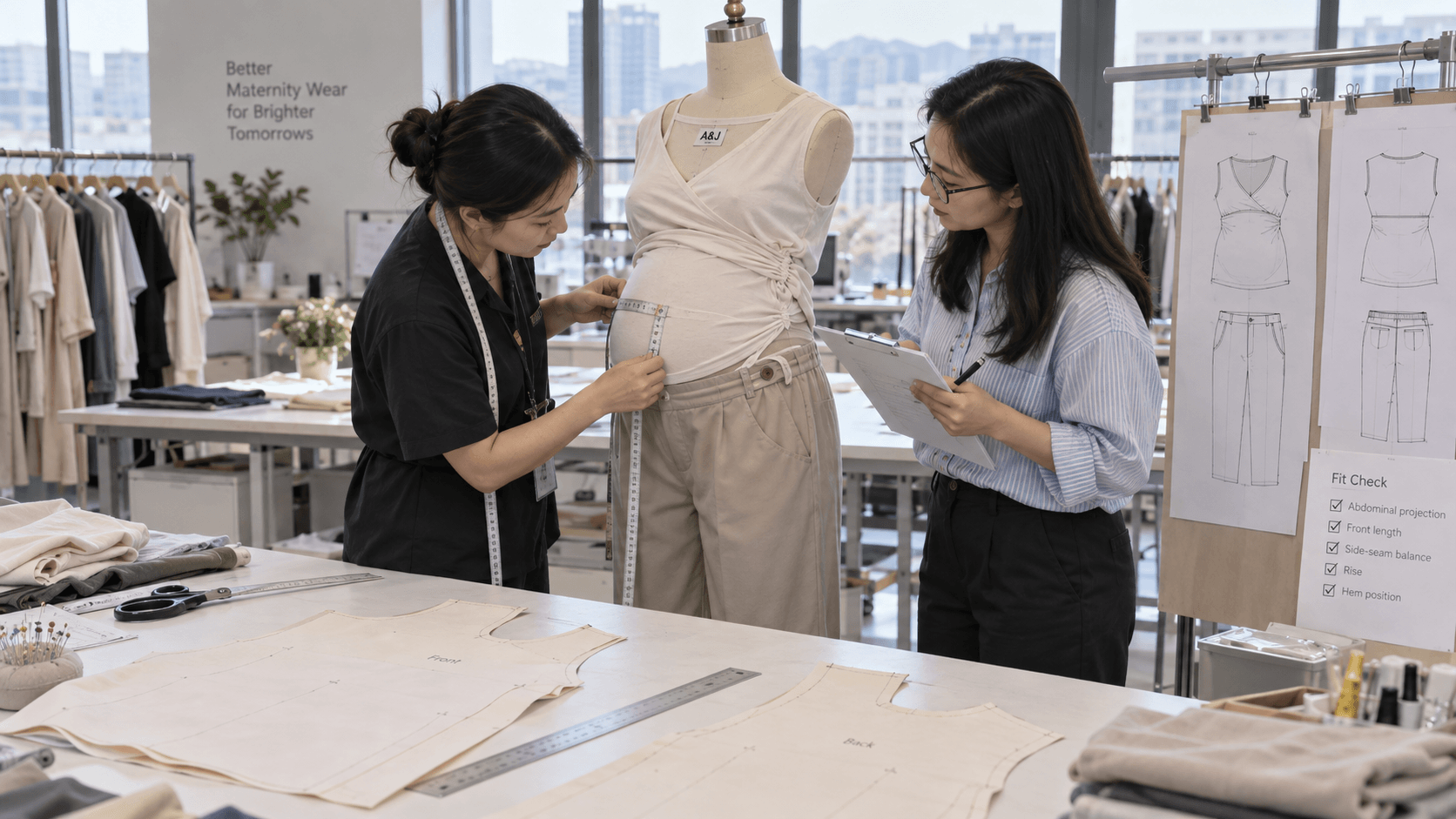
TL;DR: A maternity clothing manufacturer must develop garments around changing body geometry rather than adding width to a standard womenswear block. A&J International Apparel has manufactured womenswear in Dongguan, China since 2006 with a 50-piece minimum per style. The production brief should define pregnancy stage, postpartum use and nursing access before pattern work begins.
A maternity clothing manufacturer search covers much more than dresses. A complete programme can include adjustable trousers, support leggings, empire tops, nursing shirts, soft knit layers and postpartum transition pieces. Each product changes with the wearer in a different way, so one generic “maternity fit” cannot control the whole range.

This guide explains how to select a route, distribute abdominal volume, plan adjustment systems, grade sizes, validate nursing access and compare quotations. It also identifies when a specialist medical or technical-support supplier is more appropriate than a general cut-and-sew womenswear factory.
Maternity Clothing Manufacturer: Define the Wearing Stage
A maternity clothing manufacturer should begin by identifying the intended stage of use. Early-pregnancy garments may need discreet adaptability without obvious maternity shaping. Later-stage products require more front volume, rise and length. Postpartum pieces may need a controlled return toward a standard silhouette, while nursing products add access and coverage requirements.
| Product stage | Primary body change | Garment response | Main risk |
|---|---|---|---|
| Early pregnancy | Moderate waist and bust change | Stretch, adjusters or concealed ease | Garment looks oversized too early |
| Mid-to-late pregnancy | Greater abdominal projection and front length | Shaped panels, gathering or flexible waist systems | Front hem lifts or side seam swings |
| Postpartum transition | Body measurements change over time | Multi-position closure or forgiving silhouette | Fit works for only one short period |
| Nursing use | Bust fluctuation and access requirement | Overlay, opening, clip or concealed placket | Poor coverage or one-handed access failure |
A maternity clothing manufacturer brief should state whether one garment covers one stage or several. Trying to make every style serve pregnancy, nursing and postpartum can create excessive complexity. A focused use case often produces clearer fit and a simpler bill of materials.
Our custom maternity dress manufacturer page covers dress-specific construction. This article expands the decision to a complete maternity clothing programme.
Allocate Abdominal Volume Instead of Scaling the Waist
A standard pattern enlarged at the waist does not automatically become maternity clothing. Abdominal growth projects forward, changes front length and can alter how a waistband or seam sits relative to the body. A maternity clothing manufacturer must decide where extra volume begins, how it is distributed and how the garment hangs before that volume is fully used.
Common pattern routes include:
- side-seam gathering that adds front volume while controlling the back;
- shaped front panels that follow abdominal projection;
- high stretch panels integrated into trousers or skirts;
- empire seams that release volume below the bust;
- wrap or crossover structures with adjustable overlap;
- pleats or tucks that open progressively during wear.
The maternity clothing manufacturer should assess front and back balance separately. Adding equal width to both sides can make the back loose while the front remains short. The side seam should remain visually balanced, and the front hem should be evaluated at the intended pregnancy stage.

Use a stage-specific fit form or suitable fit model rather than placing the garment only on a standard mannequin. A flat measurement chart cannot show whether gathered volume falls in the intended location.
Build a Three-Stage Fitting Plan
One maternity clothing manufacturer approval sample cannot represent all expected body states. A maternity clothing manufacturer should use a fitting plan that reflects the product promise. For a multi-stage style, that normally means early or non-pregnant baseline, later pregnancy and postpartum or nursing use.
| Fit review | What to inspect | Typical failure |
|---|---|---|
| Baseline stage | Shoulder, neckline, back width and unused ease | Garment looks visibly oversized |
| Later pregnancy | Abdominal projection, front length, side seam and movement | Hem lifts or opening strains |
| Postpartum stage | Adjustment range, coverage and silhouette recovery | Garment cannot reduce securely |
| Nursing check | Access, one-hand operation and modesty | Opening exposes too much or closes poorly |
The maternity clothing manufacturer should keep upper-body anchor points stable while planned areas adapt. Shoulder width, armhole, sleeve balance and back neck should not drift simply because front volume increases. This is particularly important for woven tops and dresses, where material stretch cannot compensate for poor pattern balance.
For specification structure, the tech pack for clothing guide explains measurements, tolerances and bill-of-material controls. The maternity clothing manufacturer Tech Pack should add wearing-stage notes, adjustment positions and a diagram showing where expansion is permitted.
Grade Maternity Clothing Nonlinearly
Maternity grading is not the same as adding a fixed amount to every circumference. Body proportions, garment style and intended stage interact. A maternity clothing manufacturer may need different grade rules for shoulder, bust, underbust, abdomen, hip, rise and front length.
For bottoms, the waist system can combine a main garment size with an adaptable panel. The panel height, stretch and joining seam influence comfort when seated. For tops, bust growth and abdominal projection should not force identical changes through the back. For nursing garments, the access layer must continue to cover correctly across the size range.
A maternity clothing manufacturer should approve the base size before releasing the full grade, then test at least one smaller and one larger size. If the collection includes plus sizing, review whether the same adjustment device, panel height and opening proportions remain functional. Do not assume that a tie, button row or elastic length scales automatically.
The plus size clothing manufacturer page explains why larger sizes require proportional decisions rather than uniform enlargement. The same principle applies when maternity volume and size grading overlap.
Select Materials for Recovery, Comfort and Opacity
Material choice should support the expansion method. A maternity clothing manufacturer needs composition, weight, stretch direction, recovery, shrinkage, opacity and surface comfort for every fit-critical fabric and elastic.
| Material route | Useful property | Control requirement |
|---|---|---|
| Stretch jersey | Comfort and adaptable volume | Recovery, opacity and dimensional stability |
| Rib knit | Flexible fitted layers | Growth after wear and seam extension |
| Woven fabric with panels | Structured outer appearance | Panel placement and joining comfort |
| Power mesh or support knit | Targeted support | Modulus, skin feel and edge pressure |
| Soft elastic | Adjustable waist or underbust | Force, recovery and join durability |
A material that stretches far may still recover poorly. The maternity clothing manufacturer should test growth after extension and after the intended care cycle. For trousers and leggings, inspect opacity when the panel is extended over the intended body area. For nursing products, assess whether repeated opening distorts the neckline or access layer.

The maternity clothing manufacturer should approve the production lot rather than relying on a generic swatch. Shade, weight and mechanical behaviour can change between suppliers or dye lots. Record approved material codes and alternatives in the BOM.
Engineer Nursing Access as a Functional System
Nursing access should be defined by movement, coverage and closure security. A maternity clothing manufacturer can use lifted overlays, crossover necklines, concealed zips, button plackets or clip systems. Each route has different consequences for one-handed use, modesty, hardware, seam placement and wash durability.
The maternity clothing manufacturer should test access on body while seated and standing. Check whether the opening can be reached without pulling the whole garment out of position. Review how much of the bust is exposed, whether the layer returns to place and whether hardware creates a pressure point.
For products intended for both pregnancy and nursing, the bust and front-body systems should be evaluated together. Extra abdominal volume does not guarantee adequate nursing coverage. The sample file should record the opening sequence, overlap, closure type and reinforcement points.
A general maternity clothing manufacturer may not be suitable for products with medical compression, post-surgical support or regulated health claims. Those briefs require relevant specialist evidence and should not be treated as ordinary fashion maternity wear.
Maternity Clothing Manufacturer Costs and Quote Scope
A comparable quotation must use the same wearing stages, materials, size range, adjustment systems and sample plan. A maternity clothing manufacturer may otherwise quote a simple altered block while the buyer expects full multi-stage development.
| Cost driver | Why it changes cost | Required input |
|---|---|---|
| Product stages | More use cases require more fit validation | Pregnancy, nursing and postpartum scope |
| New pattern | Volume distribution requires dedicated development | Approved silhouette and measurements |
| Adjustment system | Elastic, ties, buttons, clips or panels add components | Released construction and BOM |
| Size range | Nonlinear grading requires technical review | Size architecture and fit-sample plan |
| Material testing | Recovery and opacity influence long-term fit | Test conditions and acceptance range |
| Nursing access | Overlays and closures add operations | Opening diagram and function approval |
| Quality inspection | Multiple positions and components need checks | Sampling plan and tolerances |
A&J uses a 50-piece minimum per style. Fabric, custom-dyed elastic, clips, labels and packaging can carry separate supplier minimums. A maternity clothing manufacturer should disclose these before the brand divides a small run across many colours or adjustment components.

The cost to make a clothing sample guide explains why pattern, material sourcing, sewing and revisions are separate development lines. A maternity clothing manufacturer quote should also identify which wearing stages and sizes receive physical samples.
Quality Control, Labelling and Skin Contact
A maternity clothing manufacturer bulk plan should check measurements, stretch-panel position, elastic recovery, closure function, seam extension, opacity, care performance and label accuracy. Garments with adjustable positions should be measured in the specified setting so inspectors do not compare different configurations.
OEKO-TEX STANDARD 100 covers textiles tested for harmful substances, with requirements linked to intended use and skin contact. Verify certificate number and scope rather than relying on a logo alone. The certified womens clothing manufacturer guide explains how to separate product, material and management-system evidence.
For products sold in the United States, the FTC apparel labelling guidance describes requirements involving fibre content, country of origin and responsible-business identity. Confirm care instructions and destination-market obligations before production labels are ordered.
The maternity clothing manufacturer inspection file should identify the approved fabric lot, size, colour and adjustment position. This prevents a failed measurement from being attributed to the wrong configuration.
When Another Production Route Serves You Better
Choose a specialist medical garment producer when compression values, post-surgical use or health claims define the product. Choose a dedicated lingerie facility when a broad nursing-bra cup-and-band programme is central. Choose a stock wholesaler when the immediate goal is to test maternity messaging without investing in an original pattern.
A&J is a suitable maternity clothing manufacturer route for cut-and-sew tops, dresses, trousers, skirts and nursing-access garments that require private-label development and documented fit control. We do not present a fashion garment as medical equipment. Defining that boundary before sampling protects the brand and wearer.
The what is private label clothing guide separates relabelling, modification and full development. Use full development when the maternity fit and adjustment system are part of the product identity.
Seven Steps to Order Maternity Clothing
- Define the wearing stage. State whether the garment serves pregnancy, nursing, postpartum transition or a controlled combination.
- Choose the expansion system. Map abdominal volume, front length, panels, gathering or adjustable openings.
- Approve production materials. Confirm stretch, recovery, opacity, shrinkage and skin feel.
- Fit three body states. Review baseline, later pregnancy and postpartum or nursing performance as applicable.
- Grade the size range. Protect shoulder and back anchors while scaling abdomen, bust and adjustment range intentionally.
- Seal the production sample. Freeze pattern, BOM, opening function, labels and quality tolerances.
- Inspect bulk by configuration. Check measurements, recovery, closures and coverage in the specified adjustment position.
This sequence gives the maternity clothing manufacturer a shared standard for development, production and reorders. It also prevents one attractive dress sample from being mistaken for proof of a complete maternity programme.

Frequently Asked Questions
What is the minimum order for custom maternity clothing?
A&J uses a 50-piece minimum per style. Fabric, dyed elastic, nursing clips, labels and packaging can each carry separate supplier minimums.
How should maternity clothing be fit-tested?
Test the intended body stages, movement and adjustment positions. At minimum, review front length, abdominal volume, side-seam balance, coverage and material recovery.
Which maternity products need nursing access?
Only products marketed for nursing require access. Define the opening, overlap, closure, one-handed operation and coverage instead of assuming every maternity style needs it.
How is maternity clothing graded across sizes?
Grade shoulder, bust, abdomen, hip, rise and length according to the product architecture. Do not enlarge every pattern piece by one percentage.
Can I order 50 maternity pieces that work during pregnancy, nursing and postpartum without creating three separate patterns?
Sometimes, when one controlled adjustment system supports all stages. The claim must be verified through stage-specific fittings before production.


Leave a Reply