
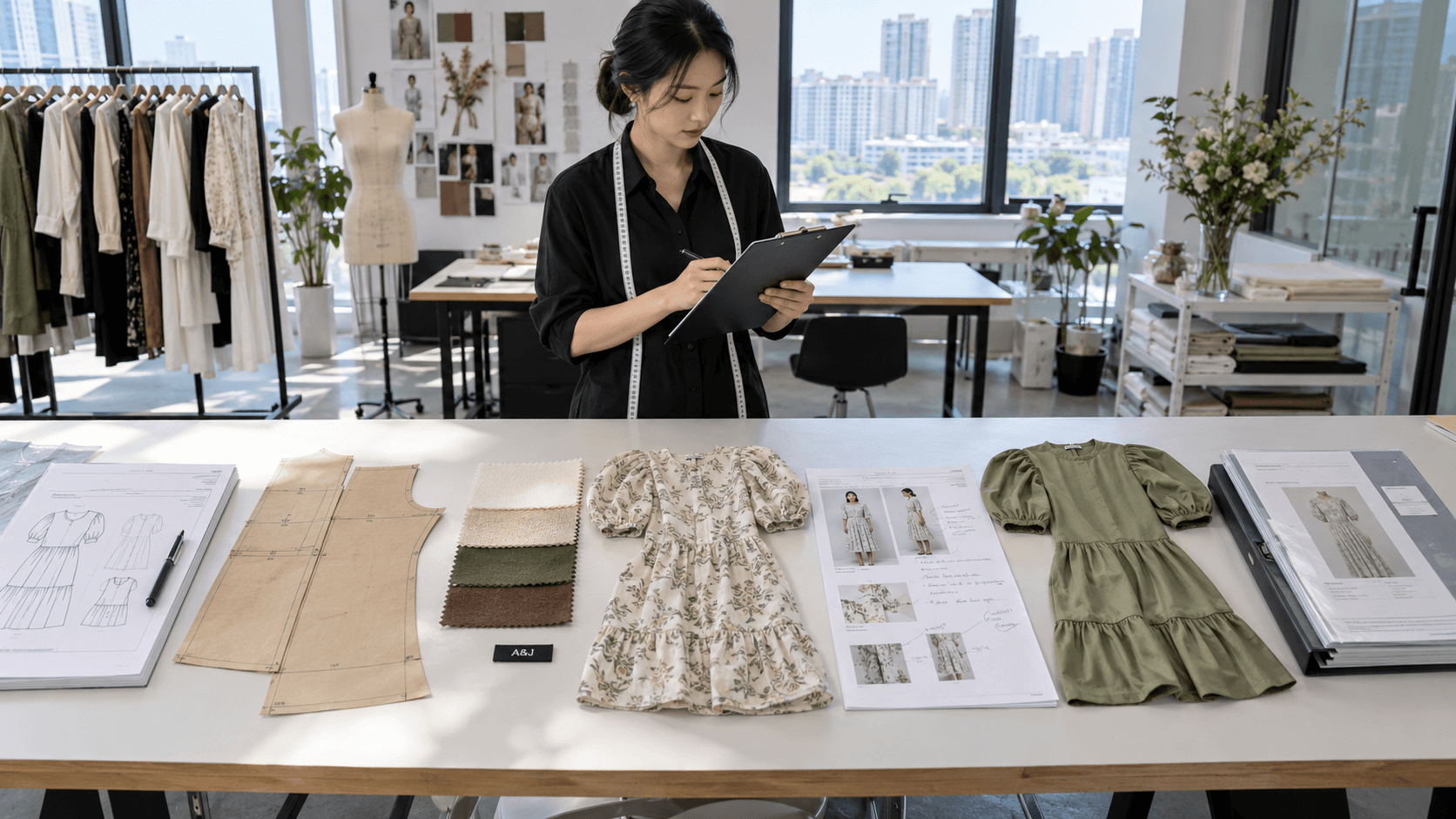
TL;DR: What is private label clothing? It is apparel made for sale under a retailer’s or brand’s identity, but the label alone does not prove ownership of the design, pattern, fabric specification or production files. A&J International Apparel has manufactured womenswear in Dongguan, China since 2006, with a 50-piece minimum per style. Before paying a deposit, put each ownership right and compliance duty in writing.
What is private label clothing in practical factory terms? The phrase describes who markets the garment, not automatically who designed it or who owns its technical assets. A factory may sew your woven label into an existing style, modify one of its blocks, or build a new product from your specification. All three can appear under your brand, yet they create very different rights, costs and switching options.

This distinction matters because a neck label is visible while a pattern file is not. A founder may believe the product is exclusive, then discover that the silhouette came from a shared factory block or that the digital pattern cannot be transferred to another supplier. The useful question is therefore not only, “Will my name be inside the garment?” It is, “Which product assets exist because I paid to create them?”
What Is Private Label Clothing?
What is private label clothing? It is clothing produced by a manufacturer and sold under the buyer’s brand. The buyer normally controls the consumer-facing identity: brand name, woven label, hangtag, packaging and retail presentation. Beyond that baseline, the production model can range from relabelling an existing garment to developing a unique pattern and material specification.
| Private-label level | What changes | What usually remains shared | Appropriate use |
|---|---|---|---|
| Label-only | Main label, care label, hangtag, packaging | Body block, fabric, trims and construction | Testing a sales channel quickly |
| Modified block | Labels plus length, fit, colour or selected details | Factory’s underlying base pattern | Creating a recognisable variation with controlled development |
| Fully developed | Pattern, grading, fabric, trims, construction and branding | Only general factory methods and equipment | Building a repeatable proprietary product |
A product can therefore be genuinely private label without being fully exclusive. What is private label clothing should never be answered with a single yes-or-no claim; the correct answer states which layer is private and which layer remains part of the supplier’s shared system.
This is also why private label is not a quality grade. A garment may be well made or poorly made under any ownership model. The term describes commercial identity and product control, not seam quality, fabric performance or inspection discipline.
Four Rights Hidden Inside One Private Label
When buyers ask what is private label clothing, they often combine four separate rights:
- Brand identity rights — permission to use your name, labels, artwork and packaging.
- Design rights — ownership of original drawings, artwork, colour combinations and design instructions.
- Pattern rights — control of the digital pattern, grading and approved measurement rules.
- Production-data rights — access to bills of materials, colour recipes, embroidery files, screen separations and approved construction notes.
| Asset | Ownership question to write down | Evidence to request |
|---|---|---|
| Brand artwork | Who supplied and authorised it? | Dated source file and written approval |
| Original design | Was it created by the buyer or adapted from a factory style? | Design brief and revision history |
| Pattern | Who paid for pattern making and grading? | Digital file release clause |
| Fabric specification | Is it exclusive, reserved or openly available? | Mill reference and approved swatch |
| Decoration file | Can the buyer reuse it on a reorder or at another facility? | Named embroidery or print file |
| Colour recipe | Will the recipe be retained for repeat production? | Lab-dip code and retention period |
A woven label proves brand identity, but it does not answer the other three ownership questions. In our agreements, patterns developed at the buyer’s cost belong to the buyer and can be released as digital files on request. Buyers should require the same clarity from any supplier rather than relying on an informal promise. In this ownership context, what is private label clothing becomes a file-control question as much as a branding question.

What Is Private Label Clothing Compared With White Label?
White label normally begins with a finished or nearly finished product offered to multiple buyers. The buyer adds branding and may select from available colours or trims. Private label may also begin from an existing block, but it permits deeper product decisions and can extend to a unique pattern.
| Decision | White label | Private label |
|---|---|---|
| Base pattern | Supplier-controlled and shared | Shared, modified or buyer-owned |
| Fabric | Existing option | Existing or buyer-specified |
| Fit changes | Usually none | Possible after pattern review |
| Development cost | Limited | Depends on the amount of original development |
| Launch speed | Faster | Longer because approvals are required |
| Exclusivity | Usually limited | Must be defined asset by asset |
Our detailed private label vs white label clothing guide handles that purchasing decision. This article has a narrower purpose: defining what is private label clothing and showing why the word “private” must be translated into specific contractual rights.
One reliable test is to ask, “Is there a pattern that exists only because of my project?” If the answer is no, the product may still carry your private label, but its silhouette is probably not exclusive. That is not automatically a problem. It becomes a problem only when the buyer assumes exclusivity that was never created or priced.
What Is Private Label Clothing Development in Seven Steps?
A disciplined process turns the phrase into an auditable product programme.
- Define the level of control. Decide whether you need label-only branding, a modified factory block or a fully original product.
- Issue a technical brief. State measurements, materials, colours, trims, construction and test requirements. Our tech pack for clothing guide shows the minimum working structure.
- Assign ownership before development. Name the owner of patterns, grading, artwork, decoration files and colour recipes.
- Approve physical materials. Sign fabric, colour, trim and label samples rather than approving only photographs.
- Fit the garment. Review balance, movement and measurement consistency on the intended body rather than relying on a flat sample.
- Approve a pre-production sample. Confirm the bulk method, including labels, packing and compliance information.
- Archive the approved assets. Retain versioned specifications, sample comments and production files for reorders or supplier changes.
What is private label clothing without this sequence? Often it is only a branding transaction. The product may still be saleable, but the buyer has less control over repeatability and fewer assets to transfer if the relationship ends.

Costs Come From Control, Not From the Label
Sewing in a label is a minor operation. The meaningful cost in what is private label clothing comes from creating and approving product-specific assets.
| Development item | Indicative range (USD) | Reusable on an unchanged reorder? |
|---|---|---|
| Pattern making | 45-160 per style | Yes |
| Size grading | 35-90 per style | Yes |
| Proto and fit samples | 90-350 per round | The approval is reusable; physical sampling is not |
| Lab dips | 40-80 per colour | Recipe should be retained |
| Embroidery digitising | 30-60 per artwork | Yes |
| Print screens | 25-45 per screen | Yes while frames and artwork remain unchanged |
| Custom trim tooling | 40-180 per item | Usually, subject to supplier retention |
These are indicative development ranges, not a price list. Fabric, construction, sample count and supplier tooling alter the total. A quote should separate one-time development from recurring unit costs. If an unchanged reorder carries the full pattern or digitising charge again, ask what new work is being performed. In cost terms, what is private label clothing depends on how many original assets the project must create.
A 50-piece first run spreads fixed development over fewer garments than a larger order. That does not mean the factory should hide the cost inside one opaque unit price. Separating it helps the buyer see which assets have already been paid for and which charges should disappear on the next run.
Our small quantity womens clothing manufacturer guide explains the fixed production inputs behind a 50-piece run. Brands planning their first supplier relationship can also use how to find a clothing manufacturer to compare factories through parallel sampling rather than claims alone.
Labels Create Compliance Duties, Not Just Brand Recognition
What is private label clothing from a regulator’s perspective? It is still a textile product whose seller, importer or responsible business may have labelling and recordkeeping duties. A brand cannot outsource every legal responsibility simply because a factory made the garment.
For the United States, the Federal Trade Commission textile labelling guidance explains fibre content, country of origin and manufacturer or dealer identification requirements. Care instructions are governed separately. Requirements differ by destination market, product and sales channel, so obtain qualified advice for the markets where goods will be sold.
| Information layer | Factory contribution | Brand or importer decision |
|---|---|---|
| Fibre content | Provide verified composition data | Ensure the retail claim matches evidence |
| Country of origin | State where processing occurred | Use the legally correct retail disclosure |
| Care instructions | Supply test and material information | Approve instructions suitable for the finished garment |
| Responsible business identity | Supply manufacturer details where required | Determine importer, dealer or RN presentation |
| Claims and certifications | Provide valid scope documents | Use only claims covered by the actual product and supply chain |
For chemical-safety claims, verify both the certificate and its scope through OEKO-TEX STANDARD 100. A supplier certificate is not enough if it covers a different facility, material or validity period. Our certified womens clothing manufacturer hub provides a broader certificate-verification framework.
How to Verify a Private Label Manufacturer
Once you understand what is private label clothing, the factory check becomes more precise. Ask for evidence tied to your exact product rather than a general capability deck.
- Request the legal manufacturing entity and match it to the quotation and invoice.
- Ask which operations occur in-house and which are subcontracted.
- Request a video walkthrough from sample room to cutting, sewing and inspection.
- Ask who creates the pattern and which digital format can be released.
- Require a bill of materials with supplier references or controlled equivalents.
- Approve a measurement chart with tolerances, not target measurements alone.
- Put file retention, confidentiality and non-reproduction terms in writing.
- Confirm what happens to unused fabric, labels and custom trims after production.
The private label clothing manufacturers USA guide adds a location-specific test: ask where the exact order will be cut and sewn. A sales office address does not prove production origin. The same evidence rule applies in every country. For supplier verification, what is private label clothing must be answered against the exact factory, exact pattern and exact order.

When Another Route Serves You Better
Private label is not automatically the right first move.
Choose white label when the commercial question is demand. If you need to learn whether customers want a colour, print or category, an existing product isolates that question and reduces development variables.
Choose wholesale when assortment speed matters more than product control. Buying finished stock lets a retailer test several silhouettes without creating patterns, grading and production data.
Choose contract development support when the idea is not yet manufacturable. A factory can interpret a clear brief, but it should not quietly invent the brand’s customer, fit objective or aesthetic. Design and technical-development specialists may be needed before quotation.
Delay production when financing stops at sampling. Knowing what is private label clothing includes understanding that sample approval creates an obligation to fund materials, bulk production, freight, duties and selling costs. A completed sample is not a substitute for a complete launch plan.
For developed womenswear, A&J International Apparel fits brands that need a custom block, controlled materials and repeatable production from 50 pieces per style. We are not a source of ready-to-ship blanks, footwear or menswear. Our private label dress manufacturer and private label swimwear manufacturer pages show how the model changes with category-specific construction.
The Short Answer to What Is Private Label Clothing
What is private label clothing? It is apparel sold under your brand, with the depth of product control defined by the development agreement. The label gives you market identity. Original design files, patterns, specifications and production data give you operational control. Neither should be assumed from the other.
Before paying a deposit, make a one-page ownership schedule. List every asset, who creates it, who pays for it, who owns it, how long it will be retained and whether it will be released. That single document makes what is private label clothing measurable instead of promotional.

Frequently Asked Questions
What is private label clothing in one sentence?
Private label clothing is apparel produced for sale under a buyer’s brand, with the level of design, pattern and material control defined by the supplier agreement.
Does a private label mean the clothing design is exclusive?
No. The branding may be exclusive while the factory block, fabric or construction remains available to other buyers. Exclusivity must identify the protected asset, market, duration and permitted use.
Who owns the pattern for private label clothing?
Ownership depends on the written agreement. When the buyer pays for original pattern development and grading, the agreement should state that the files belong to the buyer and can be released on request.
What is the minimum order for private label clothing?
Minimums vary by factory, fabric and custom trim. A&J International Apparel starts at 50 pieces per style when the selected materials and components support that quantity.
Can I start with private labels only and develop my own clothing patterns after sales prove the demand?
Yes. Begin with controlled label-only or modified-block products, document what remains shared, then invest in buyer-owned patterns after the product concept demonstrates repeat demand.


Leave a Reply