
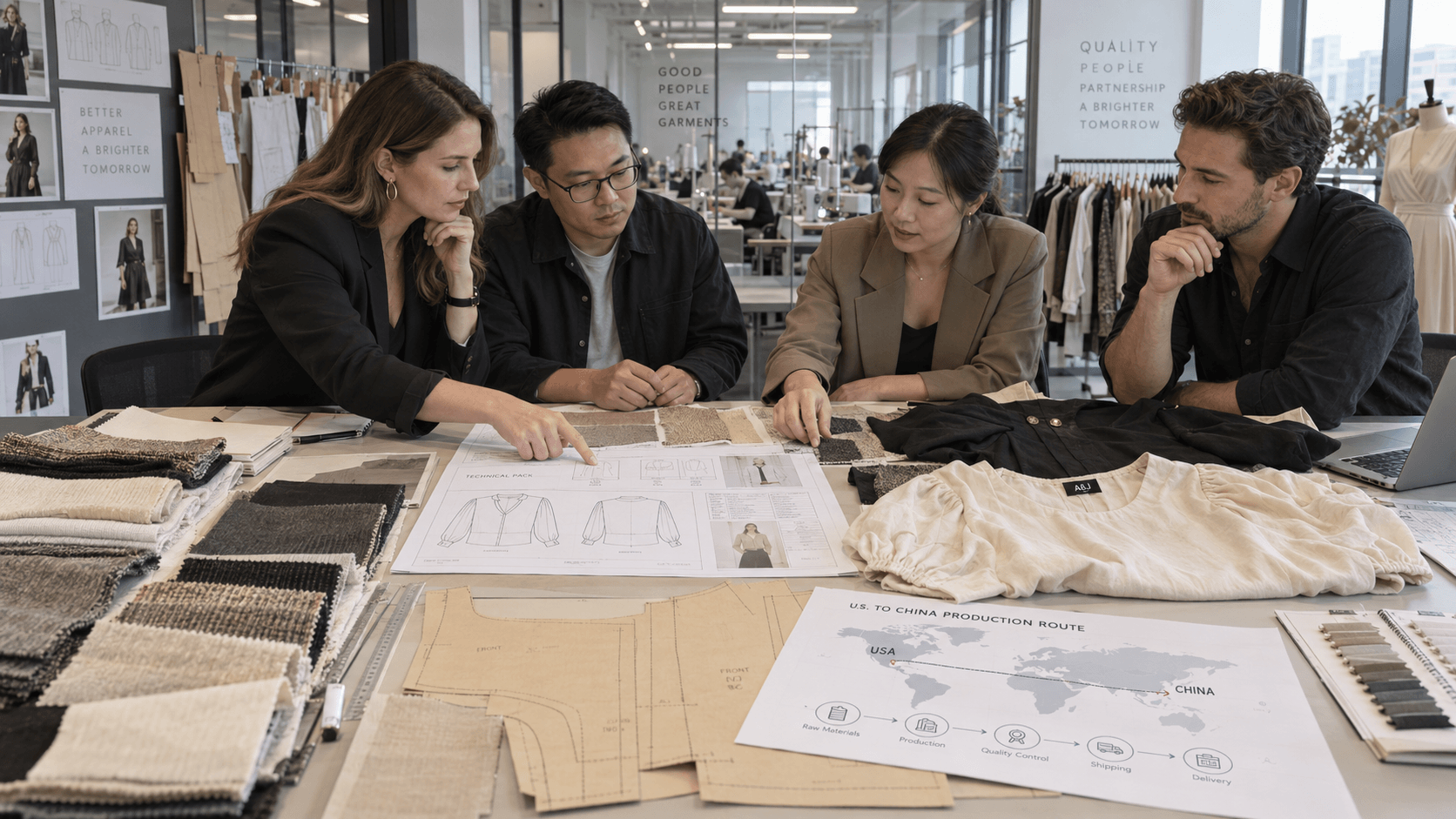
TL;DR: Private label clothing manufacturers USA searches mix two different needs: factories physically making garments in the United States and overseas factories building private label ranges for American brands. A&J International Apparel is the second type—a Dongguan, China womenswear manufacturer founded in 2006 with a 50-piece minimum per style. This guide shows how to compare both routes without confusing factory location, origin claims, landed cost, or pattern ownership.
A buyer searching for private label clothing manufacturers USA can be asking either “Who manufactures inside America?” or “Who can manufacture for my American label?” Those are not equivalent questions. The first is about origin. The second is about supply-chain fit.
A factory should state which answer it represents before discussing price. We manufacture in Dongguan, China and supply brands serving the United States. Garments made here cannot carry an unqualified Made in USA claim, and we do not offer a wording workaround.
That boundary makes the rest of the comparison useful. Once origin is clear, a buyer can evaluate minimums, development ownership, lead time, compliance and landed cost on their actual merits.
What Private Label Clothing Manufacturers USA Can Mean
The phrase covers four supplier models. Each can be legitimate, but they solve different problems.
| Supplier model | Production location | What the buyer controls | Common trade-off |
|---|---|---|---|
| Domestic full-package factory | United States | Pattern, fabric, trims, packaging | Higher unit cost and narrower material access |
| Domestic cut-and-sew contractor | United States | Construction; buyer sources most inputs | Buyer coordinates fabric, trims and decoration |
| Overseas private label factory | Outside the United States | Pattern, materials, grading and packaging | Longer freight and import responsibility |
| US-based sourcing office | Mixed supplier network | Project management rather than direct production | Less visibility into the actual factory |
The fourth model creates the most confusion in private label clothing manufacturers USA research. A US phone number, showroom or sales office does not establish where cutting and sewing occur. Ask for the production address and the legal entity named on the commercial invoice.
For private label clothing manufacturers USA research, the useful first filter is not “Are you based in America?” It is “Where will this specific order be cut and sewn?” That wording closes the showroom loophole without assuming misconduct.
Made in USA and Made for USA Are Different Claims
For private label clothing manufacturers USA comparisons, the distinction is legal, not stylistic. The US Federal Trade Commission treats an unqualified Made in USA claim as a statement that a product is all or virtually all made in the United States. A brand cannot convert imported production into US origin by adding labels, packing cartons or operating a domestic design studio.
That means an overseas factory serving American labels should use accurate country-of-origin marking. Our production is marked Made in China. A&J can help prepare fibre content, care instructions, brand labels and packing specifications for the US market, but we cannot turn Chinese manufacture into American origin.
When evaluating private label clothing manufacturers USA, check four separate statements:
- Where the company is registered
- Where the pattern and samples are developed
- Where fabric is made or finished
- Where the garment is cut and sewn
Only the fourth answers the manufacturing-origin question. The FTC publishes the current Made in USA guidance and links to the governing labeling rule. Use that source rather than a supplier’s marketing language.
When Domestic US Production Is the Stronger Route
A Chinese factory should be willing to say when a US factory fits better. Four situations make domestic production structurally stronger.
The origin claim is central to the product. If Made in USA is printed on the hangtag, sits in the campaign headline or justifies the selling price, production must be designed around that requirement from day one.
You need physical fittings every few days. A local sample room can pin a garment on the fit model in the morning and return a corrected pattern the same week. International sample shipping adds unavoidable calendar time.
The first run is under 50 pieces per style. A domestic studio taking development-scale orders may be more economical because an overseas shipment spreads freight, import processing and fabric setup across too few units.
Your inputs are already in the United States. If branded fabric, hardware or deadstock is held domestically, exporting it for sewing and importing the garments back creates two logistics movements with no material advantage.
These are not minor exceptions. A buyer comparing private label clothing manufacturers USA should treat them as early disqualifiers rather than reasons to negotiate harder with an overseas supplier.

When an Overseas Factory Serving USA Brands Wins
Private label clothing manufacturers USA buyers may find overseas production stronger when the range needs deeper material access, more processes under one roof or a stable 50-300 piece development path.
Dongguan sits inside a dense apparel supply chain. Fabric markets, dye houses, embroidery units, print shops, label makers and packing suppliers operate within the same regional network. That density reduces the number of hand-offs a buyer has to manage.
Private label clothing manufacturers USA sourcing often reaches China for five reasons:
- Material breadth — more stock fabrics across woven, knit, performance and lining categories
- Integrated development — pattern, grading, sampling, sourcing and bulk production managed together
- Flexible first runs — 50 pieces per style when standing fabrics are used
- Decoration access — embroidery, screen print, heat transfer and garment washing in the same cluster
- Repeatability — digital patterns, lab-dip recipes and approved trim records retained for reorders
The gain is not simply a lower sewing rate. It is the ability to coordinate more variables through one production owner. Our guide to a Chinese womens clothing manufacturer explains how to distinguish a factory, trader and sourcing office before sending a deposit.
Private Label Clothing Manufacturers USA Cost Comparison
For private label clothing manufacturers USA candidates, a unit quote is not a cost comparison until both routes include the same items. Compare landed cost, not factory price alone.
| Cost line | Domestic US route | Overseas private label route |
|---|---|---|
| Pattern and grading | Often billed separately | Usually billed separately on the first order |
| Fabric | Lower freight if sourced domestically | Wider stock access; mill minimums still apply |
| Sewing | Higher labour component | Lower labour component, longer logistics chain |
| Decoration | Frequently subcontracted | Often coordinated within the factory cluster |
| Freight | Domestic parcel or truck | Air or ocean plus domestic delivery |
| Import processing | Not applicable to domestic production | Buyer or broker handles classification and entry |
| Reorder setup | Depends on who owns files | Low when block, lab dip and trims are retained |
For a first order, include development as its own line. A typical womenswear style may require pattern making, grading, two or three samples, lab dips and trim setup before bulk production begins. Our private label dress manufacturer page breaks out a USD 200-400 development range for a standard dress, while swim construction can run higher because fit and performance testing add work.
Do not treat a percentage gap between unit quotes as a decision. Add freight, duty based on the confirmed classification, broker fees, domestic delivery, development and expected defect handling. Any supplier giving a final landed number without seeing the fibre composition and construction is guessing the tariff classification.
The 50-Piece Minimum and What It Does Not Mean
A&J runs a 50-piece minimum per style. That figure is possible because we hold standing materials and schedule short production runs deliberately; it does not mean every fabric, colour and trim is available at 50 pieces.
Three quantities operate inside one order:
| Quantity layer | Controlled by | Practical effect |
|---|---|---|
| Garment minimum | Factory | 50 pieces per style at A&J |
| Dye-lot minimum | Fabric mill | May force stock colours or shared fabric |
| Trim minimum | Label or hardware supplier | Surplus labels may be stored for reorders |
This distinction matters when comparing private label clothing manufacturers USA. Two factories can both quote 50 pieces while offering different products: one uses stock fabric and stock colour; the other prices an entire dye lot into the order. The headline minimum is identical and the underlying commitment is not.
Our small quantity womens clothing manufacturer guide explains the fixed costs behind a short run. If the requirement is a single garment rather than 50 pieces, clothing manufacturer no minimum separates print-on-demand, sample-room production and consolidated trading models.

Pattern Ownership Is More Important Than Factory Country
Private label clothing manufacturers USA searches should not assume a domestic factory releases files while an overseas factory locks them in. Geography does not determine ownership; the development agreement does.
Before paying a development fee, ask:
- Who owns the base pattern and graded sizes
- Whether digital files are released on request
- Whether fabric and trim suppliers are disclosed
- Whether another factory may reproduce the approved style
- How long samples, colour recipes and trim records are retained
Our position is direct: when a buyer pays for custom pattern development, the buyer owns those pattern files and can request them. That rule applies whether the next order stays with A&J or moves elsewhere.
This is the most useful test for private label clothing manufacturers USA candidates because it distinguishes private label development from relabelling stock. Ask whether a pattern exists only because your brand paid to create it. If the answer is no, you are probably buying a modified catalogue style.
The full distinction is covered in private label versus white label clothing. Category examples include our private label activewear manufacturer and private label swimwear manufacturer programmes.
US Compliance Belongs in the Tech Pack
Country of origin is one requirement, not the whole compliance file. A production brief for the United States should identify fibre content, care instructions, manufacturer or dealer identity, label permanence and the intended market before bulk labels are ordered.
A factory can execute supplied requirements and provide material documentation, but the US importer or brand remains responsible for confirming the final product and claim set. Products for children add a separate compliance layer and should never be quoted as ordinary adult apparel with a smaller measurement chart.
Material certificates should also be verified rather than accepted as a logo on a PDF. The public OEKO-TEX database lets buyers check certificate scope and validity. Our certified womens clothing manufacturer hub explains the difference between chemical safety, fibre-source, management-system and social-compliance evidence.
For private label clothing manufacturers USA evaluation, put compliance fields into the request for quotation. A supplier cannot price the correct label set, testing path or documentation if the intended market is disclosed after sampling.
A Realistic Development and Delivery Timeline
A private label clothing manufacturers USA comparison should allow for an overseas first custom style taking longer than a domestic sample-room project while gaining time on integrated bulk execution.
| Phase | Typical duration | Decision required |
|---|---|---|
| Specification and costing | 1-2 weeks | Fabric, construction and target quantity |
| Pattern and first sample | 2-3 weeks | Base block and finish details |
| Fit corrections | 3-6 weeks | One to three rounds depending on category |
| Fabric and trim approval | 2-4 weeks | Colour, hand feel, labels and hardware |
| Pre-production sample | 1-2 weeks | Bulk method confirmed |
| Bulk production | 4-6 weeks | Cutting, sewing, finishing and QC |
| Freight and import | Route dependent | Air or ocean, broker and final delivery |
A realistic planning window is 12-23 weeks before freight variability. Reorders in the same block and material can remove most development time.
Private label clothing manufacturers USA operating domestically may compress sample movement and freight, but they may still wait for imported fabric or trims. Ask for a phase-by-phase calendar rather than one ship date. A calendar exposes which inputs are already controlled and which are still assumptions.

How to Compare Private Label Clothing Manufacturers USA Candidates
Use the same evidence request for every private label clothing manufacturers USA candidate. A polished quotation is not evidence of production control.
- Request the exact cutting and sewing address for the quoted order
- Ask who employs the production workers and owns the machinery
- Request a video walkthrough from fabric storage to final inspection
- Confirm pattern ownership and digital-file release in writing
- Obtain production-fabric test reports rather than reports for a similar material
- Ask for a phase-by-phase calendar with approval gates
- Compare landed cost using the same freight and import assumptions
The third step is deliberately specific. A showroom video proves a showroom. A continuous walkthrough that starts at the cutting table, enters the sewing line and ends at packed goods is harder to substitute with borrowed footage.
Our guide on how to find a clothing manufacturer adds licence, invoice-entity and capacity checks. Private label clothing manufacturers USA searches should use those checks on both domestic and overseas suppliers; proximity does not replace due diligence.
Where A&J Fits—and Where We Do Not
Among private label clothing manufacturers USA buyers evaluate, A&J International Apparel is the overseas option: a womenswear manufacturer in Dongguan, China, founded in 2006, with a 50-piece minimum per style. We develop private label dresses, activewear, swimwear, knitwear and related womenswear for brands serving the United States, Europe, the Middle East, Australia and Japan.
We fit when the buyer wants custom patterns, access to an integrated material network, multiple processes coordinated through one factory and a first run beginning at 50 pieces. We do not fit when the product must legally or commercially carry Made in USA, when the order is below 50 pieces, or when the buyer needs in-person fittings every few days.
That distinction is the honest answer to private label clothing manufacturers USA intent: a US-market supplier and a US-origin manufacturer can both be useful, but they are not interchangeable.

Frequently Asked Questions
Are private label clothing manufacturers USA searches limited to factories physically in America?
No. The phrase is used for both domestic factories and overseas manufacturers serving American brands. Ask where the specific order will be cut and sewn, because a US office or showroom does not establish US manufacturing origin.
Can clothing made by A&J carry a Made in USA label?
No. A&J manufactures in Dongguan, China, so the garments require accurate country-of-origin marking. Adding labels, packing domestically or designing the product in America does not convert the manufacturing origin.
What is A&J’s minimum for a private label order serving the US market?
The minimum is 50 pieces per style when the design uses workable materials and trims. Bespoke colours, specialty fabrics or custom hardware may carry separate supplier minimums even when the garment minimum remains 50.
Which costs should I add when comparing US and overseas factories?
Compare development, fabric, trims, sewing, decoration, freight, import processing, domestic delivery and expected reorder setup. Do not compare a domestic delivered quote against an overseas factory price that excludes logistics and entry costs.
Can I use a Chinese factory for my American brand without presenting the product as American-made?
Yes. Many American brands source internationally and use accurate origin labels. Your brand identity can be American while the garment is marked Made in China; the key is that product-origin claims and required labels remain truthful.


Leave a Reply