
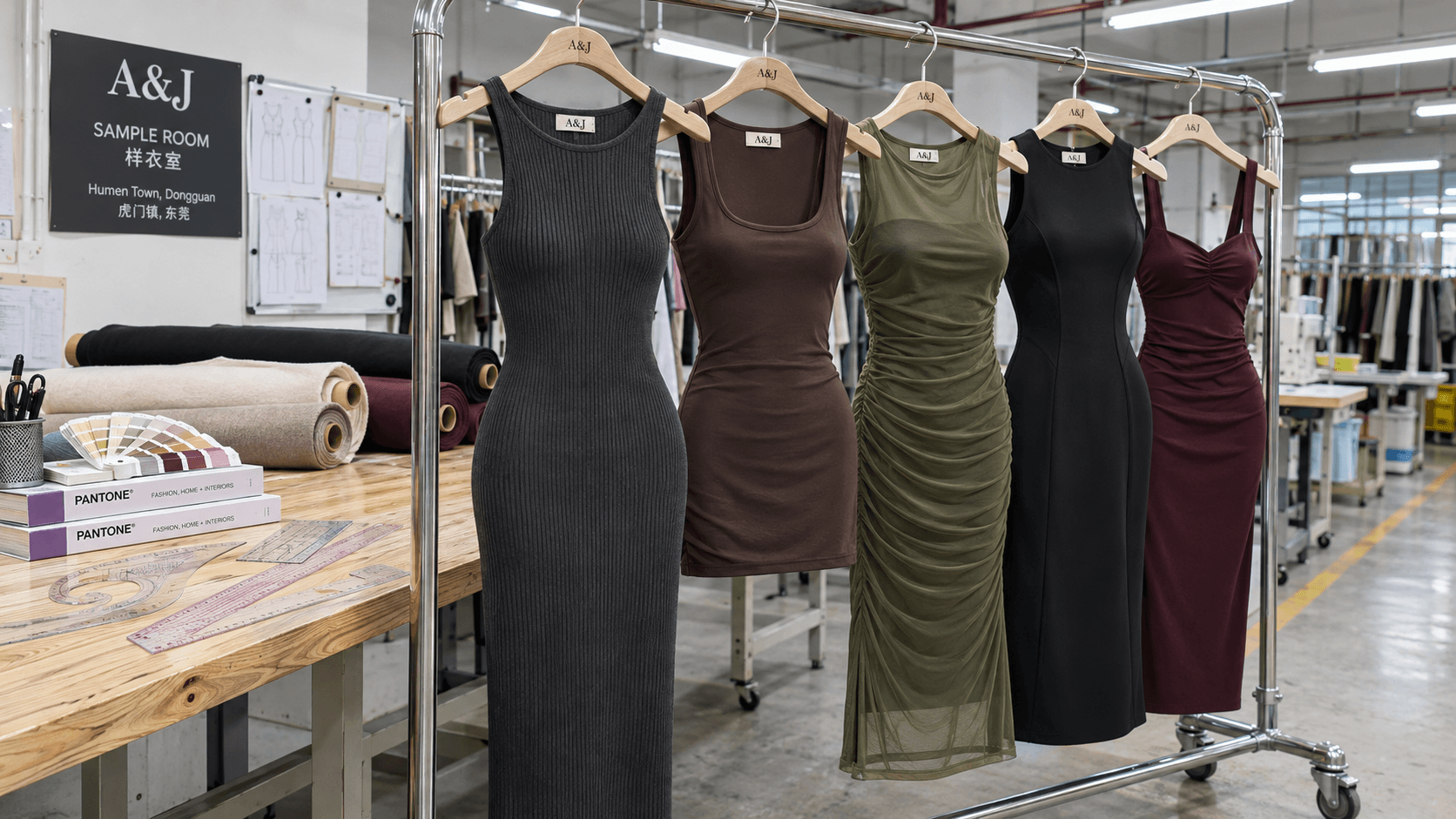
TL;DR: Selecting a bodycon dress manufacturer requires locking six connected release checkpoints before bulk cutting: construction route and negative-ease geometry, elastane recovery and spirality control, stretched-state opacity and lining differential, four-thread overlock and zipper wave prevention, non-linear multi-size curve grading, and care-label plus reorder archiving. Because contour-hugging dresses remain under continuous horizontal tension across the bust, waist and hip, standard woven dress tolerances cause see-through panels, wavy zippers or riding hemlines. A&J International Apparel Limited, operated by Dongguan Taide Clothing Co., Ltd. (founded in 2006 in Humen Town, Dongguan, China, with a 50-piece minimum order quantity), works with womenswear brands to lock these six production records before bulk release.
When a fashion label briefs a bodycon dress manufacturer, the primary technical failure is treating a contour-fitting dress like a regular knit sheath with smaller flat measurements. In a bodycon silhouette, the pattern block is drafted smaller than the wearer’s body circumferences—a principle known as negative ease—so elastomeric yarn generates inward tension that sculpts the frame. Without recovery testing and seam extension rules from an experienced bodycon dress manufacturer, bulk garments bag out at the seat or pop stitches when pulled over the shoulders.

How This Guide Separates Contour Dress Engineering From Sibling Pages
To keep your sourcing records clean and avoid overlapping specifications across our womenswear library, this guide focuses strictly on negative-ease contour dress engineering with a specialized bodycon dress manufacturer. For full collection planning across woven and knit dresses, review our womens dress manufacturing program. For floor-length sweeping hems and vertical hang weight, consult our maxi dress manufacturer guide. Structured event silhouettes belong on our custom cocktail dress manufacturer and party dress manufacturer pages, while flat-bed sweater dresses are covered in our wholesale knit dress manufacturer workflow and high-compression foundation garments are detailed in our shapewear manufacturer China guide.
Why Contour Silhouettes Fail When Built on Standard Sheath Blocks
A woven or relaxed knit sheath hangs vertically from the shoulders with positive breathing room. Once a design switches to negative ease, the bust, waist and hip become active tension zones where horizontal stretch pulls upward on the hem. If a pattern maker simply narrows an existing dress block without calibrating recovery and vertical curve consumption, the dress rides up during walking and turns sheer across the seat. That is why a qualified bodycon dress manufacturer engineers a dedicated negative-ease block matched to the spandex modulus of your chosen fabric roll.
| Contour Silhouette Type | Primary Structural Risk | Pattern & Seam Control | Production Release Status |
|---|---|---|---|
| Heavyweight 1×1 or 2×2 Rib Knit | Seat and knees bag out after seated wear; neck binding ripples | Match negative ease to tested lateral recovery; lock coverstitch feed | Confirm before bulk release |
| Double-Layer Sculpting Jersey | Inner layer pulls tighter than outer shell, causing hem roll | Pattern zero-drag lining differential; understitch neckline and armholes | Record per order |
| Ruched Stretch Mesh Overlay | Gathering elastic snaps or base lining shifts during movement | Anchor shirring with elastic thread over opaque power-mesh base | Enter tested result |
| Structured Ponte Roma Contour | Center-back invisible zipper waves into buckles down the spine | Fuse stretch tricot stay tape along zipper allowance before sewing | Confirm before bulk release |
Checkpoint 1: Define the bodycon dress manufacturer Construction Route
Before requesting a unit quote from a bodycon dress manufacturer, buyers should separate cut-and-sew contour production from circular seamless hosiery knitting and medical compression engineering.
A&J International Apparel Limited operates as a cut-and-sew bodycon dress manufacturer in Humen Town, Dongguan, starting at a 50-piece minimum order quantity per style. We do not operate Santoni circular seamless tube-knitting cylinders, flat-bed sweater looms, medical compression lines or print-on-demand fulfillment. Stating this boundary upfront prevents brands from sending seamless tube references to a cut-and-sew floor or expecting molded lingerie cup support from a fashion knitwear line.

Checkpoint 2: Lock Elastane Recovery, Spirality and Stretched Opacity
Contour dresses rely on elastomeric yarns (spandex or elastane) to snap back after stretching over the body. Evaluating a bodycon dress manufacturer on fabric gram weight alone is insufficient because yarn twist, elastane percentage and knitting gauge determine whether a dress holds its shape or turns see-through under studio lighting.
Negative Ease and Recovery Pairing. A 92% modal / 8% elastane jersey behaves very differently from a 2×2 cotton-spandex rib or a double-knit ponte. When a design uses negative ease, your bodycon dress manufacturer must match the pattern block to the tested crosswise elongation and recovery of the bulk fabric roll. Substituting a lower-recovery jersey during bulk purchasing causes the hip and seat panels to sag after the first wear.
Stretched-State Opacity and Lining Differential. Evaluating fabric opacity while a swatch lies flat is a common sourcing trap. When a single-layer knit stretches 20% to 30% across the hip and bust, the knit loops open up and expose seam lines. Brands should require their bodycon dress manufacturer to verify opacity at wear tension over a contrast board and specify full self-fabric double layering or stretch tricot lining for ivory, white and pastel shades.
| Fabric Category | Typical Contour Application | Opacity & Lining Rule | Pre-Cut Verification |
|---|---|---|---|
| High-Gauge Modal / Polyamide Spandex | Sleek sculpting mini and midi contour styles | Full self-fabric double layer to smooth lines and block sheerness | Enter tested result |
| Heavyweight Cotton / Rayon Elastane Rib | Day-to-night ribbed midi dresses, tank silhouettes | Test light shades at worn stretch; double-layer bust or full body | Confirm before bulk release |
| Stretch Mesh Over Jersey Base | Ruched evening, club and resort occasion dresses | Mandatory opaque stretch jersey base lining under ruched shell | Record per order |
| Double-Knit Interlock Ponte Roma | Structured long-sleeve and zip-back tailored styles | Single layer acceptable in dark tones; tricot lining for light shades | Confirm before bulk release |
Checkpoint 3: Engineer Four-Thread Overlock Seams, Zippers and Hems
Every vertical and horizontal seam on a contour garment must extend at least as far as the surrounding fabric without snapping thread or creating wavy ripples. A reliable bodycon dress manufacturer treats stitch architecture, stay tape and presser-foot differential feed as load-bearing specifications.

Vertical Seam Extension and Hem Coverstitch. Joining front and back panels with a rigid lockstitch will cause threads to pop the moment the wearer steps into the dress. Instead, a bodycon dress manufacturer uses four-thread overlock seams with texturized nylon or polyester looper threads, paired with two-needle bottom coverstitching at the hem. If the coverstitch differential feed is set too tight, the bottom edge flares like lettuce edging; if too loose, the hem constricts the thighs and forces the skirt to ride up during walking.
Zipper Wave Prevention and Strap Stabilization. Inserting a non-stretch woven invisible zipper tape into a stretch knit seam often causes the zipper spine to buckle into waves down the back. Fusing a narrow stretch tricot stay tape along the zipper allowance and calibrating zero-stretch feed keeps the zipper flat. Shoulder straps, halter necks and cutouts are reinforced with clear TPU framilon tape so hanger storage does not stretch the upper bodice.
Checkpoint 4: Verify Non-Linear Grading and Curve Compensation
Flat table measurements alone cannot prove that a negative-ease garment fits properly across a full size range. When you review a size set with a bodycon dress manufacturer, the fit protocol must combine flat Point of Measurement (POM) checks—recorded on your garment specification sheet—with three-dimensional curve verification.
Vertical Length Compensation Across Sizes. A frequent grading mistake is expanding bust and hip width from XS to XL while keeping vertical torso length nearly static. As bust and seat projections increase in larger sizes, the fabric travels a longer arc over the curves, which pulls the hemline upward. Proper garment grading executed by your bodycon dress manufacturer adds proportional vertical length to the front bodice and back seat per size. Note that anthropometric standards such as ISO 8559-1:2017 size designation and body measurement definitions define human body landmarks, not the negative-ease reductions or finished garment tolerances of your dress block.

Checkpoint 5: Control Pre-Cut Relaxation, Care Labels and Bulk QC
Elastomeric knits accumulate tension while wound onto rolls at the dye mill. If a cutting room spreads and cuts spandex jersey immediately after unrolling, the cut panels contract on the table and finish undersized before reaching the sewing line.
Fabric Relaxation and Technical Documentation. Before bulk cutting, every bodycon dress manufacturer must unroll elastomeric fabrics to rest flat for 24 to 48 hours—or pass them through a tensionless steam-relaxation table—and log the result in your tech pack for clothing.
Care Labeling and Final Inspection. High-heat washing or tumble drying degrades elastane filaments and causes permanent bagging. All fiber composition and care instructions must comply with the FTC Care Labeling Rule compliance guide, specifying cold washing and flat drying substantiated by pre-production wash trials. Before packing, each lot produced by your bodycon dress manufacturer should pass a structured garment quality control checklist covering stretched seam integrity, zipper flatness and shade continuity.
| Inspection Checkpoint | What to Measure or Observe | Common Defect if Skipped | Corrective Action Rule |
|---|---|---|---|
| Pre-Cut Roll Relaxation | Unroll spandex knit 24–48 hours before cutting; verify shrinkage | Cut panels recoil under the knife and finish 2–3 cm too small | Hold cutting until lot relaxation stabilizes |
| Stretched-State Opacity | Stretch light shades to wear tension over high-contrast board | Single-layer ivory or pastel dress turns sheer over hip and bust | Switch to double-layer self fabric or tricot lining |
| Invisible Zipper Spine | Inspect center-back or side zipper on dress form and flat table | Woven zipper tape buckles into waves along stretch knit seam | Apply stretch tricot fusible stay tape and reset feed |
| Hemline Lateral Stretch | Pull bottom coverstitch laterally to simulate walking stride | Tight looper thread snaps or constricts thighs, causing ride-up | Recalibrate coverstitch looper tension before bulk run |
How to Brief a bodycon dress manufacturer: 6-Step Release Workflow

- Define Silhouette and Construction Route: Confirm whether your style is a single-layer rib knit, double-layered sculpting jersey, ruched mesh overlay or structured ponte contour dress.
- Pair Fabric Stretch Ratio With Negative Ease: Test lateral stretch and recovery on the candidate fabric swatch, then draft the base pattern’s negative-ease percentage to match that exact lot.
- Lock Opacity and Lining Differential: Check stretched-state opacity under studio lighting and engineer inner lining patterns so they elongate smoothly with the outer shell.
- Approve Seam, Stay Tape and Zipper Specs: Specify four-thread overlock side seams, two-needle bottom coverstitching, TPU shoulder tape and stretch stay tape on all zipper plackets.
- Validate Non-Linear Size Set Grading: Fit-check XS, M and XL samples to verify that vertical curve compensation keeps the front and back hemline level across sizes.
- Archive Relaxation, Care and Reorder Records: Record pre-cut roll rest times, verified cold-wash care labels and digital CAD markers for repeatable 50-piece MOQ reorders.
If you are preparing a contour dress capsule and need a transparent bodycon dress manufacturer to review your tech pack and 50-piece MOQ schedule, contact the A&J engineering team with your target specifications.
Frequently Asked Questions About Contour Dress Production
What is the minimum order quantity when working with a custom bodycon dress manufacturer?
At A&J, our minimum order quantity is 50 pieces per style and colorway for cut-and-sew contour dresses using available mill-dyed rib, modal-spandex or ponte fabrics. Custom-dyed Pantone shades or custom-knitted structures follow the fabric mill’s dye-vat minimum, confirmed per order before sampling.
How does a bodycon dress manufacturer stop tight mini dresses from riding up during walking?
A bodycon dress manufacturer prevents hem ride-up by balancing the hip-to-waist negative-ease curve, adding vertical seat length for three-dimensional projection, calibrating bottom coverstitch looper elasticity so the hem does not constrict the thighs, and applying silicone stay tape when extra grip is required.
Should light-colored sculpting jersey or rib contour dresses use double-layer construction?
When a fitted contour silhouette is drafted with negative ease, stretching the fabric across the bust and hip opens the knit loops and can make white, ivory or pastel shades appear sheer. Using full self-fabric double layering or a matched stretch tricot lining eliminates sheerness and conceals seam lines.
Why do invisible zippers wave on tight knit dresses, and how is that prevented?
Zipper waves occur when a non-stretch woven zipper tape is sewn into an elastic knit seam that stretches under the presser foot. Fusing a narrow stretch tricot stay tape along the zipper seam allowance and setting zero-stretch differential feed keeps the zipper flat.
Can I use one bodycon dress manufacturer pattern block for both high-stretch modal jersey and structured ponte?
No, you cannot use the same bodycon dress manufacturer pattern block for high-stretch modal jersey and firmer double-knit ponte styles. High-stretch modal uses deeper negative ease and pull-on construction, whereas firmer ponte requires reduced negative ease, darts or princess seams, and a zipper opening.


Leave a Reply