
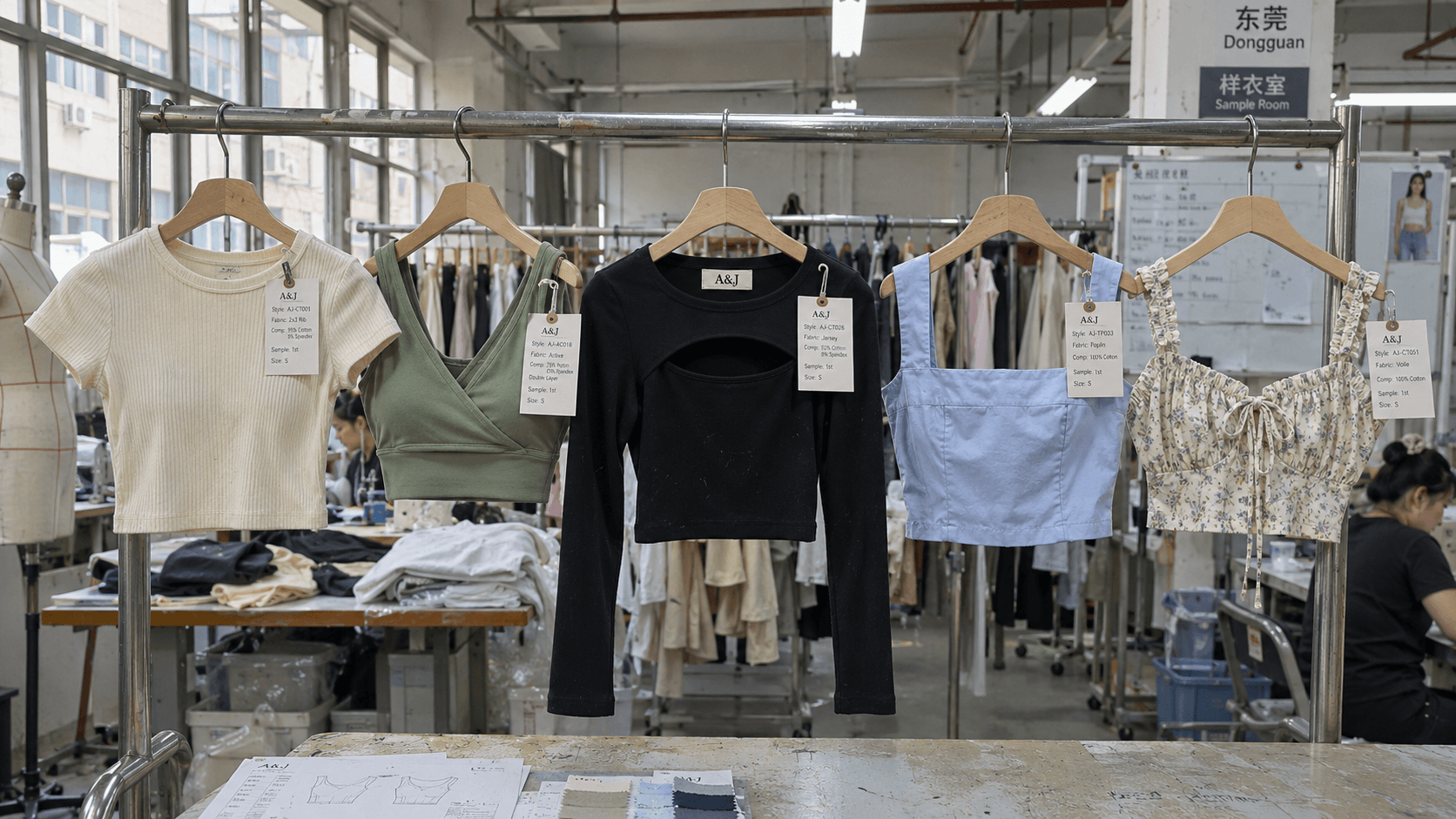
TL;DR: Selecting a crop top manufacturer requires controlling six connected release checkpoints before bulk cutting: production route and silhouette classification, rib or jersey recovery under stretch, hem band and elastic stabilization, arm-raise ride-up allowance, front-panel opacity across light and dark shades, and care-label plus reorder archiving. Because an abbreviated torso length magnifies every millimeter of hem flare, neckline drop or vertical wash shrinkage, standard full-length T-shirt blocks rarely translate into a stable cropped garment. A&J International Apparel Limited, operated by Dongguan Taide Clothing Co., Ltd. (founded in 2006 in Humen Town, Dongguan, China, with a 50-piece minimum order quantity), works with womenswear brands to lock these six production records before bulk release.
When a fashion label briefs a crop top manufacturer, the primary technical failure is treating a cropped silhouette as a regular tee with the bottom cut off. Removing ten to eighteen centimeters of lower torso length changes how the garment hangs from the bust apex, how side seams react during arm movement, and how the bottom hem sits against the ribcage. Without dedicated pattern balance and underband tension rules from an experienced crop top manufacturer, bulk garments either flare out at center front or ride up above the bust line.
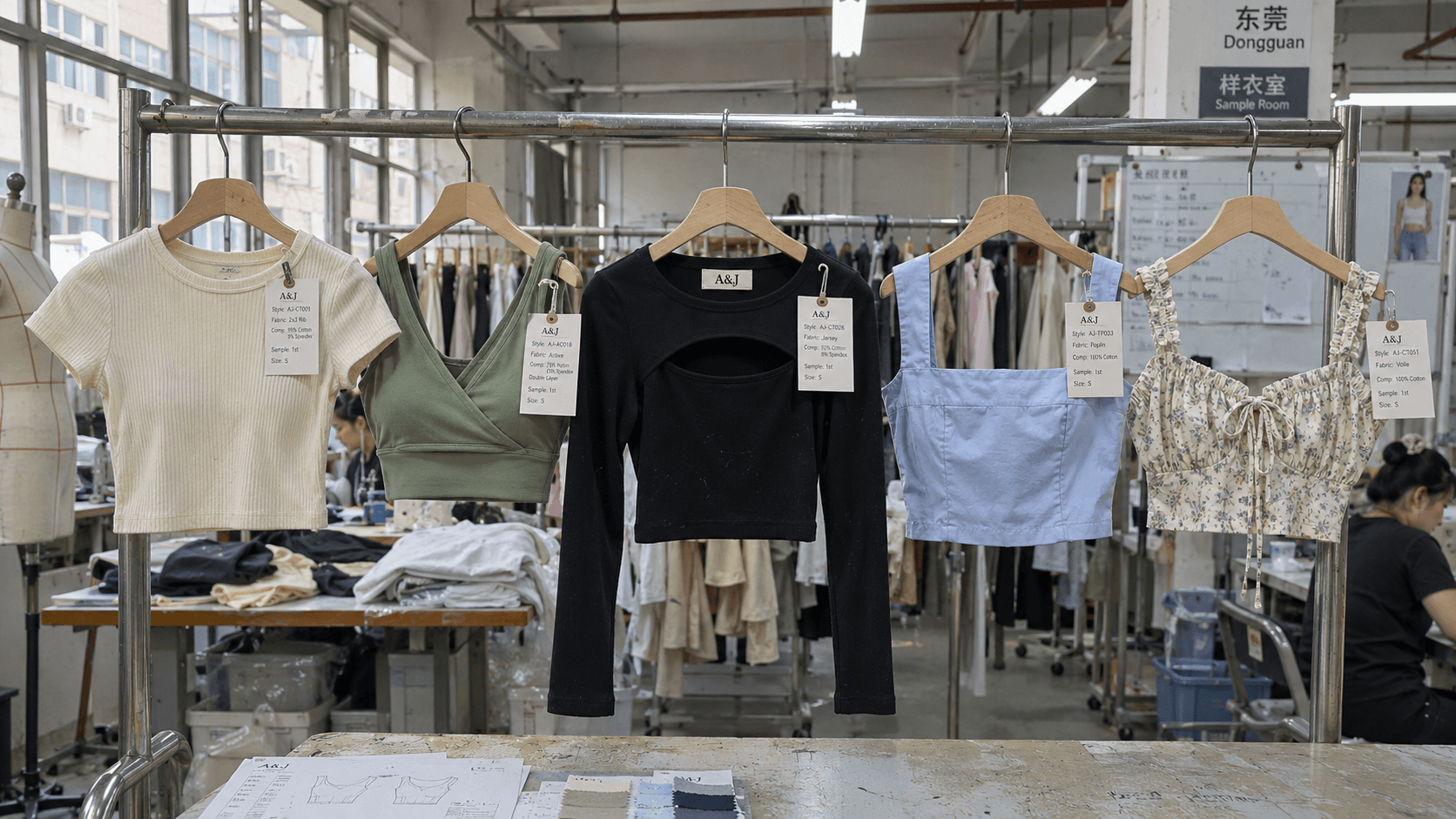
How This Guide Separates Cropped Engineering From Sibling Pages
To keep your sourcing records clean and avoid overlapping specifications across our womenswear library, this guide focuses strictly on abbreviated-torso garment engineering with a specialized crop top manufacturer. For full-torso upper-body grading across blouses and tunics, review our women tops manufacturer page. For standard hip-length jersey tees, consult our womens t-shirt manufacturer guide. High-impact athletic support belongs on our sports bra manufacturer page, while full collection planning is covered in our womens activewear program. Structural fabric differences between stretch knits and rigid wovens are detailed in our knit vs woven fabric comparison.
Why Cropped Silhouettes Fail When Built on Standard Tee Blocks
A full-length garment relies on hip and waist contact plus vertical fabric weight to keep the hemline level. Once the hem is raised above the navel, gravity provides much less downward pull, and the bust slope becomes the dominant suspension point. If a pattern maker simply shortens a standard block without adjusting front-to-back length balance and side-seam taper, the front hem lifts noticeably higher than the back hem as soon as the garment is worn. That is why a qualified crop top manufacturer engineers a dedicated cropped block rather than trimming an existing tee pattern.
| Cropped Silhouette Type | Primary Structural Risk | Pattern & Seam Control | Production Release Status |
|---|---|---|---|
| Fitted Baby Tee (1×1 or 2×2 Rib) | Front hem hikes up over bust slope; neck binding ripples | Add center-front drop balance; lock differential feed on coverstitch | Confirm before bulk release |
| Activewear Underband Cropped Style | Bottom elastic rolls or twists inside self-fabric channel | Anchor clear or woven elastic with 3-needle coverstitch or topstitch | Record per order |
| Boxy Cut-and-Sew Street Silhouette | Wide hem flares outward at side seams after washing | Taper side seam slightly inward; pre-shrink fabric lot before cutting | Enter tested result |
| Woven Smocked or Zip-Back Style | Zero-stretch shell gaps at upper chest or strains zipper | Stabilize zipper placket with fusible interlining; test smocking tension | Confirm before bulk release |
Checkpoint 1: Define the crop top manufacturer Construction Route
Before requesting a unit quote from a crop top manufacturer, buyers should separate cut-and-sew production from circular seamless knitting and molded lingerie engineering. Each route uses different machinery, yarn inventory and minimum order rules.
A&J International Apparel Limited operates as a cut-and-sew crop top manufacturer in Humen Town, Dongguan, starting at a 50-piece minimum order quantity per style. We do not operate circular seamless knitting cylinders, molded underwire bra-cup presses, medical compression lines or single-piece print-on-demand fulfillment. Stating this boundary upfront prevents brands from sending seamless tube references to a cut-and-sew floor or expecting molded lingerie support from a fashion knitwear line.
Checkpoint 2: Lock Fabric Structure, Stretch Ratio and Opacity
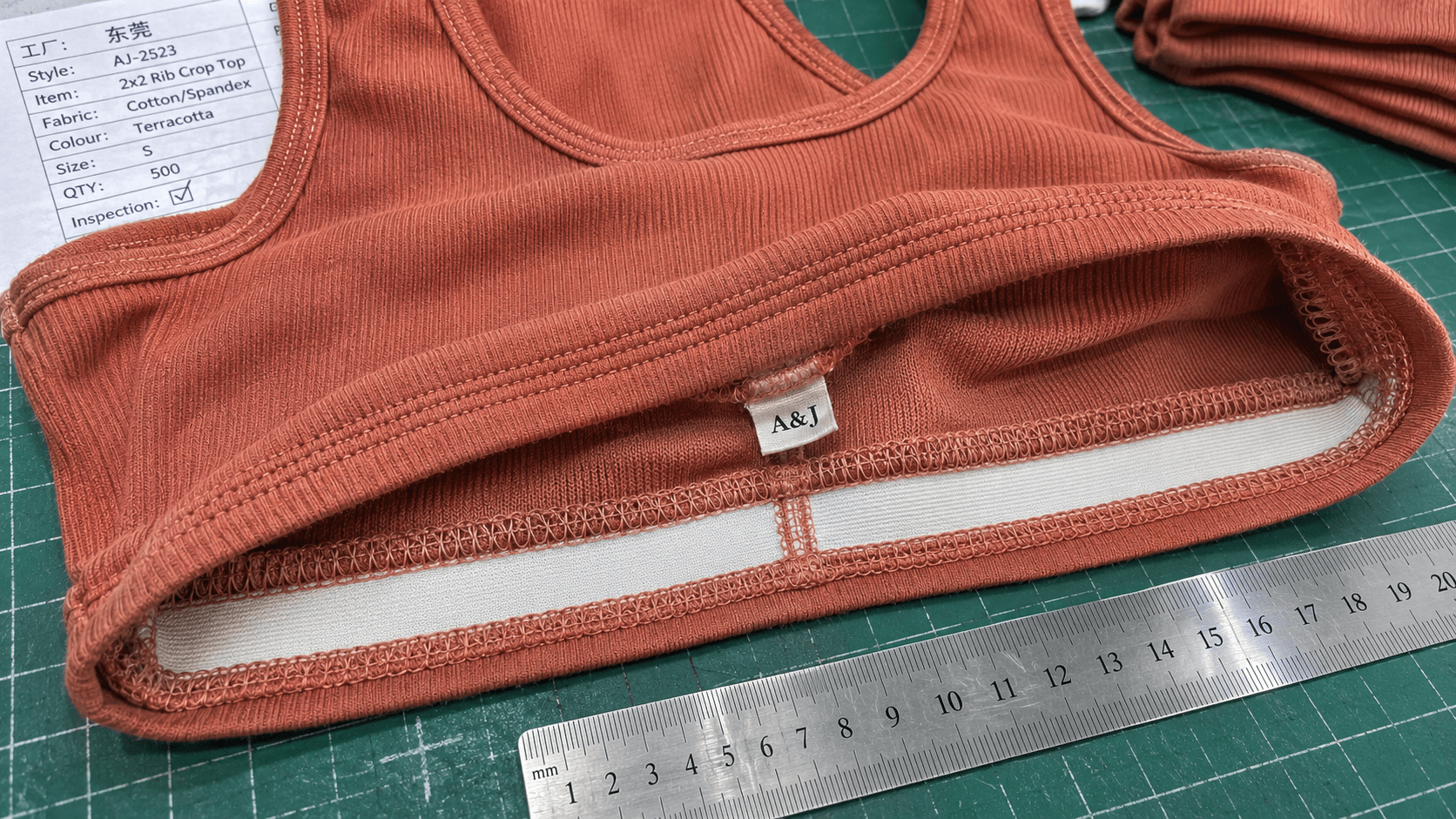
Cropped silhouettes are frequently cut with negative ease—meaning the flat garment chest width is smaller than the wearer’s body chest measurement—so the fabric must stretch smoothly and recover without bagging out. Evaluating a crop top manufacturer on GSM weight alone is insufficient because yarn twist, spandex percentage and knit gauge determine whether a white or pastel rib knit turns see-through over the bust.
Negative Ease and Recovery Pairing. A 95% cotton / 5% elastane 2×2 rib behaves differently from a brushed nylon-spandex interlock or a rigid cotton poplin. When a design uses negative ease, your crop top manufacturer must match the pattern block to the tested crosswise stretch and recovery of the bulk fabric roll. Substituting a lower-recovery jersey during bulk purchasing causes the neckline and hem to sag after the first wear.
Front-Panel Opacity and Lining Rules. Light-colored cropped styles stretched across the chest often reveal seam allowances, pocket bags or skin tone if cut in single-layer jersey. Brands should specify whether the front bodice requires self-fabric double layering, a breathable mesh lining, or a removable pad pocket.
| Fabric Category | Typical Cropped Application | Opacity & Lining Rule | Pre-Cut Verification |
|---|---|---|---|
| Cotton / Modal Elastane Rib | Baby tees, halter styles, long-sleeve ribbed silhouettes | Test light shades at worn stretch; double-layer front if sheer | Enter tested result |
| Nylon / Polyester Spandex Interlock | Studio active styles, crossover waist designs | Self-lined front bodice with optional pad-pocket opening | Confirm before bulk release |
| Heavyweight Combed Cotton Jersey | Boxy drop-shoulder cropped tees | Single layer acceptable; lock pre-shrunk lengthwise tolerance | Record per order |
| Woven Poplin / Linen Blend | Square-neck puff-sleeve styles, smocked back designs | Line front bust panels to conceal dart and seam edges | Confirm before bulk release |
Checkpoint 3: Engineer Hem Bands, Bindings and Neckline Stability
The bottom edge of a cropped garment sits directly in the visual focal zone and experiences repeated stretching during dressing and movement. A reliable crop top manufacturer treats the hem and neckline as load-bearing assemblies rather than decorative edges.
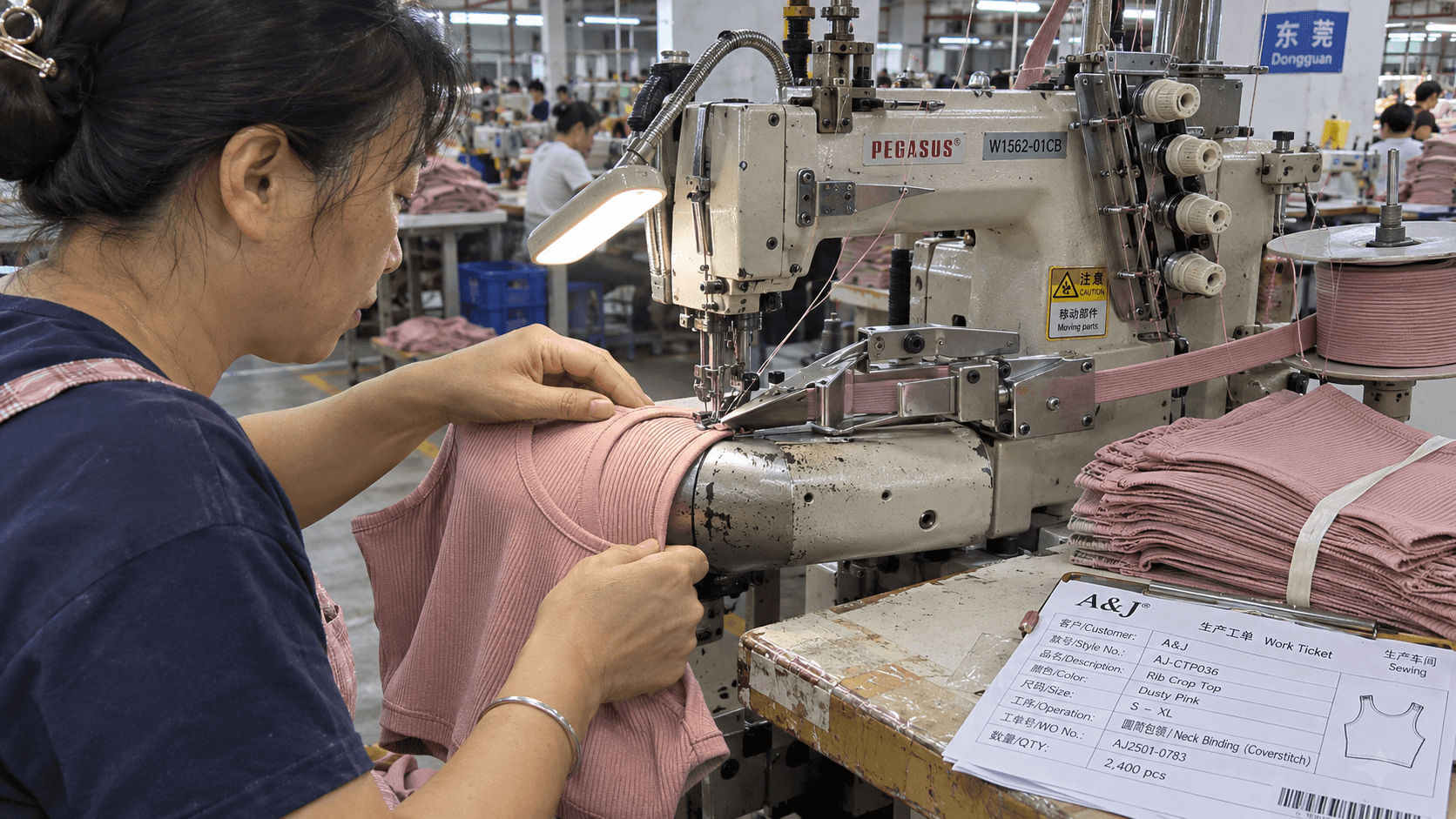
Bottom Hem and Underband Construction. Depending on the silhouette, the bottom edge may use a twin-needle coverstitch turnback, a folded self-fabric band, or an encased elastic waistband. If the differential feed on the coverstitch machine is set too tight, the hem waves like lettuce edging; if the thread tension is too loose, the stitches snap when pulled over the shoulders. When briefing a crop top manufacturer, specify whether internal elastic must be topstitched along both edges to prevent rolling.
Neckline Binding and Strap Reinforcement. Scoop necks, square necks, halter straps and asymmetrical cutouts lose their geometry if cut on an unstable bias without reinforcement. Clear polyurethane tape, mobilon tape or a controlled binding tension ratio recorded on the tech pack keeps the neckline lying flat.
Checkpoint 4: Verify Arm-Raise Ride-Up and Bust-to-Hem Balance
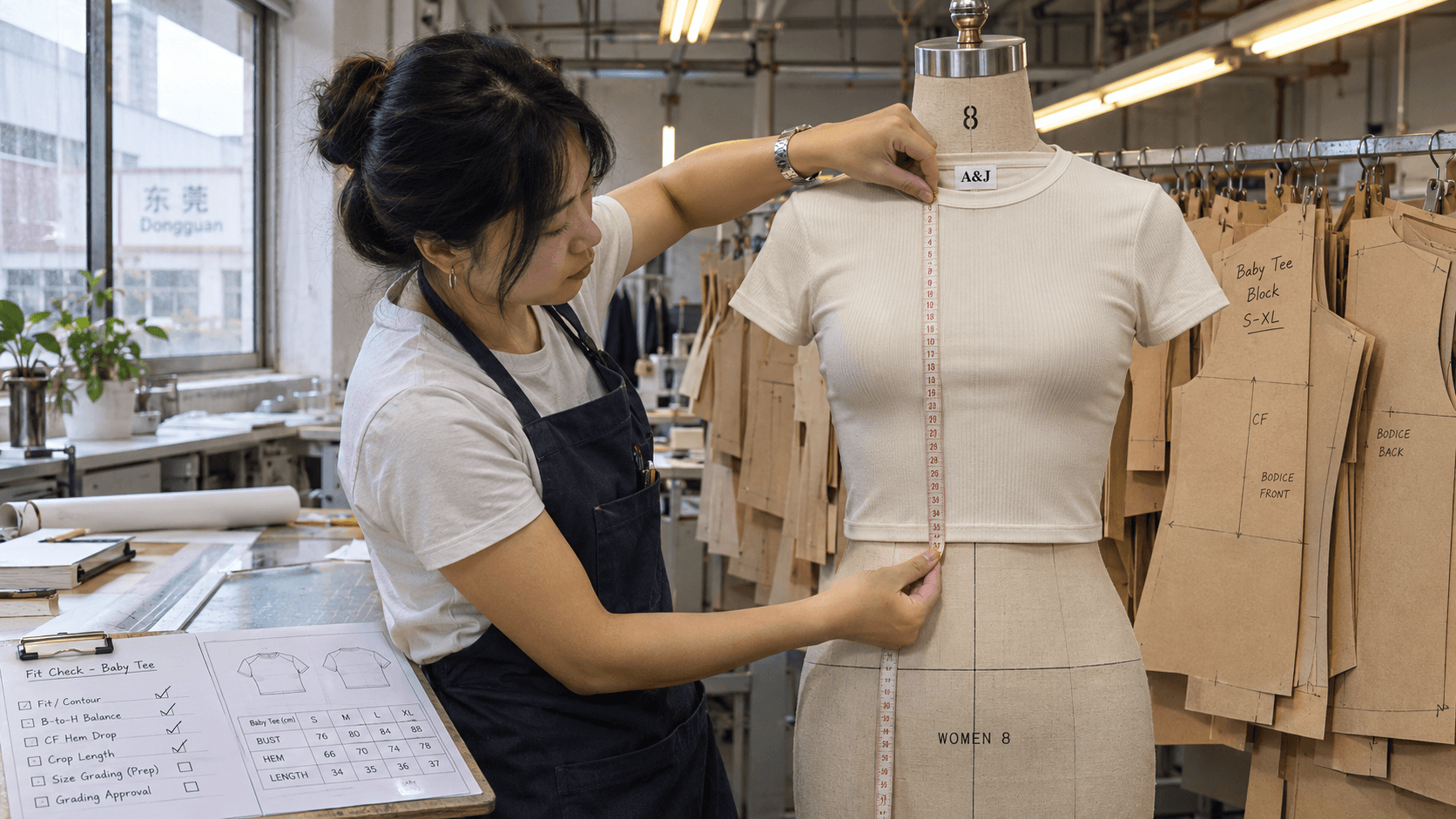
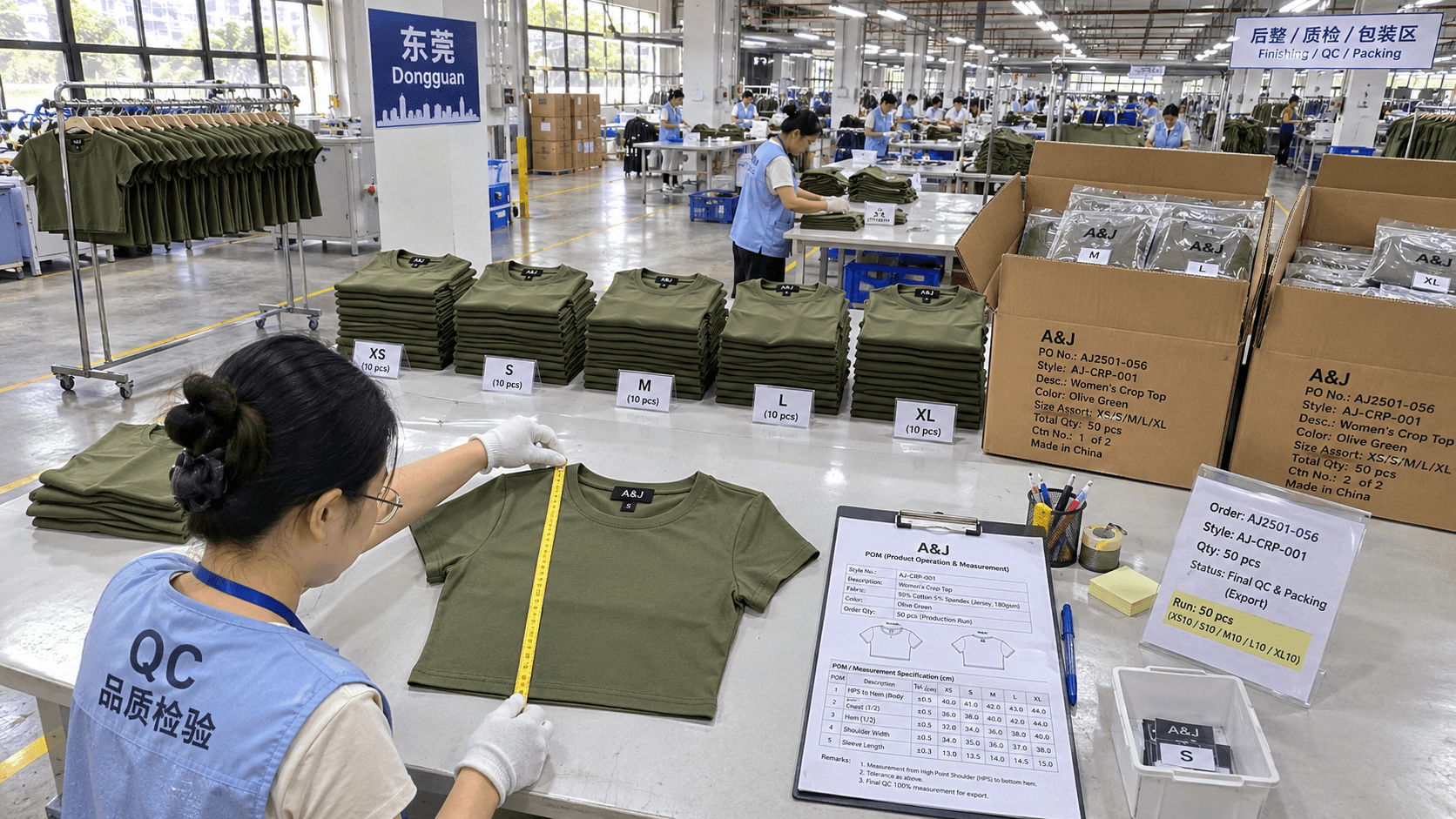
Flat table measurements alone cannot prove that a cropped garment fits properly. When you review a pre-production sample with a crop top manufacturer, the fit protocol must combine flat Point of Measurement (POM) checks—recorded on your garment specification sheet—with a dynamic arm-raise test.
Armhole Depth and Lift Allowance. If the armhole is cut too low on a fitted cropped silhouette, raising the arms pulls the entire side seam upward, dragging the bottom hem several centimeters higher than intended. Raising the underarm pivot point and refining the sleeve cap curve allow the arm to move without lifting the torso body. Note that anthropometric body references such as ISO 8559-1:2017 size designation and body measurement definitions define human body landmarks, not the finished garment measurements or negative-ease allowances of your cropped style.
Grading Center-Front Length Across Sizes. A common grading error is keeping center-front length almost static while expanding chest width across sizes XS to XL. As bust projection increases in larger sizes, the fabric travels a longer curve over the chest, which makes the visual hemline look shorter in front. Proper garment grading executed by your crop top manufacturer adds proportional front-length drop and adjusts bust dart or side-seam shaping per size.
Checkpoint 5: Control Decoration Placement, Care Labels and Bulk QC
Because cropped garments have a compact vertical canvas, a graphic print or embroidered logo that is off-center by even five millimeters is immediately visible. Furthermore, bulky care labels sewn into a short side seam often poke out below the hem during wear.
Artwork Placement and Stabilization. Screen prints, heat transfers and embroidery on high-stretch rib knits require stretch-compatible inks or soft cutaway backing so the chest area does not pucker or crack. Every crop top manufacturer should verify placement distances from the center-front collar drop across size groups in your tech pack for clothing.
Care Labeling and Final Inspection. To prevent labels from showing below a short hem, womenswear brands use a heat-transfer neck label and place the woven care label higher inside the left side seam. All fiber composition and washing instructions must follow the FTC Care Labeling Rule compliance guide, which requires a reasonable basis for care instructions without serving as a blanket guarantee for unverified fabric lots. Before packing, each lot produced by your crop top manufacturer should pass a structured garment quality control checklist covering hem symmetry, seam stretch and shade continuity.
| Inspection Checkpoint | What to Measure or Observe | Common Defect if Skipped | Corrective Action Rule |
|---|---|---|---|
| High Point Shoulder (HPS) to Hem | Measure flat before and after wash test; compare front-to-back balance | Front hem rides up or dips unevenly across the waist | Adjust front pattern drop before bulk cutting |
| Bottom Hem Stretch Extension | Pull hem laterally to simulate dressing; check stitch elasticity | Coverstitch thread snaps or hem edge waves | Recalibrate looper tension and differential feed |
| Double-Layer Front Alignment | Check inner and outer bodice layers at neck, armhole and hem | Inner lining peeks out below outer cropped hem | Trim inner layer slightly shorter and understitch |
| Side-Seam Care Label Position | Verify distance above bottom hem turnback on XS–XL | Care label hangs below the garment edge when worn | Relocate label higher on side seam or switch to heat transfer |
How to Brief a crop top manufacturer: 6-Step Release Workflow
Use this six-step sequence when launching a cropped collection with a crop top manufacturer:
- Confirm construction route and MOQ. Verify that your design is a cut-and-sew knit or woven style suitable for a 50-piece minimum per style.
- Lock fabric stretch and opacity. Specify GSM, fiber content, elastane percentage and whether light colorways require a double-layer front bodice.
- Define hem and neckline stabilization. Call out coverstitch type, binding width, clear elastic tape or encased underband dimensions on the tech pack.
- Approve bust-to-hem balance on a sample. Test the pre-production sample both flat and during an overhead arm-raise check.
- Validate graded length across sizes. Review XS–XL front-length progression so larger chest sizes keep vertical coverage.
- Archive the approved golden sample. Record bulk fabric lot numbers, binding ratios, wash shrinkage allowances and label heights for reorders.
Frequently Asked Questions
What is the minimum order quantity for custom cropped styles at A&J?
A&J International Apparel Limited, operated by Dongguan Taide Clothing Co., Ltd. in Dongguan, China, works as a crop top manufacturer with a 50-piece minimum order quantity per style. Colour splits within a 50-piece order depend on whether the selected fabric is available from stock rolls or requires custom mill dyeing.
How does a crop top manufacturer prevent the bottom hem from riding up or flaring out?
A crop top manufacturer prevents hem ride-up and flare by balancing the center-front pattern drop over the bust curve, raising the underarm pivot point so arm movement does not pull the torso upward, and matching bottom coverstitch differential feed or encased elastic tension to the fabric’s crosswise recovery.
Should light-colored rib or jersey cropped styles use a double-layer front bodice?
When a fitted cropped silhouette is cut with negative ease, stretching the fabric across the chest reduces its visual density and can make white or pastel shades appear sheer. Using a self-fabric double-layer front bodice or a stabilized lining layer improves opacity and hides seam allowances.
Why can center-front length look shorter on larger sizes if graded flat?
Larger sizes require more bust projection, which consumes vertical fabric length as the garment contours over the chest. If a pattern grader increases chest width without adding proportional center-front length drop, the hem will sit higher on the torso in sizes L and XL than on the base sample.
Can I use one crop top manufacturer pattern block for both 2×2 rib knit and woven poplin styles?
No, you cannot use the same crop top manufacturer pattern block for stretch rib knit and non-stretch woven poplin styles. A rib knit block relies on negative ease and seam elasticity, whereas a woven poplin style requires positive breathing ease, bust darts or smocked panels, and a zipper or button opening.
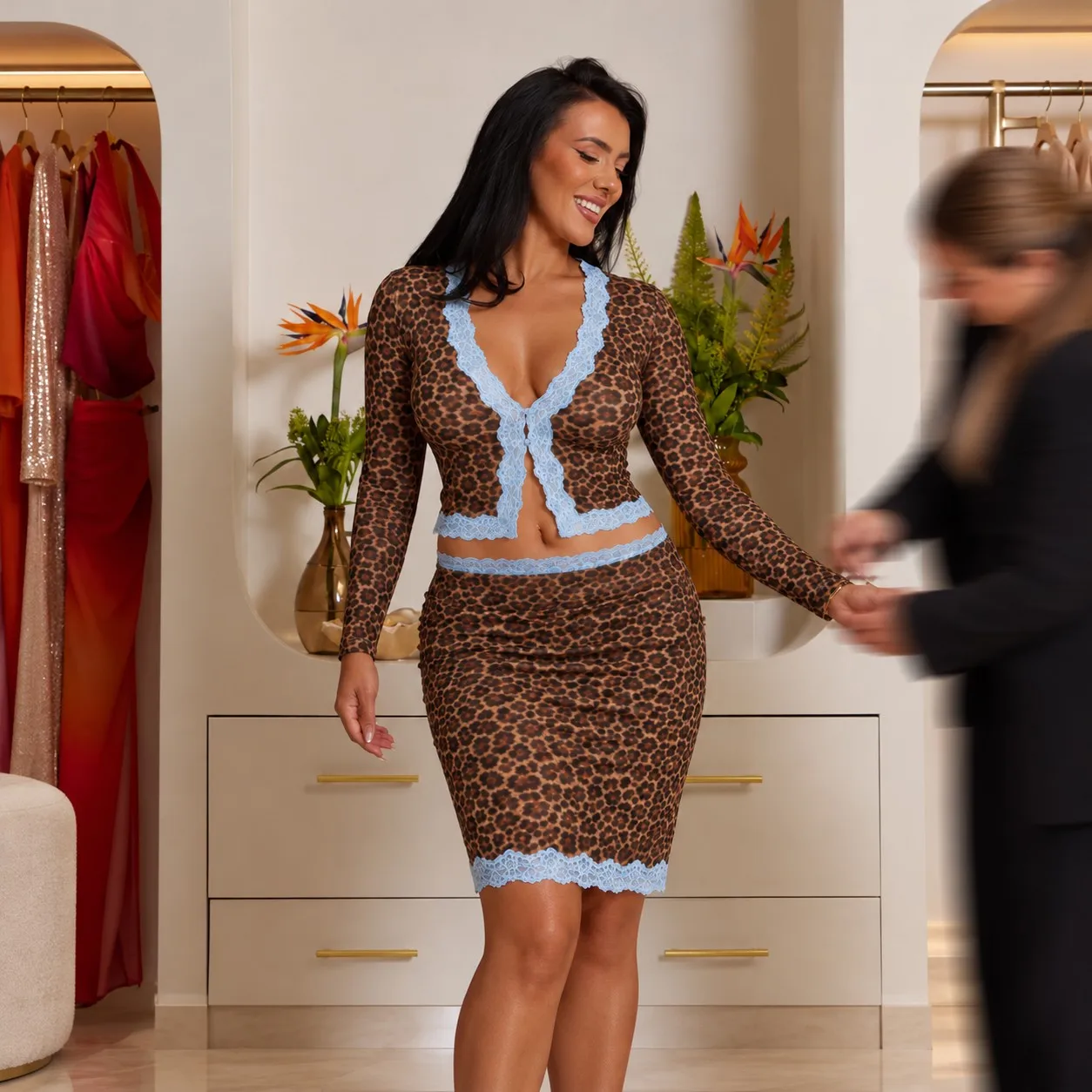
Style AJ-ST-2601: Custom Leopard Print Lace-Trim Mesh Crop Top & Midi Skirt Set
Looking to develop a custom lace-trimmed crop top or coordinated two-piece skirt set? Inspect our 4-point macro stitching callouts, size grading table, and custom OEM options on the product specification page.


Leave a Reply