
TL;DR: Modal vs viscose fabric is not a contest between one universally superior fibre and one inferior fibre. Both are regenerated cellulosic fibres, but modal has a distinct technical definition; brands should compare equivalent fabric construction, finish, colour, garment design and care conditions before approving either route. A&J International Apparel, founded in 2006 in Dongguan, China, supports cut-and-sew womenswear from a 50-piece minimum while keeping fibre identity, garment evidence and label wording linked to the order.
Modal vs viscose fabric comparisons often stop at adjectives such as soft, breathable or drapey. Those descriptions are not enough for procurement. A lightweight viscose woven, a modal jersey and a blended rib do not share the same structure, mass, finish or intended silhouette. A usable decision therefore begins with identity documents, continues through matched garment trials, and ends with a versioned release file rather than a fibre-name preference.

This modal vs viscose fabric guide uses six controls: fibre identity, fabric construction, surface and colour, movement and opacity, care response, and label evidence. It does not assign universal shrinkage, strength, pilling, lead-time or cost values. Those results must come from the actual approved lot under a stated method.
Modal vs Viscose Fabric Begins with Fibre Identity
In a modal vs viscose fabric identity review, both candidates belong to the regenerated cellulose family, but they should not be treated as interchangeable words. The official EU textile fibre-name regulation defines modal as regenerated cellulose produced by a modified viscose process with specified breaking-force and wet-modulus conditions. It separately defines viscose as regenerated cellulose produced by the viscose process for filament or staple fibre. That distinction matters for technical files and fibre-content wording.
A buyer should ask the fabric source for the generic fibre declaration, composition by weight, producer or supplier identity, lot reference and any claim-specific evidence. A commercial name, mill collection name or hand-feel description cannot replace the generic identity. If a blend contains elastane, polyester or another component, that composition belongs in the same controlled record.
| Identity field | Modal route | Viscose route | Release status |
|---|---|---|---|
| Generic fibre name | Confirm from supplier declaration | Confirm from supplier declaration | Attach current declaration |
| Composition by weight | Record every constituent fibre | Record every constituent fibre | Match purchase order and label |
| Yarn or fabric lot | Record per approved lot | Record per approved lot | Required before cutting |
| Producer or supplier | Identify legal source | Identify legal source | Verify on transaction document |
| Marketing claim | Support with claim-specific evidence | Support with claim-specific evidence | Buyer approval required |
Calling both materials “rayon-like” may be conversationally understandable, but the production file needs the exact generic term accepted for the target market. This is especially important when a hang-tag highlights one fibre while the sewn label must disclose the full composition.
A Six-Control Modal vs Viscose Fabric Comparison Map
A fair comparison keeps non-fibre variables as close as possible. The two candidates should use a comparable knit or woven construction, target mass, colour depth, finishing route, garment pattern and care procedure. If one candidate is a fine jersey and the other is a heavier twill, the trial is comparing two complete fabrics, not isolating fibre behaviour.
| Control | What must be held or recorded | Decision evidence |
|---|---|---|
| 1. Fibre identity | Generic name, percentage and lot | Supplier declaration accepted |
| 2. Construction | Knit or weave, yarn format, mass and usable width | Approved specification card |
| 3. Surface and colour | Finish, shade route and face direction | Signed swatch and lab dip |
| 4. Garment movement | Same pattern, seam route and fitting actions | Photo and fit notes |
| 5. Care response | Same stated wash, dry and conditioning route | Before-and-after record |
| 6. Label release | Target-market wording and order identity | Approved artwork version |
This six-control modal vs viscose fabric map prevents a common sourcing error: choosing a fibre from a swatch, then discovering during sampling that the approved pattern, seam, opacity or care message does not travel with it. The comparison should release a garment system, not a loose material opinion.

For a reusable input form, connect the candidates to the existing fabric sourcing evidence system. Record construction and composition in the clothing tech pack rather than leaving them inside email threads.
Modal vs Viscose Fabric in Equivalent Garments
For a modal vs viscose fabric trial, hand feel at the swatch stage is useful, but it does not reveal the complete garment. Cut two matched samples when the fibre choice could alter silhouette, cling, seam behaviour, opacity or care response. Keep the pattern version, stitch route, seam allowance, thread, pressing and finishing instructions aligned. If construction must change for one candidate, document that change because it becomes part of the commercial decision.
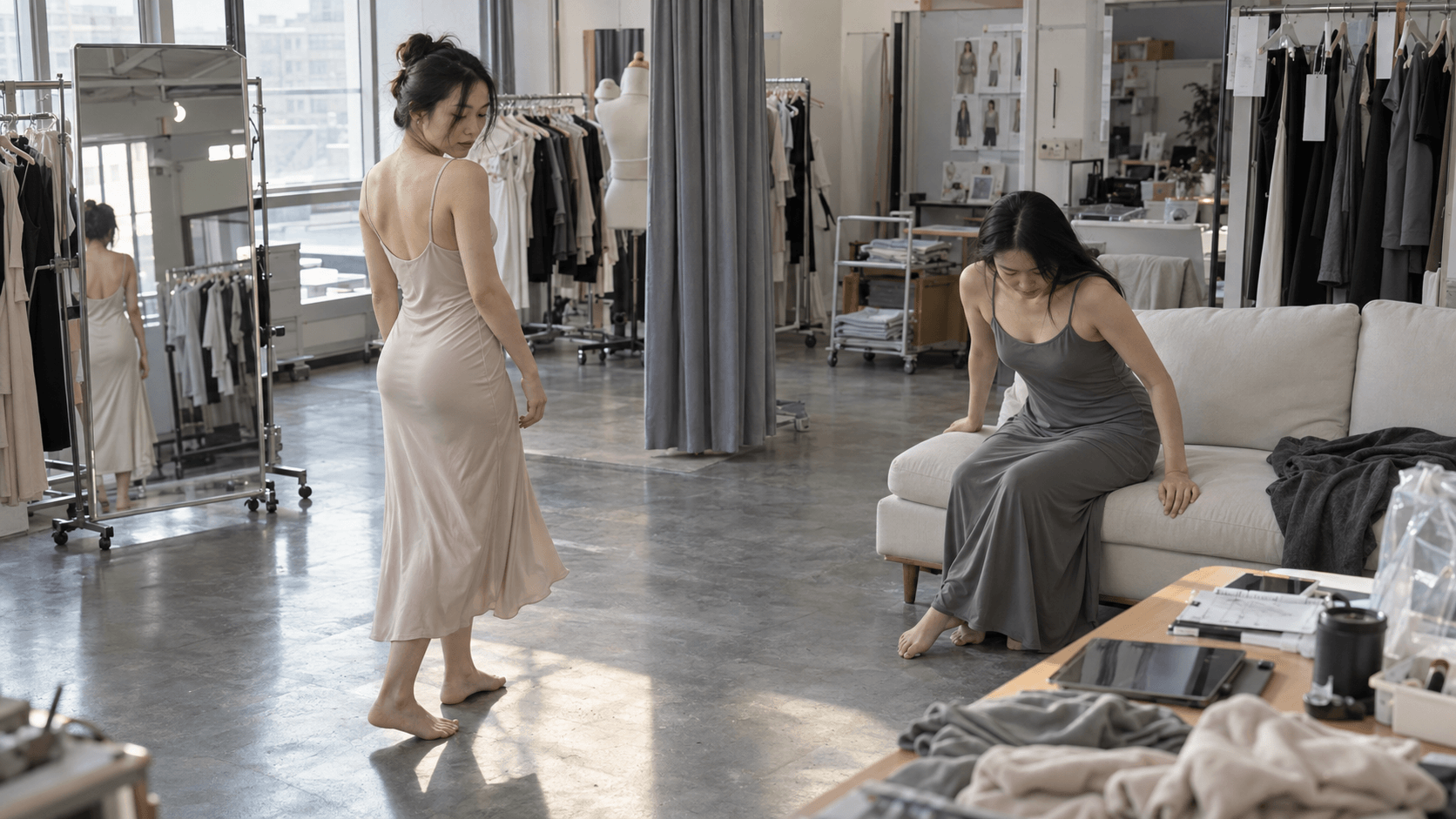
The fitting session should observe the designed movement rather than rely on a static front view. For a slip dress, review walking swing, seated recovery, bias distortion, strap stability and light transmission. For a fitted top, add stretch direction, neckline recovery, underarm comfort and surface marking. For trousers or skirts, include seat movement, knee behaviour and seam grin where relevant.
| Garment observation | How to compare | Result field |
|---|---|---|
| Drape and swing | Same silhouette, movement sequence and lighting | Record per sample |
| Cling and static tendency | Same underlayer and conditioning environment | Enter observed result |
| Opacity | Same colour family, construction and light direction | Buyer sign-off required |
| Seam appearance | Same seam type and machine settings where suitable | Attach close-up evidence |
| Dimensional balance | Same measurement landmarks before and after care | Enter measured result |
| Surface change | Same abrasion points and handling route | Confirm before bulk release |

The linked slip dress manufacturing route is a useful application page because fluid fabrics expose bias balance, strap position and body cling clearly. The linen dress route provides a contrasting reference for brands deciding whether they actually need fluid regenerated cellulose or a crisper natural-fibre expression.
Modal vs Viscose Fabric Construction and Finish Variables
In modal vs viscose fabric sourcing, fibre identity is one variable inside a fabric. Yarn size, filament or staple format, twist, knit gauge, weave density, mass, mechanical treatment, chemical finish and colour route all influence the finished hand and behaviour. A modal fabric is not automatically lighter, smoother or more stable than every viscose fabric. A well-controlled viscose construction may serve one silhouette more effectively than a modal candidate with the wrong structure.
Procurement should therefore compare specification cards, not adjectives. Ask whether the quoted fabric is greige, piece dyed, yarn dyed or printed; whether brushing, sanding, compacting or other finishing is included; and whether the approved sample and bulk order will use the same route. If a supplier changes construction or finish while retaining the same composition line, the garment may change even though the label does not.
A&J is a cut-and-sew apparel manufacturer, not a fibre producer or vertically integrated cellulose mill. We can coordinate approved fabrics into womenswear, but producer-level forestry, pulp, chemical-recovery or fibre-manufacturing claims require evidence from the relevant upstream source. The sustainable clothing evidence guide explains why one certificate or fibre name cannot prove an entire order claim.
Modal vs Viscose Fabric Care Response Needs One Test Route
A modal vs viscose fabric comparison does not supply a finished care instruction by itself. Care response belongs to the exact fabric, colour, finish, seam, trim and garment combination. Before bulk approval, define the wash medium, temperature, mechanical action, drying method, conditioning period and measurement landmarks. Use the same route for both candidates if the purpose is comparison.
The record should separate dimensional change from appearance. Length, width and key garment points belong in the measurement table. Twisting, puckering, shade movement, fuzzing, seam impression and loss of surface character belong in visual notes. Do not convert one sample result into a universal fibre claim.

| Care-control field | Required entry |
|---|---|
| Sample and lot identity | Record approved sample and roll lot |
| Care procedure | Attach current procedure version |
| Before-care measurements | Enter measured result |
| After-care measurements | Enter measured result after conditioning |
| Appearance notes | Record shade, surface, seam and shape response |
| Release decision | Buyer sign-off required |
Link this evidence to the garment quality control checklist. If the material changes after size approval, revisit the relevant fit and grading evidence instead of assuming the old result still applies; the garment grading control system shows where material response connects to a size range.
Modal vs Viscose Fabric Labels and Order Records Must Agree
For US sales, the FTC textile labelling guidance states that covered products generally disclose fibre content, country of origin and the responsible manufacturer or dealer identity. It also explains that manufactured fibres use recognised generic names and that viscose may be used for the predominant form of rayon. For EU sales, use the fibre names and composition rules applicable under Regulation (EU) No 1007/2011.
The modal vs viscose fabric purchase order, supplier declaration, bill of materials, sewn label artwork, hang-tag copy and product page should tell the same composition story. Marketing terms should not hide another constituent fibre or imply environmental performance without evidence. Keep claim wording versioned so an approved modal statement cannot accidentally carry into a later viscose order.
| Order document | Control question | Status wording |
|---|---|---|
| Supplier declaration | Does the generic fibre identity match the ordered lot? | Verify before fabric release |
| Bill of materials | Are composition and fabric code current? | Attach approved BOM version |
| Sewn label | Does wording match the target market? | Legal review required |
| Hang tag | Does it disclose or direct users to full content correctly? | Buyer copy approval required |
| Product page | Does online copy match the physical label? | Confirm before launch |
| Repeat order | Are supplier, lot route and claim evidence still valid? | Revalidate per order |
Where A&J Fits a Modal vs Viscose Fabric Decision
A&J International Apparel can support a modal vs viscose fabric decision for cut-and-sew womenswear when the approved candidate is commercially available for the order and suits the construction. The practical route is to define the garment first, source documented candidates, build matched samples where the choice is material, and release bulk only after fit, care, label and lot controls agree. Our 50-piece minimum supports a controlled first production run, but it does not override upstream fabric, colour or trim requirements.
Use the 12-stage clothing manufacturing process to place material approval before cutting. For fluid dresses, tops, skirts, soft trousers and selected lingerie components, the deciding evidence usually comes from the garment trial rather than the fibre name alone.
When Another Route Serves the Modal vs Viscose Fabric Brief Better
Move the modal vs viscose fabric brief to a fibre producer, textile laboratory or specialist fabric developer before approaching a cut-and-sew factory when your project requires a proprietary cellulose formulation, producer-level chain-of-custody claim, chemical-recovery verification or newly engineered yarn. A&J should not replace those upstream specialists.
A different material family may also fit better when the design depends on crisp structure, high elastic recovery, weather resistance, protective performance or a regulated end use. Start with the garment requirement rather than forcing either modal or viscose into every soft-hand concept. If the brand has not fixed silhouette, colour, construction and care expectation, approve that brief before ordering comparative samples.

Frequently Asked Questions
Does modal vs viscose fabric mean the same fibre?
They are related regenerated cellulose fibres but not identical generic names. EU Regulation 1007/2011 defines modal through a modified viscose process with specified wet-modulus and breaking-force conditions, while viscose has its own separate definition. Confirm the supplier declaration and target-market label rules.
Which modal vs viscose fabric route suits a fluid womenswear silhouette?
That cannot be decided from the fibre name alone. Compare equivalent construction, mass, finish and colour in the intended garment. Review movement, cling, opacity, seam appearance and care response before approving the route.
Does modal vs viscose fabric have a fixed shrinkage result?
No universal order result should be assumed. Dimensional response depends on the specific fibre, yarn, fabric construction, finishing, garment build and care method. Record before-and-after measurements from the actual approved sample and lot.
What modal vs viscose fabric documents belong before bulk production?
Request the generic fibre declaration, composition by weight, supplier identity, lot reference, fabric specification, approved swatch or lab dip, garment test record, bill of materials and target-market label artwork. Keep each item under version control.
Can I settle modal vs viscose fabric from a softer swatch without sewing matched garments first?
You can shortlist it, but a soft swatch does not prove garment drape, opacity, seam response or care stability. If the fibre choice affects silhouette or claims, sew matched garments and compare the six controls before bulk release.


Leave a Reply