
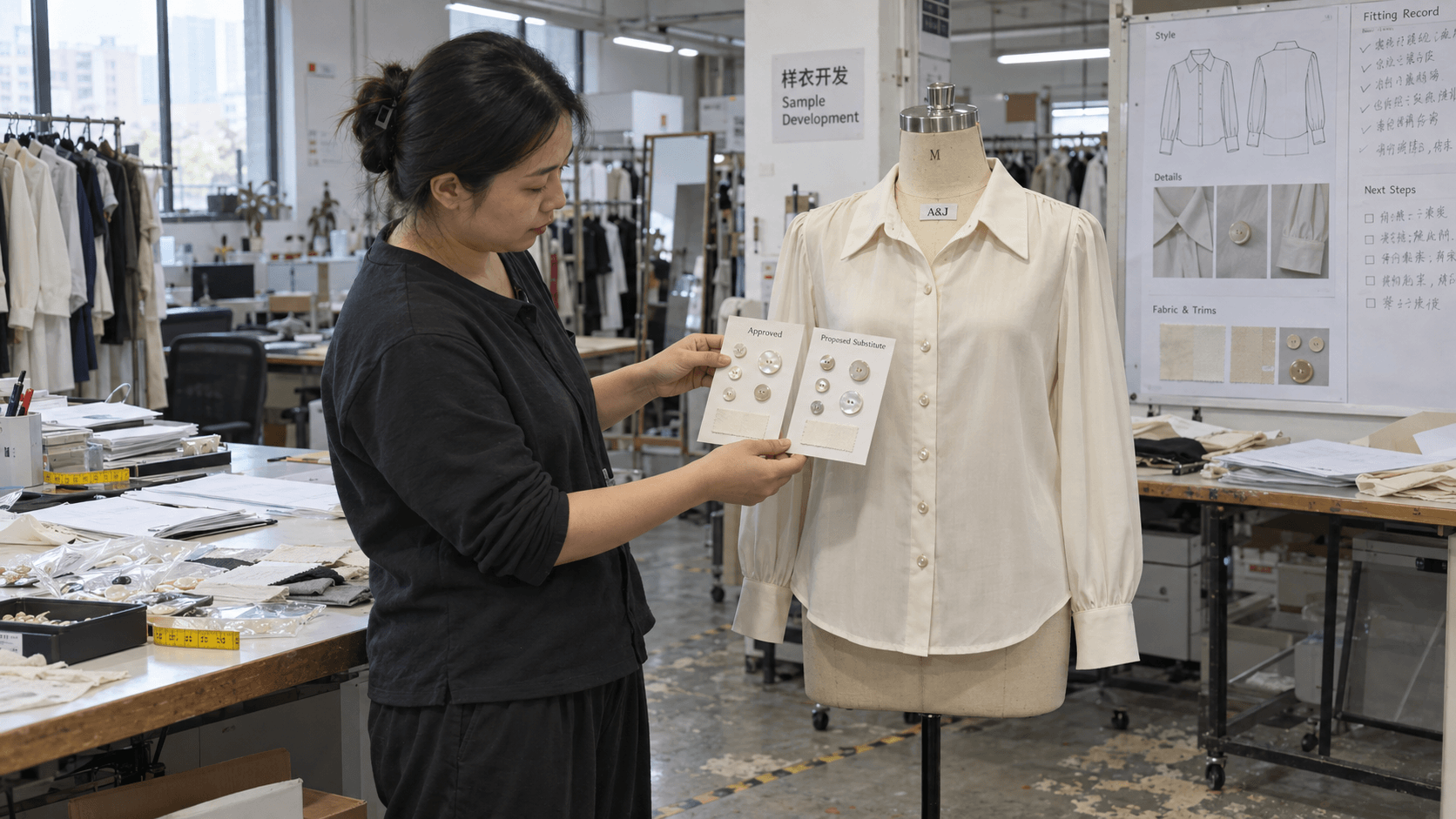
TL;DR: A BOM in garment industry production is the controlled list of every fabric, trim, label, thread, closure and packing item required for one garment. A&J International Apparel, founded in 2006 in Dongguan, China, uses order-specific material records for suitable womenswear programs with a 50-piece minimum.
A BOM in garment industry work is not a shopping list copied from a sketch. It connects each physical component to an approved identity, supplier reference, color, unit, expected usage, substitution rule, evidence requirement and version status. When one of those fields is missing, purchasing, sampling, costing and bulk production may all read the same material name differently.

This guide explains an eight-field BOM structure for clothing brands and sourcing teams. It is an educational template, not a claim that one universal consumption, wastage rate or certification scope applies to every style. Order values must be confirmed from the released pattern, sample, supplier documents and target-market requirements.
What Does BOM in Garment Industry Mean?
BOM means bill of materials. In apparel, it is a version-controlled record of the materials needed to make and pack a defined style. The record may cover shell fabric, lining, interfacing, sewing thread, elastic, zippers, buttons, labels, hangtags, bags, tissue, cartons and other approved components.
The BOM in garment industry production answers a different question from a sketch or measurement chart: exactly which physical input is approved for this style? A sketch shows appearance. A specification sheet defines dimensions and construction. A BOM identifies components and their controlled attributes. Together, these records may form part of a complete tech pack for clothing, but they are not interchangeable.
| Document | Main question | Typical control |
|---|---|---|
| Design sketch | What should the style look like? | Shape and visual details |
| Measurement specification | What dimensions should be released? | POM, size and tolerance |
| Construction page | How should the garment be assembled? | Seams, stitches and operations |
| BOM | Which components are approved? | Identity, color, usage and version |
| Purchase order | What quantity is being bought? | Commercial quantity and delivery |
| Cost sheet | What is the monetary breakdown? | Price basis and inclusion scope |
A BOM should therefore point to the current design and pattern version without trying to replace them. If a sleeve shape changes, the pattern may change the fabric usage. If a zipper length changes, both the specification and BOM need controlled updates.
BOM in Garment Industry: The Eight Required Fields
A workable master table needs more than a material description. The following eight-field structure lets the brand, factory, material supplier and inspector identify the same item without relying on memory.
| Field | What to record | Safe status wording |
|---|---|---|
| 1. Component identity | Item name, function and placement | Confirm component scope |
| 2. Supplier reference | Supplier, article or internal code | Record before purchase |
| 3. Color and finish | Color standard, finish and face direction | Approve against reference |
| 4. Unit and usage | Unit plus order-specific consumption basis | Calculate from released pattern |
| 5. Allowance basis | Cutting, process or order allowance logic | Confirm per order |
| 6. Substitution authority | Who may approve a replacement | No substitution without approval |
| 7. Evidence requirement | Composition, care, claim or certificate record | Verify current scope |
| 8. Version status | Revision, date, owner and release state | Archive current release |
The BOM in garment industry file should use one row per distinguishable component. “Main fabric and trims” is too broad. Shell, lining, interfacing, zipper, button, thread, labels and packing items require separate identities because they may have different suppliers, color approvals, minimums and compliance evidence.
BOM in Garment Industry Fields 1-3: Freeze Identity, Reference and Color
A useful material name combines function with a traceable reference. “Black fabric” cannot tell purchasing whether the approved item is woven or knitted, which article was sampled, which finish applies or which side faces outward. The row should identify the component and connect it to a supplier card, sample cutting or internal code.

Color also needs a defined reference. A verbal color name can be supported by a physical standard, approved lab dip, supplier shade card or other agreed record. The BOM should state which reference controls the order and which version is current. A digital swatch may help communication, but it should not silently replace an approved physical or supplier-controlled reference when appearance is critical.
| Weak entry | Controlled entry structure | Approval record |
|---|---|---|
| Black fabric | Shell fabric + supplier article + construction | Attach approved cutting |
| Gold zipper | Zipper type + teeth finish + tape color + length | Approve component card |
| Matching thread | Thread ticket + fiber + supplier color code | Confirm on sew sample |
| Logo label | Label construction + dimensions + color file | Approve artwork and sample |
| Clear bag | Bag material + size + closure + warning scope | Confirm target market |
Material discovery belongs in the wider source fabric for clothing process. The BOM begins controlling the chosen article once its identity and approval route are clear.
BOM in Garment Industry Fields 4-5: Separate Usage from Allowance
Usage is not the same as purchase quantity. One garment may consume fabric in meters, elastic in centimeters, thread in meters, buttons in pieces and packing material in sets. The BOM in garment industry record must define the unit before anyone enters a value.
Fabric usage should come from the released pattern, fabric width, layout direction, size mix and applicable process route. Lace borders, one-way prints, engineered placements, nap direction and matching requirements can change marker efficiency. A consumption copied from another style is only a starting reference, not an approved order value.
Allowance also needs a named basis. Cutting, printing, washing, inspection replacement and supplier packaging can create different order effects. This article does not prescribe a universal percentage. The BOM should record which allowance is included, which is excluded and who approved the order-specific basis.
| Component | Unit | Usage source | Allowance status |
|---|---|---|---|
| Shell fabric | Meter or kilogram | Released marker and size mix | Confirm per order |
| Lining | Meter or kilogram | Released lining pattern | Calculate before purchase |
| Elastic | Centimeter or meter | Approved pattern path | Include joining basis |
| Buttons | Piece | Garment count plus approved replacement basis | Record per order |
| Sewing thread | Cone or meter basis | Operation and seam plan | Confirm with production |
| Label set | Set | Approved label map | Match order quantity |
The technician should update usage after a relevant pattern or size-set revision. The garment grading guide explains why different sizes do not grow uniformly; this matters when a size mix changes material consumption.
Field 6: Control Substitutions Before They Reach Bulk
A supplier saying an item is “similar” does not make it equivalent. A replacement can alter shade, hand feel, stretch, recovery, thickness, seam response, care behavior, label wording or artwork appearance. The BOM in garment industry workflow needs an explicit substitution rule and approval owner.

A substitution request should identify the original item, proposed item, reason, affected styles, samples or evidence reviewed, decision owner and resulting BOM version. If the replacement changes composition, care or a marketing claim, the label and evidence records must return to review.
| Change type | Required review | Release status |
|---|---|---|
| Supplier changes, article unchanged | Identity and current availability | Verify before purchase |
| Article changes | Construction, color and relevant performance | Reapprove material |
| Color source changes | Visual reference and lot control | Approve new color record |
| Trim dimension changes | Pattern, function and assembly | Review on sample |
| Composition changes | Label, care and claim evidence | Reopen compliance review |
| Packing changes | Market text, dimensions and protection | Approve packing sample |
The BOM in garment industry should never let purchasing approve a technical substitution alone unless the documented workflow grants that authority. The brand, technician and factory need one visible decision trail.
Field 7: Connect Claims and Labels to Evidence
For products sold in the United States, the FTC textile and wool labeling guidance explains that most covered textile products require fiber content, country of origin and the identity of the responsible manufacturer or marketer. A BOM in garment industry file can hold the source references used to prepare label artwork, but it does not replace legal review for the target market.
Care instructions also need a reasonable basis covering the complete garment, including relevant non-detachable components. The FTC Care Labeling Rule guidance is the public starting point for U.S. care-label decisions. A shell-fabric data sheet alone may not establish instructions for a garment containing lining, elastic, print, trim or special finishing.
For harmful-substance or material-content claims, keep evidence at component level. The official OEKO-TEX STANDARD 100 information describes testing by product class and article scope. Textile Exchange states that its Content Claim Standard is a chain-of-custody tool for verifying a specified input material. Neither name should be placed in the BOM as proof unless current evidence covers the relevant organization, material and transaction or claim scope.
Field 8: Make Version Status Visible
A BOM without revision control becomes a historical mixture. The header should identify style code, revision, issue date, owner, release state and linked pattern or specification version. Every changed row should remain traceable through an approved change log.
The BOM in garment industry file can use simple states such as Draft for review, Approved for sample, Approved for bulk, Superseded and Archived for reorder. These are workflow states, not quality grades. Only one version should be clearly marked as the current bulk authority.

| Version event | Required action | Record retained |
|---|---|---|
| First sample issue | Identify provisional components | Draft BOM |
| Fit revision | Recalculate affected usage | Change log |
| Material approval | Attach current supplier reference | Approved cutting or card |
| Pre-production release | Freeze current bulk components | Released BOM |
| Bulk substitution | Reopen affected rows | Signed change decision |
| Reorder | Verify availability and evidence validity | New reorder revision |
This version sequence should align with the wider clothing manufacturing process. A production stage cannot safely rely on an older BOM simply because that file was attached to the first email.
How to Audit a BOM Before Bulk Release
Run the audit by component, not by page appearance. First confirm that every visible and internal item on the sealed sample has a BOM row. Then match each row to a physical or digital approval record. Check unit consistency, usage source, substitution permission, evidence scope and version status.
The BOM in garment industry audit should also compare the BOM with the sample, pattern, label map, packing specification and purchase records. The garment quality control checklist helps connect approved references to incoming, sewing, finishing and final inspection stages.
- Lay out the sealed sample and list every component.
- Match each component to one BOM row and reference code.
- Verify color, finish, dimensions and placement against approvals.
- Recalculate usage affected by pattern or size changes.
- Review substitutions, claims, care and label implications.
- Freeze the bulk version and archive superseded records.

When a Simple Material List Is Enough
A short internal list may be enough for an early concept, a non-production mock-up or a one-off development exercise. It is not enough when several suppliers, colors, sizes, labels, claims or repeat orders must remain consistent. The moment purchasing and production need to distinguish approved components from alternatives, a controlled BOM becomes useful.
A&J supports suitable cut-and-sew womenswear programs rather than raw-material manufacturing, footwear, jewelry, electronics or fully fashioned knitwear. Brands still own their target-market claims, artwork rights and final commercial decisions. For smaller first orders, the small quantity womens clothing manufacturer guide explains why a 50-piece minimum does not remove fabric, trim and supplier constraints.
Frequently Asked Questions
What is a BOM in garment industry production?
A BOM in garment industry production is a controlled bill of materials listing the approved fabrics, trims, labels, threads, closures and packing items for a defined garment version. It should include traceable identities, units, usage sources, substitution rules, evidence requirements and release status.
Is a garment BOM the same as a tech pack?
No. A BOM identifies approved physical components. A tech pack may also contain sketches, measurements, construction, artwork, labels, testing and packing information. The BOM is one controlled production record within that wider system.
Who should approve a material substitution?
The approval owner should be defined before purchasing. A substitute may require brand, technical, compliance and factory review because it can change appearance, construction, care, labeling or claim evidence.
When should garment BOM usage be recalculated?
Recalculate affected usage after changes to the pattern, size mix, fabric width, layout direction, print registration, matching requirement, component dimensions or process route. Keep the source and approval status with the updated value.
Do I need to rebuild my BOM if only one trim changes after the fit sample is approved?
You need a controlled revision, not a hidden overwrite. Update the affected row, review connected construction, label, care and claim implications, record the approver, then release a new BOM in garment industry version while archiving the superseded one.


Leave a Reply