
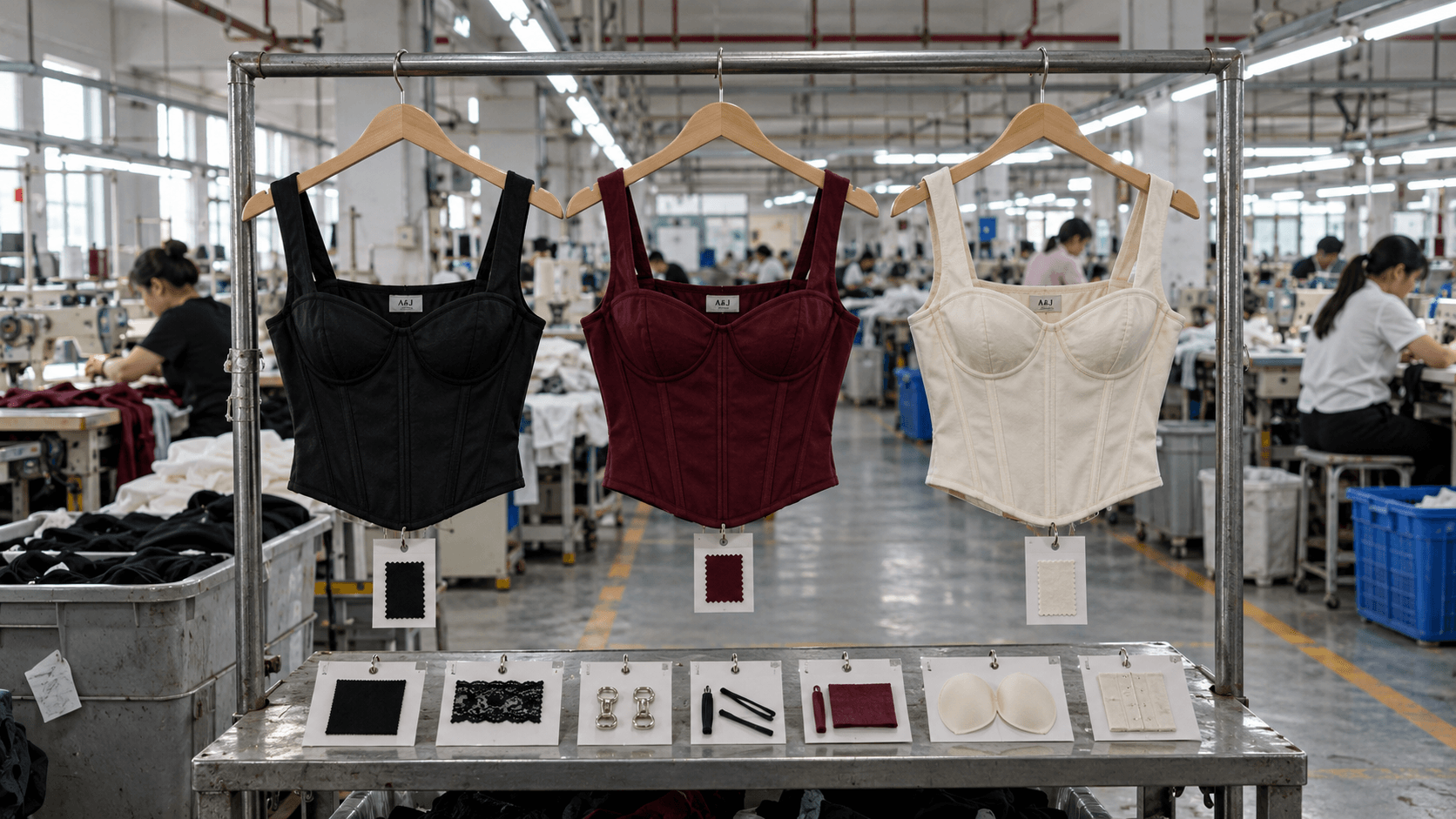
TL;DR: A corset manufacturer should freeze the product route, layered materials, panel map, support components, closure system, fit-and-grade evidence, and reorder records before bulk release. A&J International Apparel is a cut-and-sew womenswear factory founded in 2006 in Dongguan, China, with a 50-piece minimum per style; we develop fashion corsets and bustier-inspired garments, not medical compression products or extreme waist-training devices.
A fashion corset may look compact, but its production file is denser than that of a simple woven camisole. The silhouette depends on several layers behaving as one system: shell fabric, lining, interlining, channel tape, boning, closure parts, edge binding, and the pattern itself. If one component changes without a linked approval, the garment can twist, gape, wrinkle, or close differently even when each individual material appears acceptable.
The practical corset manufacturer test is whether the approved sample becomes a repeatable release record. These seven controls answer that question without inventing stiffness, pressure, wear-cycle, cost, or lead-time claims.
What a Corset Manufacturer Must Freeze Before Sampling
Start by naming the actual product route. “Corset” is used online for several garments that need different patterns, layers, closures, and validation. A corset manufacturer should not treat a fashion outer garment, bustier-inspired dress panel, lingerie foundation, historical reproduction, and therapeutic support device as one project.
| Product route | Intended role | Typical construction focus | Release status |
|---|---|---|---|
| Fashion corset | Structured outerwear styling | Panel shape, controlled support, visible closure | Confirm design brief |
| Bustier-inspired garment | Fashion silhouette with lighter structure | Neckline, cup seam styling, dress or top integration | Confirm design brief |
| Soft lace corset | Decorative layering piece | Lace placement, lining coverage, flexible edge finish | Confirm material route |
| Historical reproduction | Period-specific construction | Archive pattern, period layers, specialist methods | Refer to specialist if required |
| Medical or therapeutic support | Health-related function | Regulated performance and clinical evidence | Outside A&J scope |
| Extreme waist-training device | High-force reshaping | Specialist engineering and risk controls | Outside A&J scope |
A&J is suited to the first three cut-and-sew fashion routes. We do not convert a fashion sample into a health claim, and we do not treat visual similarity as proof that one route can use another route’s materials or grading rules.
Control 1: Product Route and Support Intent
The development brief should state where the garment sits in the collection, how it is styled, what clothing layer sits beneath it, and whether the closure is decorative or functional. These are design inputs, not laboratory results. A brand can record them in a one-page intent sheet before requesting a quote.
| Brief field | What to record | Why it changes production |
|---|---|---|
| Styling role | Outer garment, layering piece, dress insert | Changes coverage and finishing expectations |
| Support intent | Light structure, defined shape, firm fashion hold | Changes layer and component selection |
| Closure route | Busk, zipper, hook-and-eye, lacing, mixed | Changes front and back pattern allowance |
| Edge shape | Straight, sweetheart, dipped, asymmetric | Changes binding, stabilization, and grading |
| Wear context | Stage, event, editorial, retail fashion | Changes movement review and styling brief |
| Size range | Record per order | Changes grade validation plan |
Do not use adjectives such as “firm” or “soft” alone. Pair them with a sample reference, a component list, and a movement review. The corset manufacturer can then quote a defined route instead of an undefined silhouette.
Control 2: Shell, Lining, Interlining, and Strength Layers
The shell creates the visible surface, but it should not be assumed to carry every structural load. A stable lining may control seam behavior; an interlining may support channels and closures; a decorative lace overlay may require separate placement and handling. The bill of materials should identify each layer by supplier reference, composition, color, usable width, finish, and approved substitution rule.
| Layer | Required evidence | Unknown-data status |
|---|---|---|
| Shell | Swatch code, fiber claim, color approval, roll identity | Confirm with fabric supplier |
| Lining | Composition, hand feel, opacity, care route | Record per order |
| Interlining | Construction, placement map, bonding or sew-in route | Approve on setup sample |
| Channel material | Width, fold, seam allowance, component match | Enter approved specification |
| Lace or mesh overlay | Motif direction, repeat, placement photograph | Confirm before cutting |
| Binding | Width, stretch behavior, corner method | Approve on setup sample |
For U.S. sales, the FTC textile labeling guidance explains fiber-content, country-of-origin, and responsible-business identification for most covered textiles. It defines responsibility, not a specific order’s composition; the corset manufacturer and brand still need order-level documents.
Brands building the layer record can use the existing BOM in Garment Industry guide, while material qualification belongs in Source Fabric for Clothing. Those pages own the general systems; this page applies them to a structured fashion garment.
Control 3: Panel Map, Boning Channels, and Seam Allowance

Panel count alone does not define quality. The production file must show which seam creates shape, which seam carries a channel, where seam allowance is pressed, and how the edge finish meets the closure. A numbered panel map prevents mirrored pieces, directional shell materials, and lace motifs from being cut or assembled in the wrong order.
Each panel should have a unique code. The pattern set should also mark grain direction, cut quantity, mirrored status, notches, channel centerline, closure allowance, and approved seam allowance. If boning type or channel width changes, the corset manufacturer must reopen the pattern and finished measurement table; it is not an isolated purchasing swap.
A practical setup record includes:
- numbered panel map and cutting orientation;
- channel placement map with start and stop points;
- boning identity and end-finishing method;
- seam construction and pressing direction;
- edge binding route at corners and closures;
- photographs of the approved inside and outside construction.
This is the corset-specific layer that complements Tech Pack for Clothing. The general tech pack page explains the master file; the panel map here controls a structured style with multiple narrow pieces.
Control 4: Closure, Lacing, and Hardware Compatibility
Closures change both appearance and pattern balance. A zipper requires a different stabilization route from a front busk. Hook-and-eye tape creates a different edge thickness. Back lacing requires an approved gap range, eyelet or grommet placement, reinforcement, cord identity, and a clear decision about whether a modesty panel is included.
The corset manufacturer should not infer compatibility from catalogue photographs. Freeze finish, dimensions, supplier code, attachment, color match, relevant base-metal declaration, and replacement rule. Review the closure through its intended range without claiming an untested cycle life.
| Hardware field | Release entry |
|---|---|
| Component identity | Confirm before sample cutting |
| Finish and color | Approve against physical sample |
| Attachment method | Record in operation sheet |
| Reinforcement | Mark on panel map |
| Lacing path | Photograph approved route |
| Replacement authority | Brand approval required |
If a hardware change alters thickness or tension, reopen the linked pattern and sewing approvals. “Equivalent” is not an adequate substitution status unless the order file defines what must remain equivalent.
How a Corset Manufacturer Validates Fit and Grading

A structured fashion garment should not be graded by enlarging every panel at the same percentage. Shape is distributed through panel seams, neckline and underarm curves, waist placement, closure length, and the relationship between rigid and flexible areas. Grade rules therefore need point-of-measure definitions plus a visual panel-balance review.
The corset manufacturer should approve the base size before releasing the range. Record the flat-garment closure condition, each measuring path, material version, and design-specific gap or overlap; then review edge position, closure alignment, panel balance, and movement across a size set.
Use What Is Garment Grading for the general base-size and grade-rule system. For adjacent intimate-fashion development, Private Label Lingerie Manufacturer explains why cup-and-band projects require a separate route. A fashion corset manufacturer should not silently reuse lingerie grading when the product architecture differs.
The release sheet can use these status fields:
| Fit record | Status |
|---|---|
| Approved base size | Record signed version |
| Point-of-measure diagram | Attach current revision |
| Closure condition during measuring | Confirm before measurement |
| Size-set sample range | Record per order |
| Panel-balance review | Approve by size |
| Movement observations | Enter reviewed result |
| Pattern revision after review | Archive current release |
Control 6: Sewing, Pressing, and In-Line Evidence

Structured garments accumulate small alignment errors. A shifted notch can move a channel; a channel can alter edge tension; edge tension can change closure alignment. The operation sheet should therefore connect stitching, pressing, component insertion, binding, closure attachment, and final measurement rather than treating them as unrelated stations.
The corset manufacturer can compare the approved setup piece with production at defined control points. Record panel-notch alignment, channel path, hardware position, edge shape, closure symmetry, loose ends, lining roll, and press marks. Enter acceptance limits only after order-level approval.
The broader inspection framework remains in the Garment Quality Control Checklist. This article narrows that framework to failure points created by multiple panels, support components, and closures.
What a Comparable Corset Manufacturer Quote Must State
A comparable corset manufacturer quote separates known construction from open decisions instead of hiding pending materials or hardware inside one price. Require the shell, lining, structural layers, channel and boning route, closure, binding, labels, packaging, sample scope, and open approvals.
| Quote line | Required statement |
|---|---|
| Pattern and sample development | Included or excluded; record revision scope |
| Shell, lining, and overlay | Supplier code or pending status |
| Structural components | Itemized route; confirm before bulk release |
| Closure and lacing | Itemized route; finish pending or approved |
| Labels | Brand label, fiber/origin label, care label |
| Packaging | Record per order |
| Testing or inspection | Method, condition, sample scope, acceptance limit |
| Freight, duty, and local charges | Confirm with logistics and customs providers |
A&J’s 50-piece minimum applies per style, but component suppliers may have separate order quantities. That distinction must be recorded during sourcing rather than converted into a universal material promise. For small-quantity planning, use Small Quantity Womens Clothing Manufacturer to separate garment quantity from fabric, trim, and color commitments.
Care wording should follow the approved material and construction route. ISO 3758:2023 establishes a system of care symbols covering washing, bleaching, drying, ironing, and professional textile care. A standard name is not an order result: the final instruction still needs evidence appropriate to the actual garment and target market.
Control 7: Label, Packaging, and Reorder Release
The corset manufacturer’s final release should archive the pattern revision, graded nest, BOM, supplier and color references, panel map, operation sheet, approved sample, measurement record, label artwork, packaging instructions, and deviations. Reopen connected approvals when any item changes on reorder.

The corset manufacturer must separate fashion styling from health-related or extreme-shaping claims. A&J develops cut-and-sew fashion corsets, bustier-inspired garments, and structured styling pieces—not medical compression, therapeutic support, extreme waist training, bespoke historical corsetry, or unverified performance claims.
For lace-led fashion routes, Lace Underwear Manufacturer owns scallop placement, motif symmetry, lining, and elastic-edge controls. For general fashion compression sourcing, Shapewear Manufacturer China explains why cut-and-sew and seamless circular-knitting routes should not be confused. These links help a buyer choose the correct production architecture before requesting samples.
Frequently Asked Questions
What information should I send a corset manufacturer for a first quote?
Send the product route, front and back drawings, panel design, support intent, shell and lining direction, structural component route, closure, size range, colorways, label market, quantity, and reference sample. Mark unknown fields as pending so the corset manufacturer does not guess.
Which materials should be approved before corset bulk production?
The corset manufacturer should approve shell, lining, interlining, channel material, boning, binding, closure, lacing, labels, and overlays as one set. Record supplier identities and substitutions because one changed layer can affect pattern balance, pressing, or closure behavior.
How should a fashion corset size range be graded?
The corset manufacturer should approve the base size, define measuring paths and closure condition, then review panel balance and edge positions across a size set. Do not enlarge every panel by one percentage or copy lingerie rules without matching product architecture.
What quality records should a corset manufacturer keep for reorders?
The corset manufacturer should keep the released pattern, graded nest, BOM, panel and channel maps, operation sheet, component cards, measurements, label artwork, packaging instructions, approved sample, and deviation history. Each reorder should reference current versions.
Can I launch just 50 pieces of a fashion corset before expanding colors and sizes in the next order?
Yes. This corset manufacturer accepts a 50-piece minimum per style for suitable cut-and-sew fashion corsets, but the first order still needs an approved base size, material and component commitments, and a defined size-color breakdown. Reopen approvals for any changed material, hardware, color, or pattern.


Leave a Reply